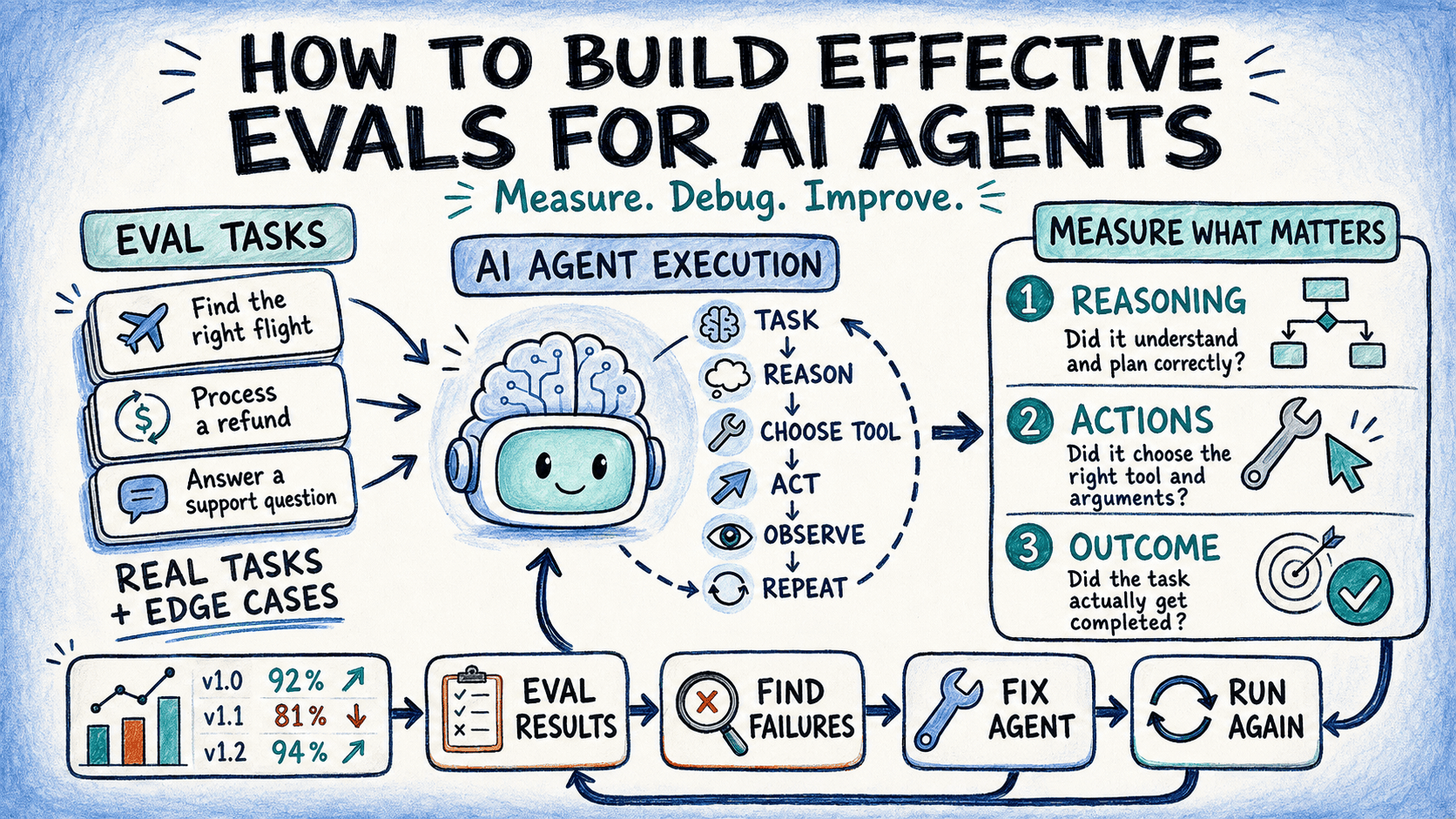
Learn how to build effective evals for AI agents, from designing clear tasks and choosing the right graders to building reliable eval harnesses and tracking changes over time.
Introduction #
A common problem with AI agents is that their performance can seem worse after a change, without anyone knowing what caused it. The system prompt may have been changed, a tool description may have been updated, or the underlying model may have moved to a different version. Any of these changes can affect how the agent behaves. Without a consistent way to measure those changes, it is easy to end up guessing and repeating tests manually.
Evals provide a way to measure these changes. An eval gives an agent a task, runs it, and checks the result against a set of defined criteria. The same process can be repeated across different versions and changes, making it easier to spot differences. Rather than making a broad or subjective claim about an agent's behavior, you can describe the specific, measurable change observed. This gives you a clear issue to investigate and a way to check whether a change improved the result.
This article covers:
- Why agents are harder to evaluate than single-turn LLM calls, and how that affects test design
- How to find and write eval tasks with clear outcomes
- Which graders to use for reasoning, tool calls, and final results, and when to combine them
- How to build a harness that produces useful results without unnecessary noise
- How evals fit alongside monitoring
We'll start by looking at what makes agent evaluation different and how that should shape the way you design tests.
Understanding Why Agent Evals Are Different #
A single-turn eval is easy to reason about: one prompt, one response, a grader checks it against an expected answer. Agents break that model. An agent reasons about a task, picks a tool, acts on it, observes the result, and repeats — sometimes for dozens of turns — and each step can go wrong independently. A mistake early on changes the state every later step reasons over, so errors compound instead of staying isolated. This compounding is why it helps to think about an agent's failures in layers rather than as one big pass/fail.
When evaluating an agent, it is useful to separate failures into three layers: reasoning, action, and overall execution. For example, a travel-booking agent may fail by choosing the wrong sequence of steps, using a tool incorrectly, or completing the task inefficiently.
| Layer | What it covers | A typical failure |
|---|---|---|
| Reasoning | Understanding the task, breaking it into sub-steps, and choosing the right order of operations | A travel agent tries to book a flight before checking whether the requested flight is available |
| Action | Selecting the right tool, providing the correct arguments, and calling it at the right point in the sequence | The agent uses the correct flight-search tool but passes a city name or airport code the API does not recognize |
| Overall execution | Whether the task was actually completed, and how efficiently | The agent eventually books the flight, but calls the same search tool three times for information it already had |
A good eval, therefore, should tell you which layer failed, not just that the task failed.
Frontier models also make static grading harder. Given enough autonomy, an agent may discover a valid solution that nobody anticipated when the task was written. A rigid grader might mark that as a failure even though the agent solved the user's problem better than the expected path. Good graders should therefore evaluate the outcome and the reasonableness of the approach, rather than requiring one exact sequence of steps.
Sourcing Tasks for Your First Eval Set #
You don't need hundreds of tasks to start. A handful of focused tasks are often enough to catch meaningful changes early. It's also easier to turn clear requirements into test cases before the system becomes more complex.
The fastest way to build your first eval set is to use the checks you already perform manually: common workflows, known edge cases, and scenarios you test before a release. Turn these into repeatable tasks instead of testing them from scratch each time.
Keep the set balanced. Include cases where a behavior is expected and cases where it is not. For example, a search eval should test both queries that require search and queries that can be answered without it. This helps measure whether the agent is making the right decision, not simply repeating the same action.
Writing Clear, Testable Tasks #
A good eval task should have clear, objective success criteria. Two people reviewing the same result should be able to reach the same conclusion about whether the agent passed. If the task is vague or leaves important details open to interpretation, the grader may measure the ambiguity rather than the agent.
Before adding a task, check that the instructions contain everything needed to complete it. If the grader assumes information that the task does not provide, a failure may reflect the task design rather than the agent.
A reference solution helps validate both the task and the grader. If a capable agent consistently performs poorly, first check whether the task is solvable and whether the grader correctly recognizes a valid result. This simple check can prevent misleading evaluation results.
Choosing Graders for Each Layer #
Not every part of an agent's behavior should be measured the same way. The key is to match the grader to the layer being evaluated:
| Grader type | Good for | Main limitation |
|---|---|---|
| Deterministic (string match, test suite, database check) | Fast, cheap, unambiguous results | Not effective against valid variations it wasn't built to recognize |
| Code-based (assertions, API checks, state validation, custom tests) | Functional behavior, tool calls, structured outputs, and state changes | Requires reliable test logic and a well-controlled test environment |
| Model-based (LLM scores the transcript against a rubric) | Subjective or open-ended tasks, freeform output | Needs regular calibration against human judgment |
| Human review | Judgment calls a script or model shouldn't make alone | Expensive, slow, hard to run at scale |
A useful way to choose a grader is to match it to what you actually need to verify. Different aspects of an agent's behavior call for different evaluation methods:
- Tool selection and arguments: use deterministic or code-based checks at the point where the call is made.
- Plan quality and adherence: evaluate the full trace when the sequence of decisions matters.
- Task completion: verify the resulting state directly using code, database checks, or system assertions rather than relying on the agent's summary.
- Open-ended outputs: use a model-based grader when there is no simple expected answer.
- Complex or ambiguous cases: use human review when automated grading cannot reliably make the judgment.
Avoid grading the exact sequence of steps unless the order is important. An agent may take a different path and still produce the correct result. Grade the outcome by default, and enforce specific steps only when they are actually required.
Building an Effective Agent Harness #
An eval is only as trustworthy as its environment. Every trial should start clean and isolated. Leftover files, cached data, or shared history can skew results and make an agent look better or worse than it really is.
Use partial credit instead of treating every task as pass or fail. An agent that diagnoses the issue and verifies the customer but misses the refund is clearly ahead of one that misunderstands the request entirely. Binary scoring hides that difference. It is important to focus on non-determinism as agents rarely produce the same result twice, so one trial can be misleading. Two useful metrics are:
| Metric | What it measures | Best suited for |
|---|---|---|
| pass@k | Chance of at least one success across k attempts | Tasks where eventually finding a solution is enough |
| pass^k | Chance that all k attempts succeed | Customer-facing agents where consistency matters |
Choose the metric that matches your use case. Otherwise, a shaky agent can look reliable, or a reliable one can look inconsistent.
Reading Transcripts Before Trusting the Score #
A dashboard score doesn't tell you whether the eval is measuring the right thing. Read a sample of transcripts to see the agent's reasoning, tool calls, and final state. When a task fails, the transcript shows whether the agent actually failed or the grader rejected a reasonable solution.
This also exposes broken graders and ambiguous tasks. Simple string matching can penalize correct answers for minor formatting differences, while unclear specs can make tasks impossible to complete as written. In some cases, fixing grading bugs alone has dramatically improved benchmark scores without changing the model.
Watch for suites where agents already pass nearly everything. A 98% score is useful for regression testing, but it won't indicate where the agent can improve. Keep the suite as a regression guard and add harder tasks to test new capabilities.
Wiring Evals Into Your Development Workflow #
Evals become more useful when they run automatically. Trace the agent's core function and run the eval suite like unit tests on every pull request. If performance regresses, block the merge before the issue reaches users.
Production monitoring still matters. Use evals for fast, repeatable checks, then combine them with user feedback, live usage data, and periodic transcript reviews to catch edge cases and drift that fixed test suites miss.
Summary #
Effective evals turn AI agent development from guesswork into measurable engineering. Instead of relying on subjective judgments after a model, prompt, or tool change, teams can use repeatable tasks and clear graders to measure what improved, what regressed, and why.
Strong evals start small, reflect real user needs, and focus on outcomes rather than rigid action sequences. They separate reasoning, tool use, and task completion, while isolated environments and repeated trials make results more reliable. Here's a review of what we've discussed in this article:
| Area | Key takeaway |
|---|---|
| Task Design | Use clear, realistic tasks based on failures and user needs. |
| Evaluation Layers | Measure reasoning, tool actions, and final outcomes separately. |
| Graders | Match deterministic, model-based, and human graders to the task. |
| Test Harness | Keep trials isolated, reproducible, and free from state leakage. |
| Reliability | Run multiple trials and track pass@k or pass^k where appropriate. |
| Transcript Review | Inspect failures to distinguish agent problems from flawed evals. |
| Continuous Testing | Run evals with every change and add new failure cases over time. |
| Feedback | Use observed failures and user feedback to improve the eval suite. |
Eventually, a good eval suite is more than a scorecard. It creates a continuous feedback loop: test → measure → diagnose → improve. By combining repeatable evals with ongoing monitoring and regular transcript review, teams can make AI agents more reliable and catch regressions earlier.
[Bala Priya C](https://www.kdnuggets.com/wp-content/uploads/bala-priya-author-image-update-230821.jpg) is a developer and technical writer from India. She likes working at the intersection of math, programming, data science, and content creation. Her areas of interest and expertise include DevOps, data science, and natural language processing. She enjoys reading, writing, coding, and coffee! Currently, she's working on learning and sharing her knowledge with the developer community by authoring tutorials, how-to guides, opinion pieces, and more. Bala also creates engaging resource overviews and coding tutorials.