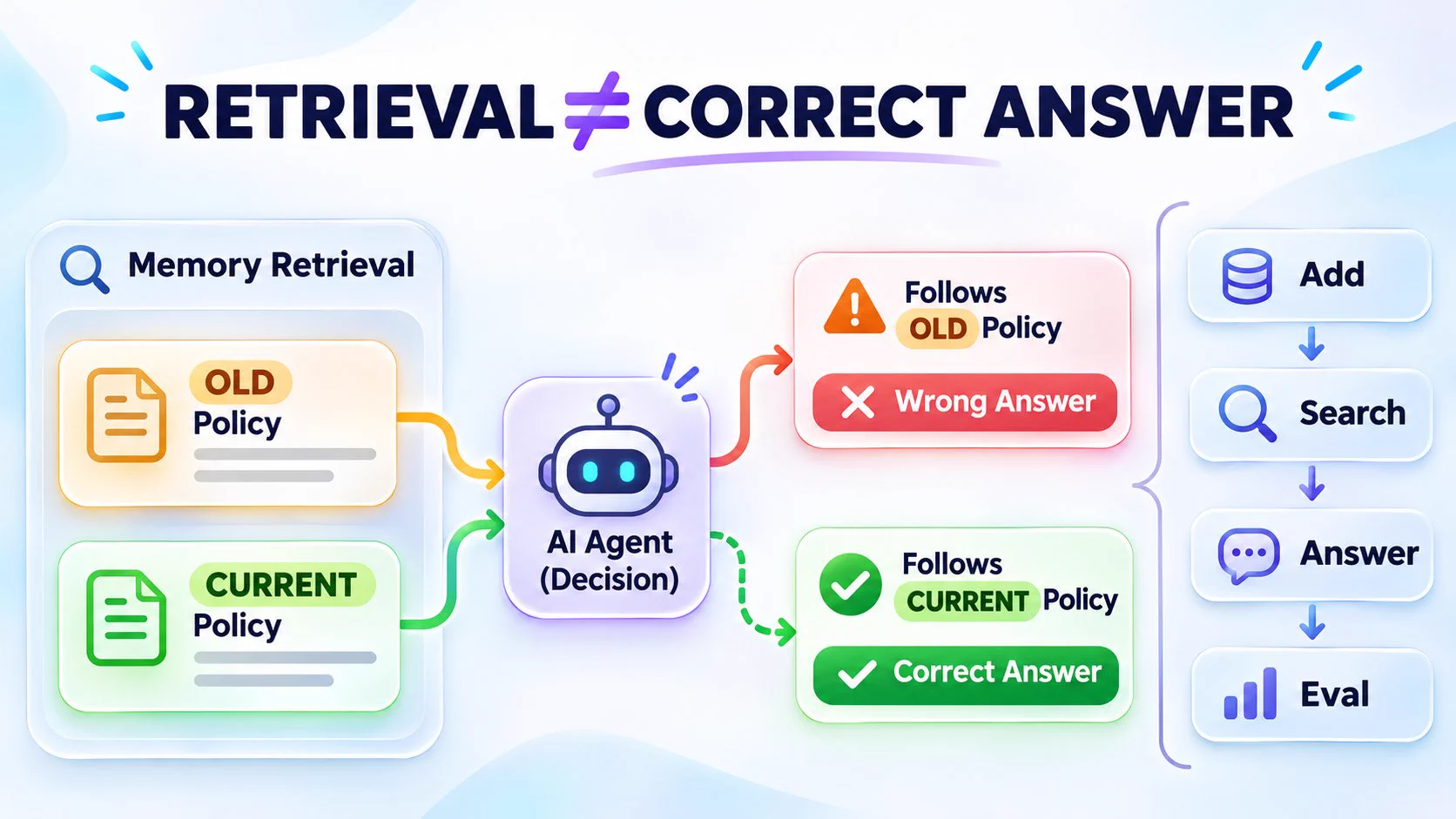
Agent Memory Leaderboard on X: "Finding the right memory doesn't guarantee the right answer. An October 8 analysis by Engram tested 6 memory systems on 1,536 LoCoMo questions, evaluating retrieval and answer accuracy separately. The takeaway: retrieval success ≠ answer correctness. Report: https… / X
Agent Memory Leaderboard on X: "Finding the right memory doesn't guarantee the right answer. An October 8 analysis by Engram tested 6 memory systems on 1,536 LoCoMo questions, evaluating retrieval and answer accuracy separately. The takeaway: retrieval success ≠ answer correctness.
Report: https://t.co/EIts48VAj5" Finding the right memory doesn't guarantee the right answer. An October 8 analysis by Engram tested 6 memory systems on 1,536 LoCoMo questions, evaluating retrieval and answer accuracy separately. The takeaway: retrieval success ≠ answer correctness. Report: engram.tools/en/insights/ai…
Finding the right memory doesn't guarantee the right answer. An October 8 analysis by Engram tested 6 memory systems on 1,536 LoCoMo questions, evaluating retrieval and answer accuracy separately. The takeaway: retrieval success ≠ answer correctness. Report: engram.tools/en/insights/ai…
Consider a simple case: A policy has been updated, but the retrieved memories contain both old and new versions. The correct update is right there. Yet the Agent may still apply the outdated rule. Finding evidence and using it correctly are two different capabilities.
To understand where failures happen, examine the full pipeline: Add — Was the update stored? Search — Was the right evidence retrieved? Answer — Was the evidence used correctly? Eval — Was the answer judged consistently? A final score alone cannot tell us where the failureShow more
How does AML evaluate Textual Memory? Participants provide two standardized interfaces: Add & Search. AML controls downstream Answer and Eval under a shared protocol. This isolates the memory layer from the LLM. Explore AML: