on
[CC-BY-NC-SA-4.0](http://creativecommons.org/licenses/by-nc-sa/4.0/legalcode)

[Apache-2.0](http://www.apache.org/licenses/LICENSE-2.0)
8 mins
🤖 This post includes
some LLM-derived content🤖 I've been recently thinking about how Open Source maintenance seems to be becoming a little more a slog recently - largely with the increased amount of contributions possible with AI agents - and how it impacts being a maintainer.
I'm very fortunate that my literal job is to be an Open Source project maintainer (among other things) and that it's a privilege not many others have. That being said, it still doesn't mean that undoes the amount of work that seems to be increasing every month.
Mike McQuaid recently wrote an eloquent post about how Open Source needs to be fun, which naturally struck a chord - the work that we do needs to be sustainable and enjoyable.
As someone who feels like they're consistently pushing the edges of burnout - possibly due to my ADHD - I've hit a bit of a wall several times, where the overwhelm of so many things to do unfortunately leads to needing to (often silently) take a step back from the project for my own mental wellbeing.
This is moreso true with [ oapi-codegen](https://github.com/oapi-codegen/oapi-codegen) and

[how we're trying to make it more sustainable](https://www.jvt.me/posts/2024/05/09/oapi-codegen-sustainable/).
oapi-codegen
is a widely used project with a difficult API surface: give me your arbitrary OpenAPI specs, and we'll convert the complex or straightforward spec to a form of Go that is generally nice to use. Being guided by our users' usage can be difficult at time, as well as Go's not-that-great type system.More recently, we've been feeling this pain with Renovate, and a significant uptick in contributions and feature requests that aren't really scaling with the team size we have, largely due to the usage of contributions with help from AI agents.
(But at the same time, it's pretty great that we are seeing an increase in adoption and engagement, and the patterns in our codebase work quite well for AI agents to help with contributions!)
This has been something on my mind for a bit - as the project lead, I'm looking at what we can do to make things more sustainable for us as a project, while also taking into account valuable contributions from the community.
This post doesn't come with an answer - it's more of a way for me to think through my feelings, and a call to action from other maintainers to hear how they're doing, and whether they're having to rely on AI to be able to deal with the increase in AI contributions, or if they have any other practices at their disposal.
Why am I feeling the pressure? #
This isn't really an answer that should surprise anyone familiar with running an Open Source project - especially in the last few years. But to make it clear, it's because there's a significant increase in contributions to the project, be they bug reports, feature requests, Pull Requests to review, and (potential) security vulnerabilities.
When I joined the Renovate project as the project lead in September, we had roughly 100 open Pull Requests, and I'd been trying to keep that number below 100 as long as I could. As of today, we have ~340, which has been a fairly consistent number over the last few months, increasing at a rate consistent with cutting off the head of a hydra.
(Some folks may notice that as of writing, I have 72 of those open PRs - a number of these are drafts as I need to finish tweaks on them, and I'm aware that adds a good chunk to the overall number of PRs we have)
As previously mentioned, the core maintainer team is only 3 people. Although we have some collaborators like Rahul and Sergei who do great work, the final decisions on functionality and reviews are the three of us maintainers - which is a tiny team considering that zero of the three of us are working 100% full-time on the project, and we're so widely used as a project.
To put this increase in contributions into perspective, let's look at some stats over the last few years.
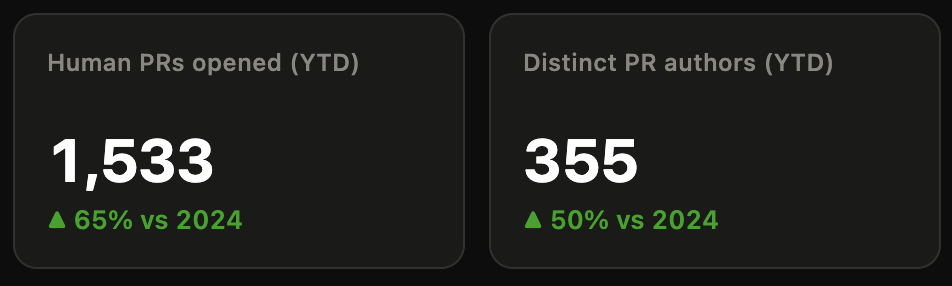
I set Claude Opus 4.8 to take data from my "maintainer dashboard" - which also includes information from Pull Requests - in a way to get some understanding of whether our feelings matched the facts. This data has all been analysed between January-July across 2024, 2025, and 2026.
At a high level, we see:
Something I also wanted to investigate is how GitHub Discussions interactions have changed, given it is our key interface with users. Although we're generally seeing increased adoption of Renovate, it appears like more folks are using AI to answer the sorts of questions they'd come to our Discussion forums. This is good and bad - it's good that AI models are able to provide the support users need, but reduced interactions with the project means that we have less information about common issues, to improve documentation or smooth out rough edges.
We can also see that although 2024 and 2025 were fairly consistent in their incoming PR contributions, 2026 has had ~60% more contributions during the same period:
Looking at the data, we can also see more of a breakdown of how often we see one-off contributors vs people who stay more engaged with the project:
Finally, we can also see that contributions to the project now are more generally larger - we see that our PRs are also growing in size:
All of these show that there's an increased demand for maintainer work to review these PRs - we're doing what we can to add linters and documentation to reduce how many rounds of reviews or common issues need fixing, but there's still a lot of valuable work that reviews need to apply to the changes.
Keeping my humanity #
With the increase in contribution, and the lack of cloning technology, this means that the maintainer team is remaining at 3 for the time being. Which begs the question - how do we keep our work sustainable? Do we need to lean on AI tooling to be able to keep up with it all?
I'd say that I - most of the time - pride myself on my communication skills and empathy for my users. If I'm starting to outsource all that to our AI overlords, what's the point of a human being part of the conversation?
I've interacted with some projects that do appear as maintainers completely using an AI agent to reply to your issue/PR comments and it feels impersonal and a little disappointing. I absolutely get why they are doing that, but it still doesn't feel great.
If I don't enjoy being on the receiving end of AI-generated messages, why would I do that to my users? Even if I tried to coax the agent into a more natural speaking style for me, that still isn't my words and thoughts - and I'm generally of the opinion of "if you couldn't be arsed to write that, why should I read it?"
My co-maintainer Marcin recently has done so much great work on oapi-codegen
to get us into a better place, and has managed to clear a huge amount of the overwhelming backlog. That was only possible because of his leaning on Anthropic's Claude, and I'm really glad he was able to do so - but at the same time, that also led to some surprising scenarios for some of our users who felt it was "a bot" doing the work.
Although I aim to attribute my usage of AI in my codec changes and interactions on PRs/Issues/etc, I'm still not sure that someone knowing it's via AI would make it any better - I don't really feel better knowing an AI agent is replying to me instead of a person.
However, if it reads like a user is replying to me with an AI agent, is it worth me spending my time to reply to them, or should I also have an agent replying to them?
Given we only have so many keystrokes left, I'm thinking about how I want to try and optimise my time, while also not losing an aspect I appreciate about myself - my human empathy for my users, and theirs with mine. Sometimes as humans we get frustrated, or reply in the few minutes before bed, and that's important too, instead of sanitising it through an AI model.
Please respond! #
And most importantly, to Open Source maintainers everywhere, please let me know what you're thinking about this all and how you're handling it.
Are you a maintainer who's using AI to help maintain your project and/or your mental health? What's working for you? What don't you recommend?
Are there tools like automated code review tools or tools for handling "here's how you may be able to solve your issue" tools you're finding useful?
How much are you using in terms of authoring/actually responding to users vs using your own words?
If folks are using AI to interact (including in terms of their replies to you), are you leaning on using AI to reply to them? I.e. "fight AI with AI"?