Post written by Simas Kučinskas and Josh Rosenberg
AI companies increasingly say that they may soon achieve recursive self-improvement (RSI). With RSI, current AI systems help develop future AI systems in a recursive loop. RSI could dramatically accelerate AI capability progress. Importantly, this acceleration could happen inside AI companies before outsiders can notice.
AI companies now say that this loop is starting. In an update to its IPO filing, Anthropic claimed that, based on expected future models, it now meets its definition of “dramatically accelerated progress attributable to AI.” OpenAI said that it reached its goal of an “automated AI research intern” in September 2026, and it targets an automated AI researcher by March 2028.
Of course, AI companies are not necessarily neutral observers. So how close is RSI really? In our new report, we provide a comprehensive overview of AI companies’ reported data, public benchmarks, and existing forecasts.1 We also turn the key disagreements into forecasting questions and provide initial forecasts from an ensemble of frontier LLMs.
This post summarizes what we found.
AI is a highly capable research assistant, but humans still supply most of the research judgment
The data reported by AI companies show that AI does a large and fast-growing share of AI R&D.
At Anthropic, Claude wrote over 90% of contributions to the codebase in September 2026. At OpenAI, AI agents did 3.1 workdays of work for each human workday in August 2026, up from about 0.5 in May 2026.
However, humans still supply most of the research judgment, such as choosing which research areas to focus on. For instance, no measured part of Anthropic’s AI R&D is fully autonomous. Anthropic also states that “large performance gaps persist when it comes to Claude exercising judgement in choosing goals in both engineering and research.” At OpenAI, AI completed 57% of 2–4-hour tasks with no human intervention in July 2026 (up from 28% in January) and 35% of 8–16-hour tasks (up from 10%).
Public evidence points the same way
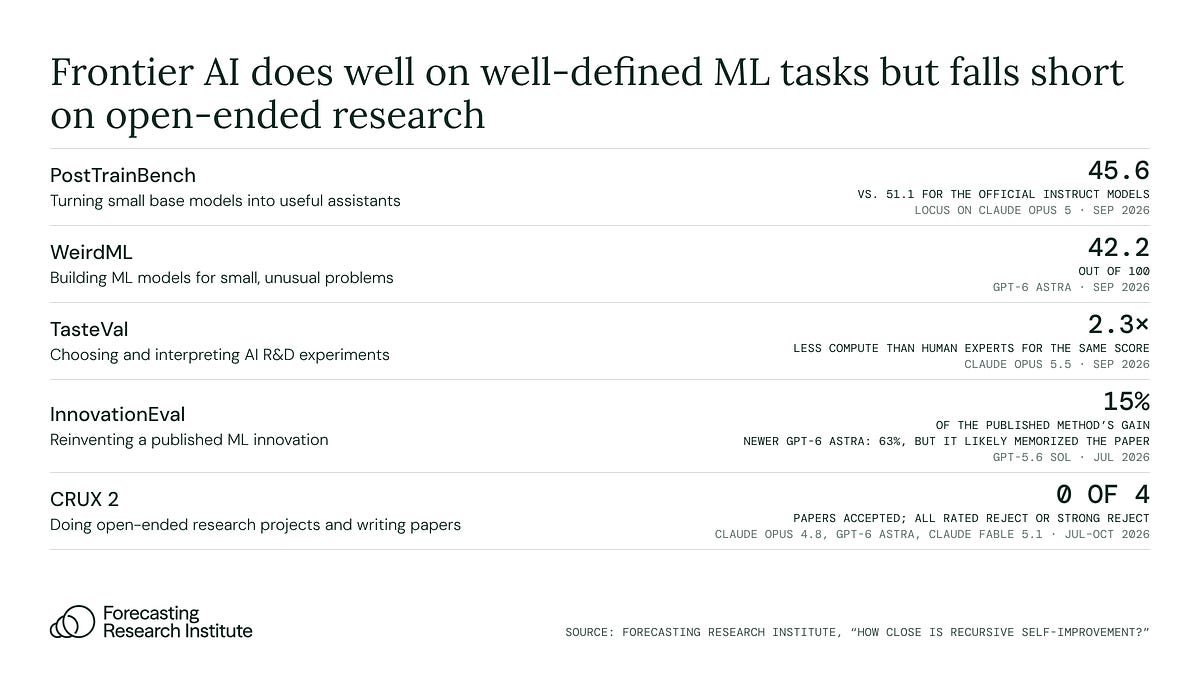
AI agents do well on well-defined machine learning (ML) benchmarks.
On PostTrainBench, where agents turn small base models into useful assistants, the best agent scores 45.6, against 51.1 for the official instruct models. On WeirdML, where agents build ML models for small, unusual problems, GPT-6 Astra scored 42.2 (out of 100) in September 2026, up from 15.0 for GPT-5.6 Sol in July 2026. On TasteVal, where a model chooses and interprets AI R&D experiments, Claude Opus 5.5 reaches the score of human experts with 2.3× less compute.
However, AI agents struggle with open-ended research. On InnovationEval, where agents try to reinvent a published ML innovation they have not seen, GPT-5.6 Sol recovered 15% of the innovation’s gain. (GPT-6 Astra scored 63% but had likely memorized the original paper.) In the CRUX 2 open-world evaluation, AI agents got the research question of an unpublished AI paper and had to write their own paper on it. The original paper’s authors rejected all four AI-written papers, including two from a follow-up study with newer models, more time, and a larger budget.
There is some internal evidence of a potential acceleration
AI capability progress has not clearly accelerated on public measures. Since September 2024, the frontier of the Epoch Capabilities Index (ECI) has risen by about 14 points a year. Here, the ECI frontier is the highest ECI score of any publicly available model by a given date.
That said, there is some internal evidence from frontier AI companies of a potential acceleration. In the Claude Opus 5.5 system card, a preliminary METR assessment estimated “~1.5X overall acceleration in capabilities due to AI” inside Anthropic, with “perhaps 30% chance of 2X.” At OpenAI, experiments per active experimenter hit an all-time high in August 2026, about 1.6× the 2025 level. However, OpenAI notes that “our available compute has also grown significantly since 2025.”
In a report published after our November 3 data cutoff, METR now estimates that capability progress at Anthropic is about 2× its earlier rate, and that around 80% of this acceleration is due to AI. This estimate applies to Anthropic only and includes unreleased models. In addition, part of the acceleration may reflect Anthropic catching up to the frontier, and Anthropic redacted much of the evidence that METR found most informative.
Broad acceleration needs three contested steps
Existing forecasts about the likely trajectory of RSI diverge widely.
On a simple extrapolation of current trends, mostly using company-reported metrics, AI could take over most AI R&D tasks by 2027–2028, in line with OpenAI’s internal goal of an automated AI researcher by March 2028. A key uncertainty is whether these trends continue, as the remaining non-automated tasks increasingly require research judgment. Forecasts of full automation of AI R&D range from 2027 (insiders at AI companies and the AI Futures Project’s AI 2027 scenario) to 2052 (the AI Impacts survey of ML researchers).
In our report, we cover the key points of debate, including the views of researchers who expect RSI very soon and those who are more skeptical. For example, the AI Futures Project’s AI 2027 scenario depicts a superhuman AI researcher in 2027. In contrast, Arvind Narayanan and Sayash Kapoor expect gradual automation of AI development instead of “a singular, discontinuous moment when recursive self-improvement is achieved.”
Why do people disagree? Broad acceleration through automated AI R&D needs three steps to happen in turn, as shown in the diagram below:
- Automation: Is AI R&D automated?
- Acceleration: Does AI capability progress accelerate sharply?
- Breadth: Are capability gains broad?
Each step is contested. The main cruxes are whether AI develops research taste, whether diminishing returns or bottlenecks such as compute, data, or regulation cap the acceleration, and whether gains spread beyond AI R&D and easily verified tasks.
Frontier LLMs forecast about a 40% chance of a “fast year” by 2030
We turned these cruxes into 18 forecasting questions.
To measure acceleration, we propose a forecasting question on the likelihood of a “fast year”: any 12 months in which the ECI frontier rises by 30 points or more. This increase is about 2× ECI’s pace since September 2024. The largest rise in any 12-month window (as of our data cutoff of November 3, 2026) is 21 points.
To get an initial set of forecasts, we asked an ensemble of four frontier LLMs: Claude Opus 5.5, Claude Sonnet 5.5, Claude Fable 5.1, and GPT-6 Astra. Each LLM did its own web research and answered every question five times. We used the forecasting pipeline of our Automated AI Risk Outlook (AIRO) dashboard.
The ensemble forecasts about a 40% chance of a fast year by 2030. If a fast year happens, the ensemble gives about a 70% chance that AI automation of AI R&D caused it. The four LLMs disagree substantially on the probability of a fast year. For a fast year by the end of 2030, their forecasts range from 35% (Claude Sonnet 5.5) to almost 56% (GPT-6 Astra).
The LLMs made these forecasts on October 29, 2026, before the new METR report was released. If Anthropic’s internal 2× pace holds and reaches public models, that would roughly match the pace of a fast year.
With a fast year, the LLM forecast of an AI catastrophe is almost 3× higher
We also asked how a fast year would change the chances of two outcomes by 2050. Both definitions come from our Longitudinal Expert AI Panel (LEAP).
The first outcome is expert artificial general intelligence (AGI): more than 50% of LEAP panelists agree that AGI exists. Here, AGI is a commercially available AI system that meets two conditions: (i) in every primarily non-physical occupation, it can outperform a 90th-percentile human professional (based on 2025 performance) on at least 90% of the economically useful non-physical tasks in that occupation; (ii) its inference cost is no more than 5× the cost of equivalent human labor.
The second outcome is an AI catastrophe: a catastrophic event caused primarily by AI systems in which more than 10% of the people alive at the start of a five-year period die by the end of that period.
Conditional on a fast year by 2030, the LLM ensemble forecasts:
- An 84.3% chance of expert AGI by 2050 (vs. 55.7% without a fast year).
- An 8.4% chance of an AI catastrophe by 2050 (vs. 2.9% without a fast year).
If a fast year happens by 2030, the ensemble’s forecast of an AI catastrophe by 2050 is almost 3× higher. For comparison, the median expert in LEAP gave 2% to an AI catastrophe by 2050.
Limitations
We note a few key limitations of our report:
- LLM forecasts. Several LLMs are now statistically indistinguishable from superforecasters onForecastBench , our forecasting benchmark. For this reason, we think that LLM forecasts provide an informative first benchmark. However, we know less about their accuracy on complex questions with little base-rate information, such as the fast-year question. Also, we elicited the LLM forecasts before the new METR report was published.
- Data cutoff. Our data cutoff is November 3, 2026. The evidence is moving rapidly, so the report does not fully cover, for example, the new METR report, Epoch’s Bayesian update to the ECI, or Claude Mythos 5.2 and Fable 5.2.
What comes next
We are currently collecting forecasts from top human forecasters and AI experts. We plan to add them, together with evidence released after our current data cutoff, to an updated version of the report.
The full report collects the definitions of automated AI R&D, the complete set of evidence, existing projections and forecasts, and all 18 forecasting questions.
Read the full report [here](https://forecastingresearch.org/research/recursive-self-improvement-v1).

[1](#footnote-anchor-1)

For this report, we reviewed data up to November 3, 2026 (our data cutoff).