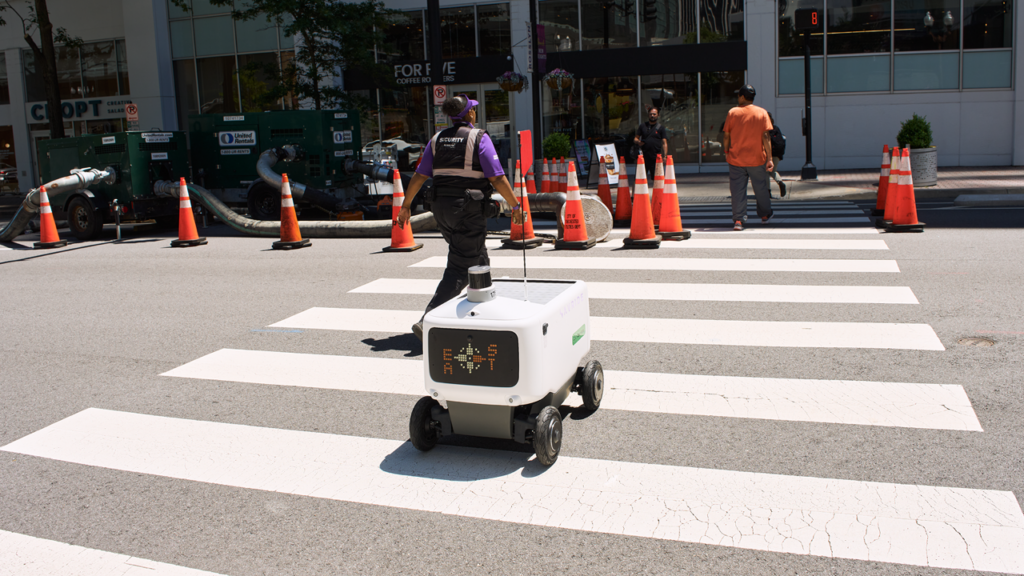
Avride integrates cloud-based vision-language models into delivery robots to enhance situational awareness, ensuring safety in dynamic urban environments.
Avride Inc., known for its autonomous delivery robots, is stepping up its game with a strategic integration of vision-language models (VLMs). These cloud-based systems add a layer of situational awareness that goes beyond what's currently offered by onboard sensors.
From Object Detection to Contextual Awareness #
Avride's delivery robots, already adept at handling city streets, are getting smarter. While their onboard sensors and neural networks can detect objects like cyclists and emergency vehicles, they often miss the broader context. Enter VLMs. These models are about more than just recognizing objects. they're about understanding the scene as a whole. Picture a robot distinguishing between a police officer heading home and one actively managing a crime scene. The difference is critical.
Without this contextual understanding, robots risk stumbling into sensitive situations, crossing police lines or rolling into fresh cement, mistaking it for a solid sidewalk. The VLMs, running in the cloud, offer the deep semantic analysis needed to prevent such blunders.
VLMs: The Cloud Guardians #
Interestingly, Avride doesn't use these VLMs for real-time navigation. That would introduce latency and risk. Instead, they act as an 'early warning system.' Every few seconds, robots send camera snapshots to the cloud, where VLMs process them, flagging unusual contexts for human review. If a situation is tagged as high-stakes, Avride's remote team steps in to guide the robot appropriately.
This system isn't static. Avride's open architecture allows constant testing and integration of state-of-the-art models. The goal? Always using the best semantic interpreters available.
The Future: Edge Computing #
For now, this VLM setup is a cloud-based solution, but Avride's eyes are on the prize: edge computing. As VLMs become more efficient and hardware more powerful, the plan is to move these capabilities onto the robots themselves. This would cut the cord, making them even more autonomous and reliable without needing constant connectivity. Avride's approach raises a key question: Will other delivery robot manufacturers follow suit in emphasizing context over pure object detection? It's a strategic bet that's clearer than the street thinks.
Get AI news in your inbox
Daily digest of what matters in AI.