Kennedy School unveils 10-year strategic plan that features robust new focus on promise, perils of technology #
Artificial intelligence is poised to soon change virtually every part of our lives, including the way we lead.
“There is no policy area, there is no function in the public or social sector, that isn’t going to be massively impacted by the accelerating power of generative AI,” said Jeremy Weinstein, dean of Harvard Kennedy School. “We need our curricular offerings to rise to meet that challenge.”
HKS recently unveiled a series of new initiatives across a range of areas, including financial aid and several AI and technology-focused shifts as part of a broad, 10-year strategic blueprint for the School.
As part of the plan, HKS will launch a new tech policy concentration for its master’s in public policy candidates and has hired two AI and policy professors, including MIT’s Stephen Casper, who joined HKS this summer. Casper will teach methods courses and electives on AI governance. The School also plans to look at offering a tech policy degree.
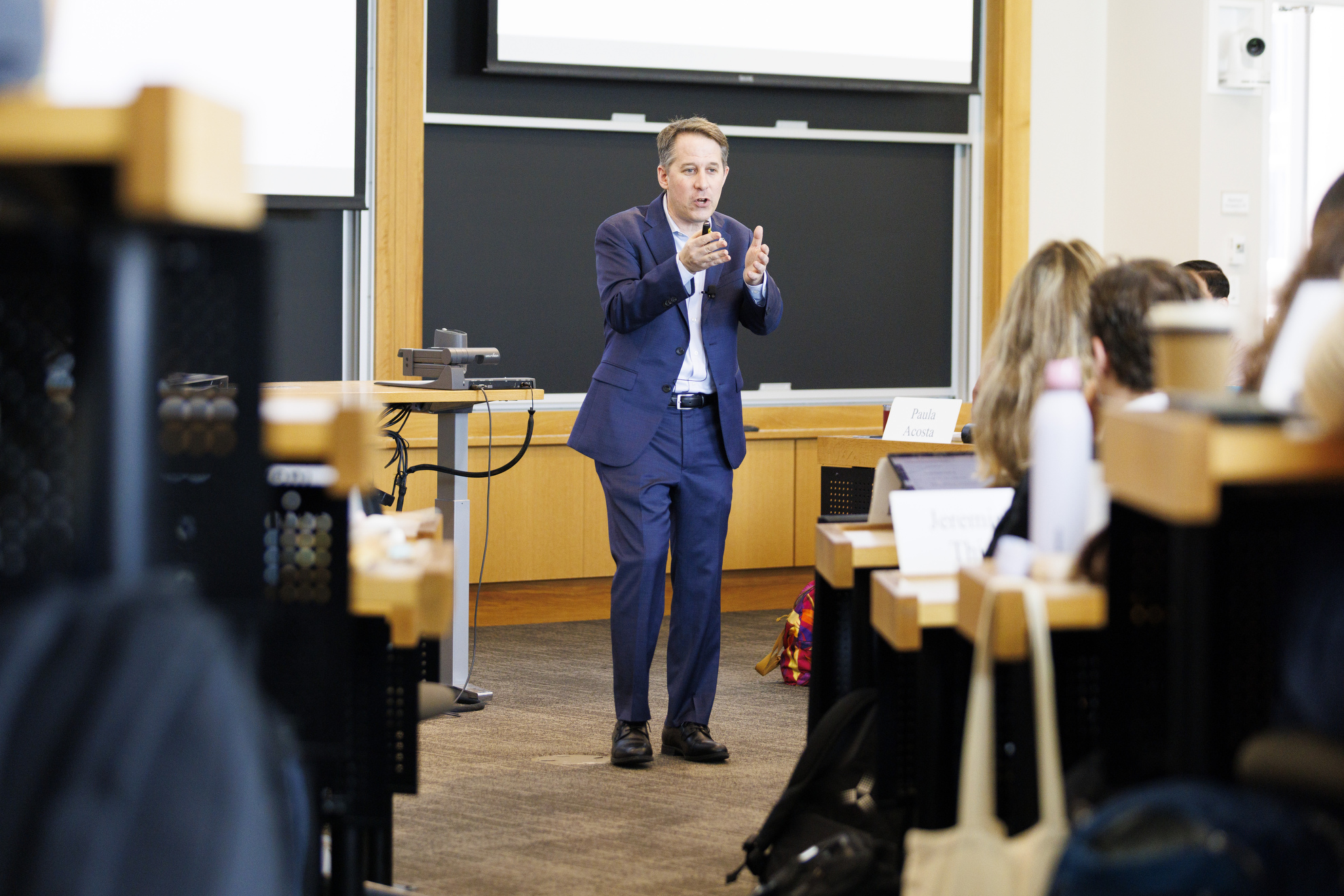
Some changes are already underway. This spring, students were offered two semester-long courses, one on the national security implications of AI led by Jake Sullivan, former national security adviser to President Joe Biden, and another on AI and policymaking that Weinstein co-taught with Sharad Goel, an applied mathematician and computer scientist at HKS.
An important focus involves getting the students more comfortable with the technology by learning how to use AI assistants to code and conduct rigorous analytics.
The goal is to ensure that they can use the powerful tools to solve public policy problems “and not just be observers or passive consumers” of AI, said Weinstein, Don K. Price Professor of Public Policy at HKS and a government professor at the College. “And that is just getting easier and easier because of the skill of the tools themselves.”
AI has “no clear analogue in history,” said Sullivan, now the Kissinger Professor of the Practice of Statecraft and World Order at HKS. Unlike other national security technologies, such as the internet or the nuclear bomb, AI development is not being led by government, but by the private sector. That makes this moment an especially “exciting” time of “radical uncertainty” for those entering both the public and private sector.
Weinstein and Goel’s class, “Public Problem Solving with Generative AI: Challenges and Opportunities,” drew inspiration from a multidisciplinary course that Weinstein, who came to Harvard in 2024, had taught at Stanford.
Combining case study and discussion with hands-on assignments, the course objective is to help HKS students, many of whom were not STEM concentrators in college, understand the technical underpinnings of AI while confronting the big policy questions this powerful new technology raises across domains from national security and science to education and healthcare, said Goel, who developed the School’s AI module two years ago.
So far, HKS students have responded enthusiastically.
Given AI’s importance, it’s essential to not only understand how this technology is being deployed globally but also how AI “works under the hood,” said Jacob Gordon, M.C./M.P.A. ’26, who took Weinstein and Goel’s course and valued the opportunity to vibe code and use Python as part of class assignments.
Gordon, who hopes to start an AI safety nonprofit, supports the push to expand and deepen the School’s focus on AI and technology.
“It’s vital, and HKS needs to move fast if it wants to contribute to this small decision-making window as the world figures out what path to take on the future of AI,” he said.
In one lab, students in Weinstein and Goel’s course tackled the challenge of getting 911 callers quickly routed to the appropriate agency or service provider when the situation doesn’t require law enforcement.
Some emergencies, like a behavioral health crisis, may demand other expertise, and dispatching armed police officers to a scene where they’re not needed may add danger to volatile situations, said Goel.
But preparing 911 call takers to quickly and accurately assess the type of help to dispatch often requires two or more years of training, a costly process that can strain municipal budgets, he added.
So, using generative AI, students built voice-training tools that used real-world data to simulate 911 callers.
The simulators tested call takers’ decision-making skills and later assessed their performance, representing a potential low-cost option that can better identify training deficits and get new call takers online faster.
Globally, AI has already begun to remake major policy and geopolitical questions involving national security and AI regulation, said Sullivan, who served in the Obama administration as an adviser to then-Vice President Joe Biden and deputy chief of staff to Secretary of State Hillary Clinton.
“The developments of this technology are shaping relations among nations; they are shaping the national development strategies and growth strategies of nations; they’re shaping the power balances among nations” and affecting “every aspect of national security, economic security, and social interaction,” he said.
His class focuses on how nations, particularly the U.S. and China, are trying to take advantage of AI’s potential while managing its risks.
Sullivan said during his time in Washington, few who were not working on the technology side of government focused on how AI might reshape their policy domain, let alone pursued training in how to use it, but that’s no longer the case.
“You don’t need everyone to be a technical expert, but I do need everybody to have a framework and a sense of priority for this because it’s going to be so central to the big questions,” he said.
Sarah Zheng, M.P.P. ’26, who reported on Chinese technology and geopolitics for Bloomberg News and the South China Morning Post, said Sullivan’s class offered firsthand insight into how major decisions on AI and national security are being made and presented a full spectrum of perspectives on AI, from skepticism to optimism.
“Few classes give you the chance to discuss policy issues, such as technology export controls, with someone who was directly involved in shaping those policies at the highest levels of government just months earlier,” she said.
Weinstein said when HKS first began to incorporate technology into the M.P.P. curriculum several years ago, the intent was to prompt students to think about “everything from how is technology used in the defense sector; how do we think about cyber issues and cyber threats; how do we think about civic technology … and how do we govern in a digital age.”
Now, the School’s growing emphasis on AI and technology reflects the inevitable reality as well as the potential promise and peril of what they may bring.
“For me, it’s very simple. One of the most important things that we can do as a school over the next generation is to populate public institutions, including people in political leadership, with the technical understanding and know-how to take advantage of this technological revolution to improve the ability of our public institutions to deliver what people need,” Weinstein said. “And this kind of teaching is essential for that.”