From pediatric research to smart hospitals, AI is helping care teams spend less time on routine tasks and more time with patients. Health systems and startups are putting it to work across healthcare, from matching patients to clinical trials to supporting radiologists, hospital teams and patients at home. Clinicians stay at the center, reviewing AI outputs and guiding decisions, while NVIDIA technologies provide the compute behind the applications.
Read on to learn how healthcare teams are using AI to improve and speed patient care.
Friday, Nov. 13, 5:00 a.m. PT 🔗
Dyania Health Uses AI to Turn Decades of Patient Records Into Better Care #
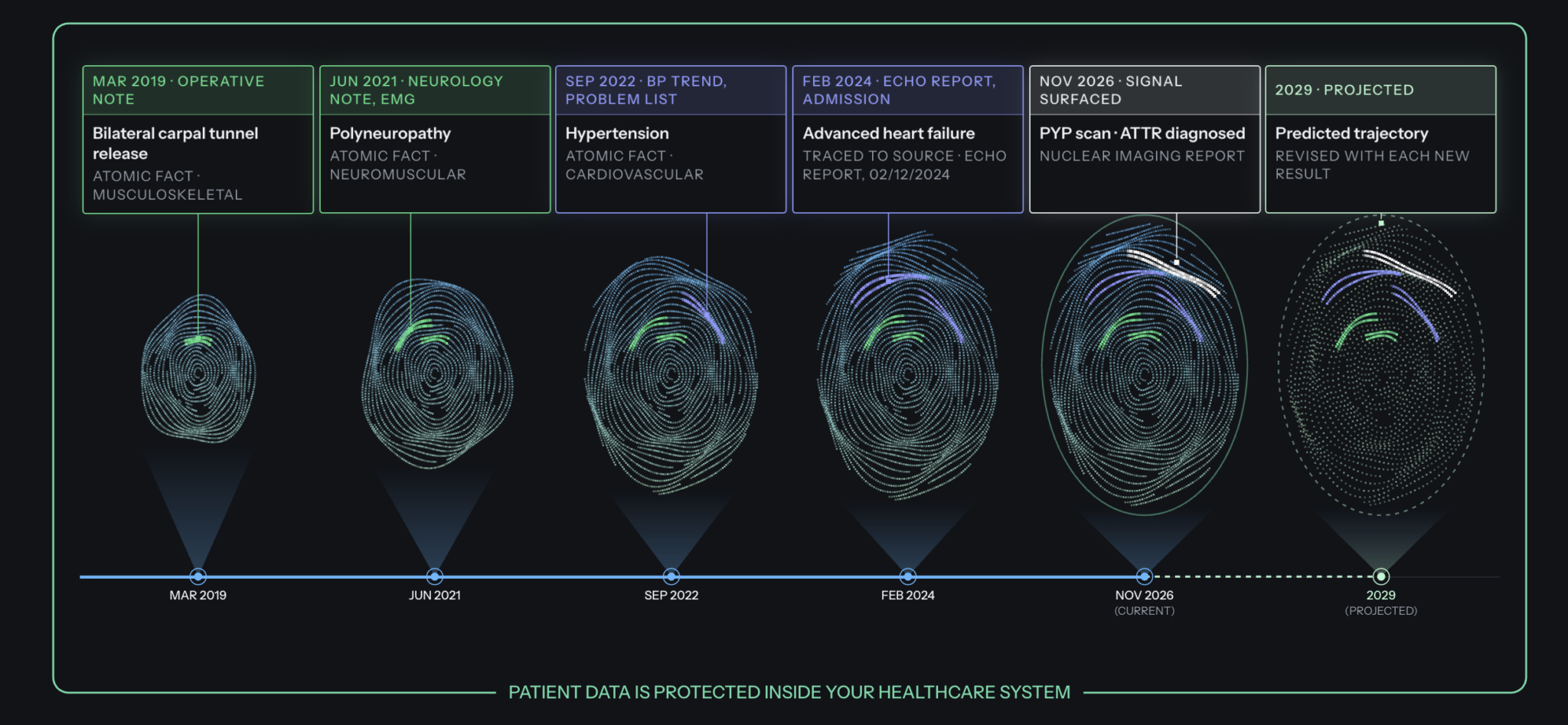
Hospitals hold decades of patient history, most of it written in free text, as physicians’ notes, operative reports, imaging and pathology reads and discharge summaries. To understand one patient’s full story, a clinician would need to read through years of charts.
Dyania Health, a New Jersey-based clinical AI company, built Synapsis AI to do just that. Synapsis AI is a clinical reasoning engine: It works across every note, report and lab result in a patient’s record, connecting findings that may be years apart to answer clinical questions the way a specialist reviewing the chart would.
The output is a set of clinical signals, each traceable to its source in the record, that tells care teams which patients need attention and why. Clinicians review the evidence and make every decision.
Keeping Patient Data Inside the Hospital Walls
Synapsis AI runs on NVIDIA-accelerated computing inside a health system’s own firewall. The entire health system’s patient records can be processed onsite, so patient data is never shared and never leaves the hospital.
Processing records this way takes chart review off the desks of clinical teams and lets them spend that time with patients. But Synapsis AI still requires clinician input — it’s an assistive tool that surfaces evidence from medical records that a clinician must still confirm and act on.
Dyania builds and trains its clinical models with NVIDIA NeMo open libraries, then uses NVIDIA TensorRT and TensorRT-LLM to optimize them to run faster and more efficiently on the hospital’s own GPU servers.
Synapsis AI in the Real World
Cleveland Clinic used Synapsis AI to support a study of more than 7,800 aortic valve replacement patients between 2005 and 2021.
Synapsis AI reasoned across each patient’s record, including every echocardiogram added in the years after surgery, and used this information to build a predictive model of valve deterioration and reintervention risk at the three-, five- and ten-year mark after a patient undergoes an aortic valve replacement procedure. The AI platform completed chart review across the full cohort that would have taken clinicians years to complete by hand.
“Using technology to bring together and analyze information that can help us predict the duration of implanted heart valves is a promising step towards enhanced outcomes and more personalized care for patients,” said Dr. Lars Svensson, chief of the Heart, Vascular & Thoracic Institute at Cleveland Clinic.
The same approach can be applied to any healthcare challenge where the answer sits inside the medical record, such as identifying patients eligible for clinical trials, closing care gaps in cardiology and oncology, and populating clinical registries.
Learn more about Dyania Health.