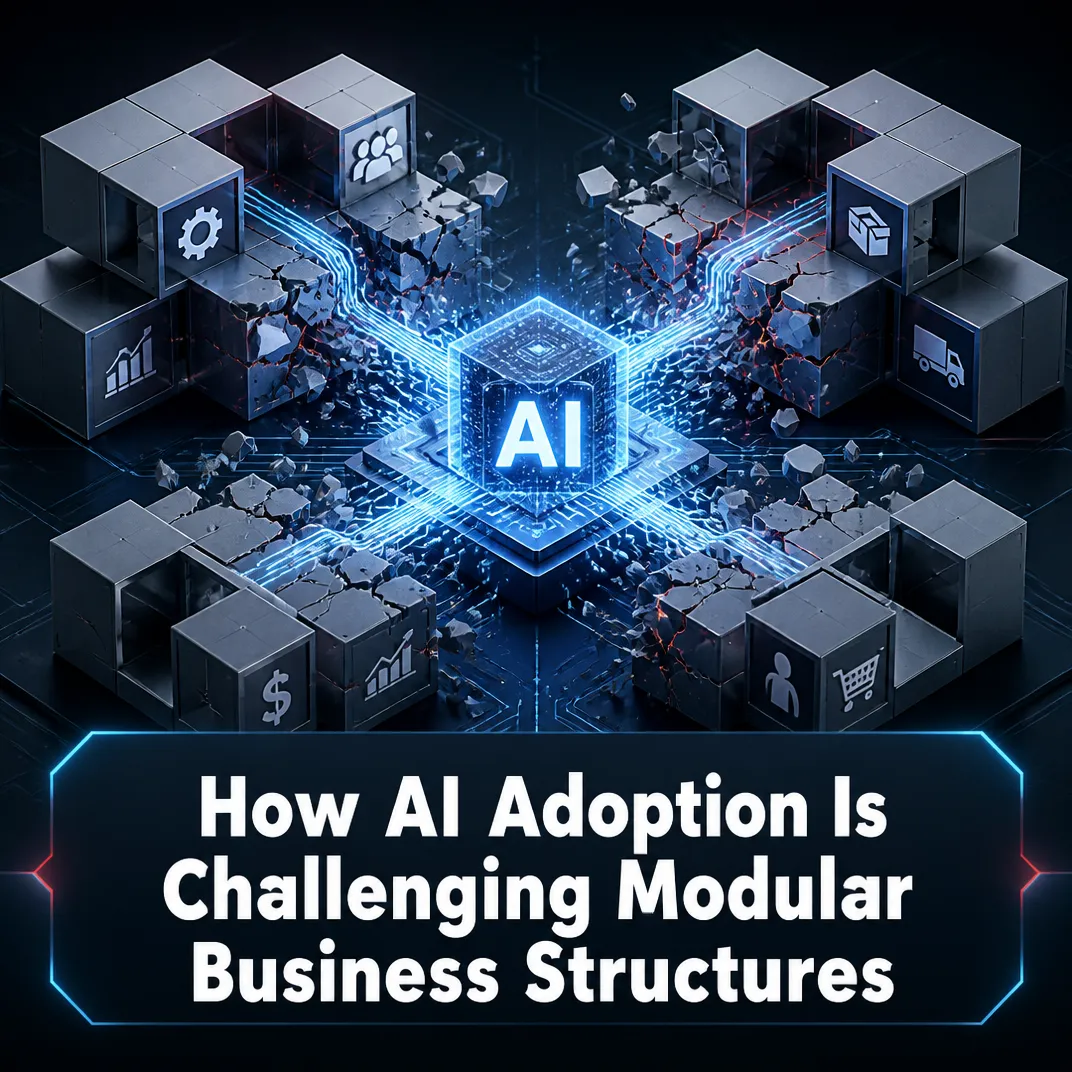
July 13, 2026, (Inside AI) — For over 20 years, modularity has shaped how large companies organize. The idea is simple: break a firm into independent units with clear interfaces. This promises flexibility, speed, and scale. But now, artificial intelligence is testing that logic.
Many enterprises run agile squads, platform architectures, and decentralized business units. Yet AI demands something different. It thrives on unified data, cross-functional collaboration, and rapid iteration. Modular structures, designed for stability, often create silos that slow AI adoption.
This tension is emerging across industries. Companies that once praised autonomy now find it blocks the data sharing AI needs. The very interfaces meant to simplify coordination become barriers to the fluidity machine learning requires.
The Data Dilemma in Decentralized Systems #
AI systems are hungry for data. They learn from vast, diverse datasets that span departments. In a modular firm, each unit often guards its own data. Governance policies, legacy systems, and cultural resistance keep information locked away.
This isn't just a technical problem. It's a strategic one. Without integrated data, AI models produce biased or incomplete insights. A 2025 McKinsey survey found that 72% of modular organizations struggle with data fragmentation for AI. That's up from 45% in 2020.
Some companies are responding by creating centralized data lakes. But that undercuts the autonomy modularity promises. It sparks turf wars and slows decision-making. The balance between independence and integration is delicate.
When Interfaces Become Walls #
Modularity relies on stable interfaces between units. Think of APIs, service-level agreements, or standardized reports. These work well for predictable tasks. But AI projects are exploratory. They need constant back-and-forth between teams.
Rigid interfaces can't handle that. A 2026 Harvard Business Review study noted that firms with strict modular boundaries saw 40% longer AI deployment times. The research pointed to coordination overhead and rework as key culprits.
Some experts argue for a new model. Instead of fixed interfaces, they propose dynamic, AI-mediated connections. These would allow units to share data and models on the fly, without sacrificing all autonomy.
Yet that vision is far off. Most companies still struggle with basic data hygiene. The gap between AI's demands and modular reality is widening.
Industry voices are split. Some see modularity evolving. Others think it's a relic. As one executive told us:
“We built our structure for a world of static processes. AI needs a living organization. The old playbook doesn't work.”
This shift recalls earlier tech disruptions. When cloud computing arrived, many firms had to rethink their IT silos. AI is now forcing a similar reckoning across the entire enterprise.
The stakes are high. Companies that adapt quickly could gain a decisive edge. Those that cling to pure modularity may fall behind. The coming years will reveal which organizational forms can truly harness AI's power.