This is the end of the university as you know it
Hey, Alberto here! 👋 Each week, I publish long-form AI analysis covering culture, philosophy, and business. Paid subscribers get Monday how-to guides and Friday news commentary. If you’d like to become a paid subscriber, here’s a button for that:
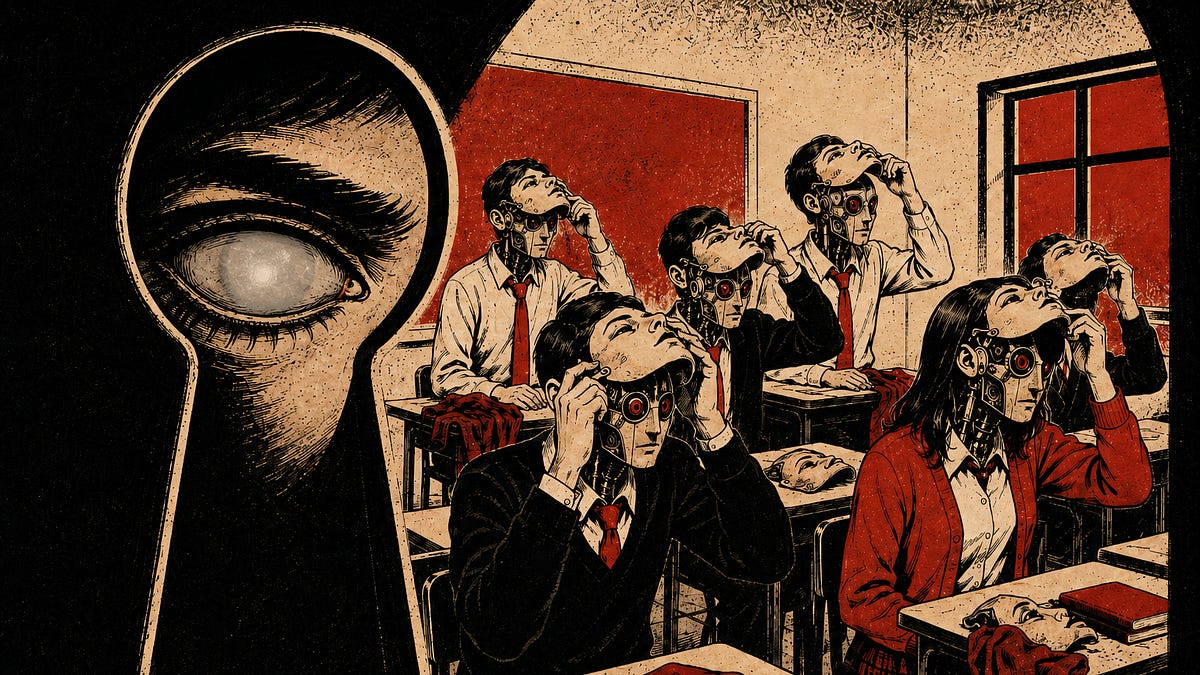
The grades are up on the board. Luckily, you’re the best student in class. Your score: a 95. Congratulations—on taking 41st place. Huh? Yes, forty 100s stand tall above you. Your classmates are chatting, smile on the face, phone in the hand. But it’s the emptiness in their other hand that makes it dawn on you: Those forty 100s belong to forty cyborgs—half human, half machine—who, in exchange for enhanced abilities, have surrendered their souls to AI. You smile now: eventually they will depend on that empty hand and realize they are neither cyborgs nor humans, but merely an impotent shadow of either. The professor comes in: “The final exam will be in person.”
This is my retelling of something that actually happened at Brown University. Roberto Serrano, a Madrid-born economist who began losing his sight as a teenager, decided to make the midterm exam of his mathematical economics class take-home because in December a gunman had walked onto Brown’s campus and killed two students, one of whom he had just met. He didn’t want to force anyone back into a classroom. Forty students used this humane gesture to AI-score a perfect 100.
After he realized students had probably cheated—a 96 average for a class historically ranging from 65-80, and on a particularly hard exam, with responses eerily similar to the ones ChatGPT gave—he made the final exam in person. The vast majority of students, most of whom had enrolled after learning the class would be from home, got a much worse score, and that’s without counting the 27 who dropped the course or didn’t show up at all (22 of the dropouts had scored a perfect 100 on the midterm). The average fell from 96 to 48.
It’s the students’ empty hand that Serrano is vindicating when he says that “we cannot choose to become idiots.” When our best young minds start to think that cheating is okay, he says, it “leads to a declining society, to a failed society.” I fully agree: a failed society starts with the failure of its most promising members, young students. Serrano is wrong about one thing, though: most of his students are already idiots. They’re smart enough to use AI to cheat, but too dumb to glimpse the collective dilemma staring at them. Had they actually studied for the exam in Welfare Economics and Social Choice Theory by a world-renowned game theorist, they’d know what I mean: each student can profit from abusing the professor’s trust, but once everyone does it, no student gets trusted again—a textbook “tragedy of the commons.”
Cheating is as old as studying, though, and so we seem to be dealing with a matter of degree, not kind. Society is, after all, well prepared to deal with the occasional cheater. It has natural filters to protect itself against that: the professor himself, the inherent hardship of cheating without being caught, etc. But when a new technology overwhelms those natural filters in a society unready to create new ones overnight, all the requirements for cheating—time, risk, effort, subtlety, a sort of bravery—go out the window. It’s easy to see how, when you can simply open ChatGPT, paste the entire problem, and get a perfect solution in seconds, what appeared to be a matter of degree becomes a matter of kind: One student cheats and you issue an admonition but if the entire class does, then you need a revolution. To be precise, you need one as powerful as AI itself.
Which in practice means you have to become an immovable object; that is, you need to hold oral exams. One by one, each student must defend their knowledge out loud like a medieval disputatio. As Frank Herbert of Dune fame said, society always grows in complexity but not always for the best; a return to 1,000 years ago would be a win in this case (nothing suits a post-literate society better than tests of articulation and discourse). If that’s too much, maybe a lifetime expulsion on first offense is more adequate? Or better: degrees revoked retroactively when the market discovers, as Serrano predicts it will, that the Brown label—and the label of any other reputable university where this happens—no longer certifies anything.
There’s another way, though: work around AI. Accept the new reality and adapt instead of confront. This is the option generally preferred by universities and, well, everywhere, because 1) it doesn’t require you to see AI as a civilizational risk—Serrano, for one, does see it that way: useful if used well, devastating if not—and 2) because it doesn’t push you to take up radical measures. Just amend the academic code. Or just add an AI-literacy workshop to freshman orientation. These are real proposals of the current university repertoire, by the way. They won’t work. They are soft, as soft as the universities implementing them, as if AI were not a forced overhaul of humanity.
You guys are not taking AI seriously. Like all these tech companies doing sparkly logos and autocomplete features on email and office software services, deans and provosts are merely fearful atheists: you don’t believe AI is a genuine problem, but just in case, you play safe. So instead of a barbell strategy—load both extremes and empty the middle: fully embrace AI where it teaches, fully ban it where it bypasses learning—you’re doing a dumb-bell strategy: you sound the alarm, but you’re pulling the rope too softly, and so the clapper doesn’t quite strike. When an entire generation of cyborgs comes begging they’d rather have two hands of flesh, don’t say I didn’t warn you.