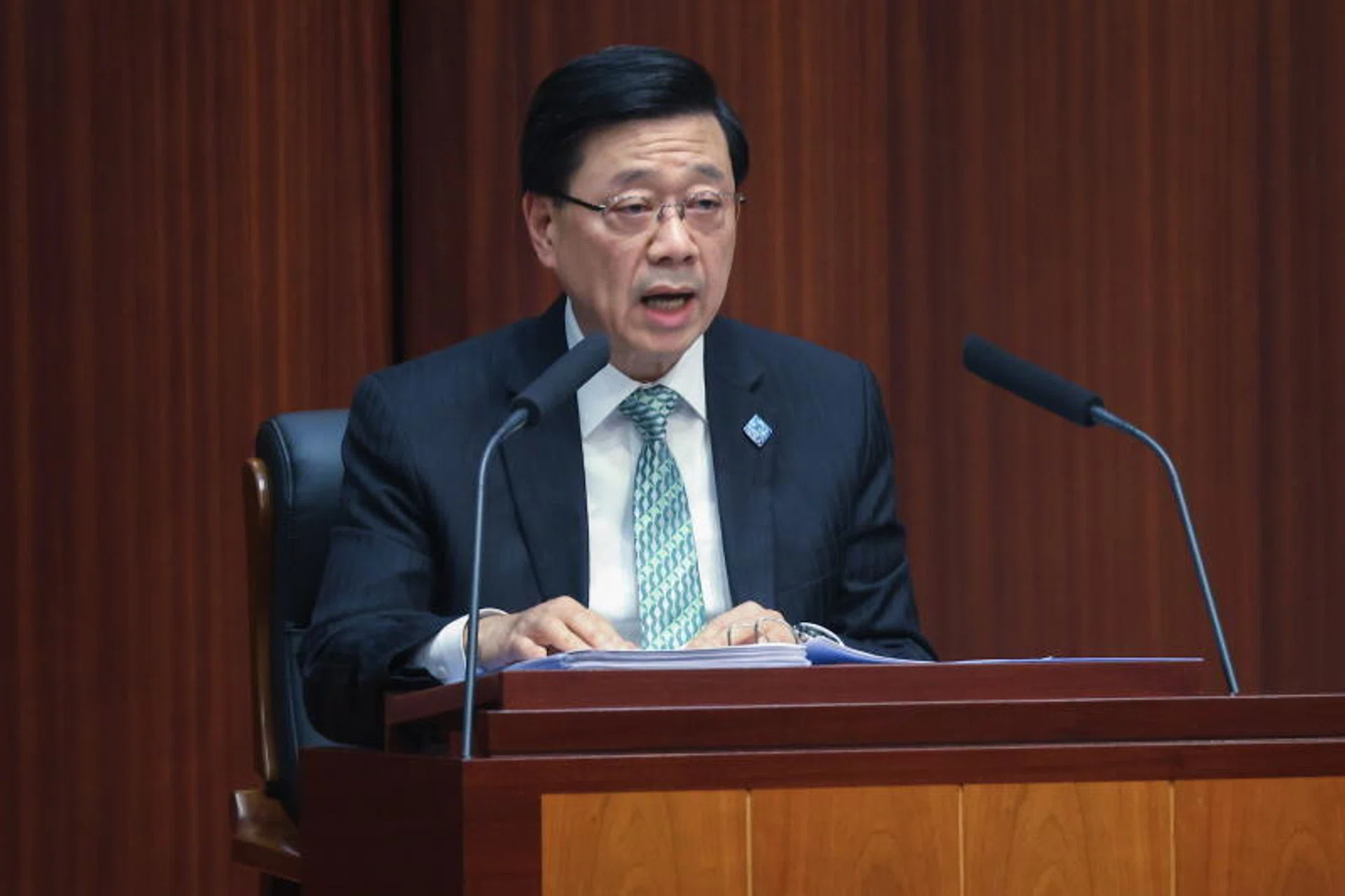
The city aims to make AI a core industry and have R&D account for 3% of GDP after 2030
[HONG KONG] Hong Kong chief executive John Lee set out plans to almost double the city’s spending on innovation in coming years, as his government seeks to align the financial hub more closely with Beijing’s economic priorities.
The target was announced on Wednesday (Sep 16) as Lee unveiled Hong Kong’s first five-year development plan, a blueprint covering the economy and social policy.
The city will strive to make research and development account for 3 per cent of gross domestic product after 2030 from 1.63 per cent in 2024, according to an official document.
“We will closely align with our country’s strategic technology areas,” Lee said in a speech, naming life and health technology, artificial intelligence and robotics, microelectronics, new energy, advanced manufacturing and new materials as focus areas.
The target is based on a new metric called total domestic expenditure on innovation activities, which includes corporate spending on areas such as software development and product testing.
Such spending amounted to HK$51.7 billion (US$6.6 billion) in 2024 for Hong Kong. China’s research and development expenditure accounted for 2.8 per cent of GDP in 2025.
The plan calls for AI to become a core industry for Hong Kong and be applied more widely across finance, trade, logistics, professional services and healthcare.
The government will expand computing infrastructure through a Sandy Ridge data facility due to start operating by 2029 and review legislation to support wider AI use.
A key part of Lee’s technology drive is the Northern Metropolis project bordering the mainland city of Shenzhen.
That development is intended to provide land, infrastructure and talent for tech and emerging industries. Lee set a binding goal of increasing “spade-ready sites” – plots that can be readily used for development – to 900 hectares by 2031 from 120 this year.
The Hang Seng Property Index advanced as Lee highlighted cross-border initiatives and progress on the future tech hub. Developers with ample liquidity stood out, with Longfor Group, Hang Lung Properties and Sun Hung Kai Properties among the biggest gainers.
Lee presented the five-year plan alongside his annual policy address, casting them both as a roadmap for the city. The one-year document’s goals will serve to achieve the objectives of the broader blueprint.
The longer-term plan also seeks to enhance Hong Kong’s traditional roles as a centre for finance and trade.
The government plans to expand offshore yuan products, promote the currency’s use in settling public expenditure and develop a commodity-trading ecosystem with gold as an entry point.
Hong Kong will seek to attract more global companies and talent, targeting annual growth of 4 to 5 per cent in the number of businesses with parent companies located outside the city.
Three university towns planned for the Northern Metropolis will combine education, research and industry, with student housing and other services designed to attract international talent.
The innovation goal aligns Hong Kong with China’s 15th Five-Year Plan, which puts technological self-reliance at the centre of the country’s strategy.
Beijing is seeking breakthroughs in fields including advanced chips, quantum computing and robotics as competition with the US intensifies and American export controls expose China’s dependence on foreign technology.
AI is a particular focus. China’s national plan calls for AI to be deployed across the economy, including in manufacturing and other industries, as Beijing seeks to raise productivity and compete with the US for leadership in the technology. BLOOMBERG
Decoding Asia newsletter: your guide to navigating Asia in a new global order. Sign up here to get Decoding Asia newsletter. Delivered to your inbox. Free.
Share with us your feedback on BT's products and services