Higgsfield closed a $400 million Series B at a $5.4 billion valuation today. You’ve probably already seen the funding headline. Ignore it. The number that matters for developers is this: agentic product adoption on Higgsfield’s platform grew 42-fold in three months after the company shipped Supercomputer in May 2026. That’s not a growth rate. That’s a market flipping from experiment to infrastructure.
What Higgsfield Supercomputer Actually Is #
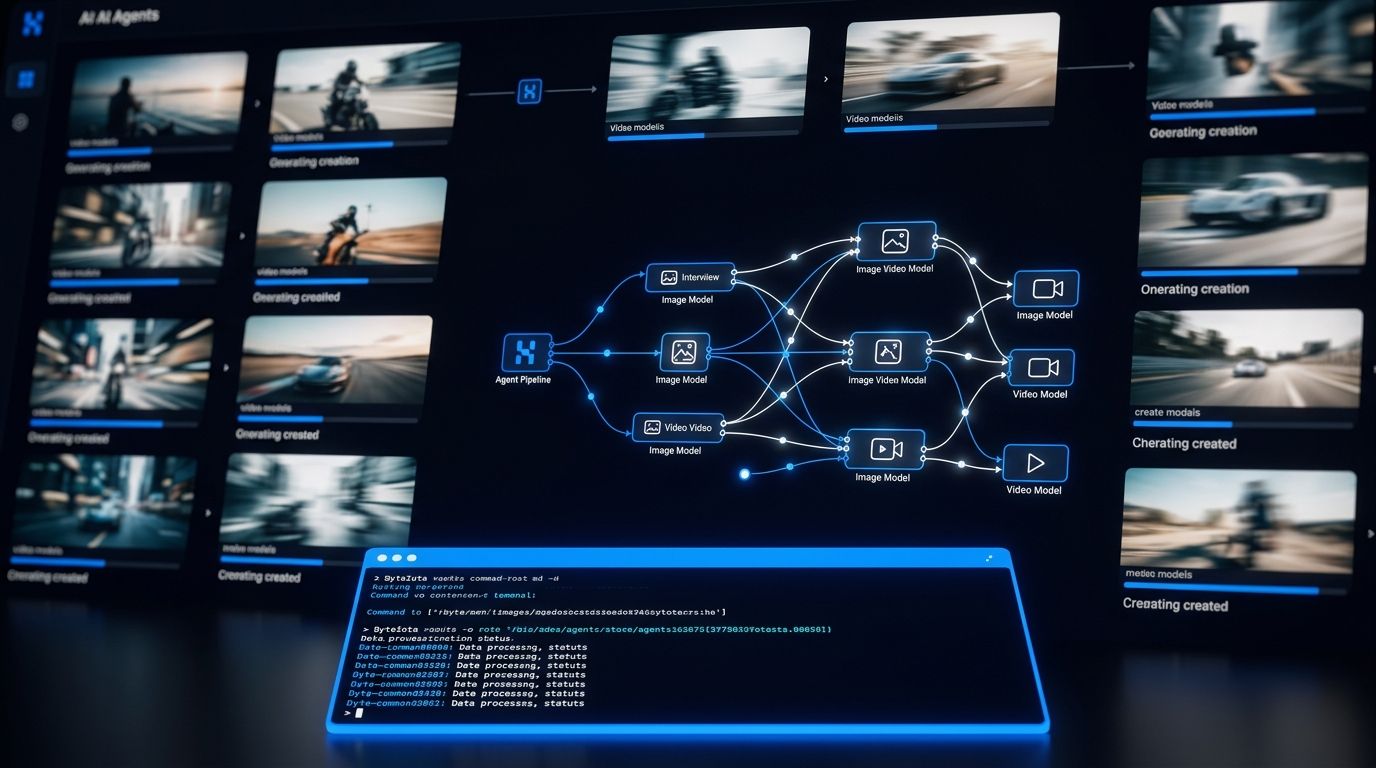
The name is misleading. Higgsfield Supercomputer is not a GPU cluster — it’s a cloud-native agent stack for visual production. You describe a campaign or a video sequence in natural language, and the agent handles task planning, model selection, generation across image/video/audio, and connection to external apps. The whole pipeline runs end-to-end without human intervention at each step.
The architecture runs what the company calls a “Hermes brain” with three layers of memory and 40+ built-in tools. It orchestrates Claude Opus 4.7, GPT-5.5 Pro, Gemini 3.1 Pro, and video generation models like Kling 3.0 and Veo 3.1. Supercomputer 2.0, launched June 2026 on NVIDIA’s Agent Toolkit, takes a marketing campaign from concept to live video ads in under 15 minutes.
The platform aggregates 15+ models — proprietary Soul 2.0 alongside Veo 3.1, Kling 3.0, and Seedance 2.0 — under a single subscription and API. A 15-person team used it to produce a 95-minute AI-generated film in 14 days for under $500,000. That benchmark is the reference point enterprises are using to decide whether to build in-house pipelines or buy access.
Three Ways to Integrate #
Higgsfield has built three distinct developer integration paths, and most of the funding coverage misses this entirely.
MCP server — for chat agents like Claude, OpenClaw, or any MCP-compatible client. Higgsfield’s MCP is now free and exposes 30+ image and video generation models. If your team is already running MCP-connected agents, this is the lowest-friction path. Point any compatible client at the MCP server and you’re generating.
CLI and Skills — for coding agents like Claude Code, Cursor, or Codex. Two commands to install:
npx skills add higgsfield-ai/skills
higgsfield auth login
The skills package ships three capabilities out of the box: generate, soul, and product-photoshoot. It also includes Marketing Studio (brand-consistent ads with avatars and product hooks) and a Virality Predictor that scores finished videos. The CLI is optimized to reduce token overhead compared to MCP — structured skill definitions instead of free-form parameter selection.
REST API — for direct pipeline integration. Standard async architecture: submit job, receive webhook when generation completes. Billing is per-second on the underlying model. This is the path for high-volume production pipelines where you need cost tracking and queue management. The Skills source is on GitHub if you want to inspect the integration layer before committing.
The Market Context #
OpenAI shut down Sora in April 2026 — the API discontinues September 24. Runway ML is at $5.3 billion valuation with $300 million in revenue. The AI video market hit $946 million in 2026, and it’s consolidating. Higgsfield is betting on the aggregator position: instead of competing with Veo or Kling, it licenses them all and adds agentic infrastructure on top.
The $700 million in annualized revenue — up from $20 million a year ago — suggests the bet is working. That 35x revenue jump in 12 months is not driven by individual creators paying $34/month. It’s driven by enterprises running production at scale, which is exactly what the Goldman Sachs Growth Equity and Intel Capital backing signals.
The 42x Number Is the Docker Moment #
When Docker adoption spiked in 2014, the conversation was still “containers are interesting.” By the time most teams got around to evaluating it, enterprises were already running it in production. The 42x growth in Higgsfield’s agentic users over three months has the same shape.
The MCP path is the lowest-friction evaluation for most teams: free, no setup beyond pointing an agent at the server, and you immediately have access to 30+ models. If you’re on Claude Code or Cursor, run the skills install and test the generate capability before you decide whether to move to the REST API for production volume.
What Higgsfield is selling is not video generation. It’s the infrastructure layer that makes video generation programmable. The $400 million is going toward making that layer harder to replace. Start evaluating it now, before you’re integrating against a de facto standard you didn’t choose.