A fleet of mobile museums is touring the country with a version of American history the administration can get behind.
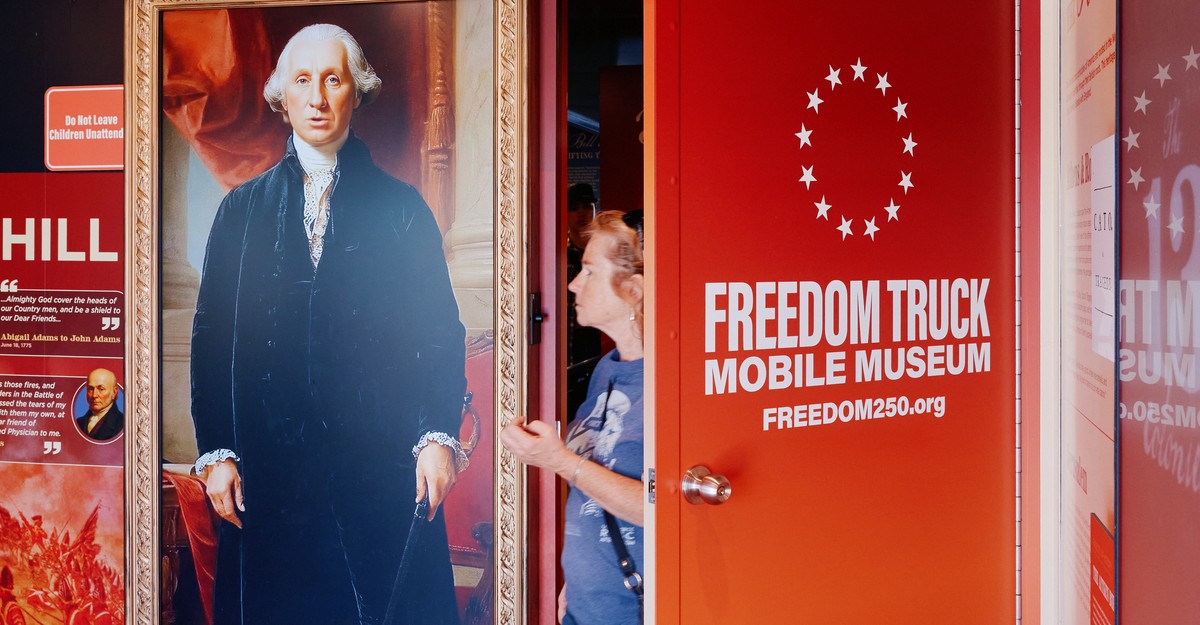
Right now, six AI-Generated George Washingtons are roaming around the country in semitrucks, stopping at sites as varied as the New Mexico desert and the National Mall and attracting lines in some places that would rival those at Disney World. On an afternoon last month at an American Legion parking lot in Bel Air, Maryland, locals—many sporting the Stars and Stripes in cap, tee, and even Croc form—waited for a glimpse of the past with an eagerness history teachers could only dream of.** “**Introducing: the Freedom Truck, a mobile museum,” a deep voice boomed to crescendoing music. “Go back in time and experience the dawn of America.”
The “Freedom Trucks” are part of the official celebration of the nation’s 250th birthday, an 18-wheel complement to the fairs, rallies, and work crews currently proliferating in Washington, D.C. When you enter one, after walking past a reproduction of a painting of English colonists praying before a cross, you meet the animated Washington, who tells you sternly that despite their differences, the 13 colonies agreed: “Our rights are a gift from God, not a favor from kings or courts.”
It’s a familiar-sounding line, invoking the core American concept of inalienable rights, but the statement isn’t actually from Washington. Lindsay Chervinsky, the executive director of the George Washington Presidential Library at Mount Vernon, told me in an email that the quote doesn’t even sound like the first president. “He regularly spoke of providence and a higher power, but usually called on republican values and virtues to defend his positions.” A similar sentence can, however, be found in an events tool kit from Freedom 250, the White House–led group behind the trucks, under suggested “faith-based messaging.”
President Trump has had much to say about how museums treat our country’s past. He has griped about the Smithsonian’s focus on slavery’s horrors, and his administration has asserted that the public has no tolerance for museums that are “uncomfortable conveying a positive view of American history.” But his efforts to influence the United States’ preeminent museum complex haven’t gotten far. With the trucks, at least, the administration has been able to take its preferred version of the American story on the road, where history is more, well, movable.
I’ve spent a lot of time unpacking which kinds of museum displays and narratives the White House rejects (for example, artwork showing migrants crossing the southern border). I went to a Freedom Truck to try to figure out what sort of materials the administration supports, which has been trickier to ascertain. You can only squeeze so much information into a semi, so I figured that what made it inside the trailer would surely be revealing.
What I saw felt like a typical, triumphant middle-school-textbook telling of the American Revolution and its aftermath, but with digital interactives, a Trump cameo, and the volume on Christianity turned up a few notches. Institutions such as the Smithsonian’s National Museum of American History tend to highlight the political circumstances of the nation’s birth—the people versus a monarch, the sense of injustice that gave way to rebellion—and include an array of belief systems when they do talk about religion (as a 2018 exhibition at the museum did). Here, the truck nods to one notable American value, religious freedom, to the neglect of another: the separation of Church and state.
For two and a half centuries, Americans across the political spectrum have projected their own ideals onto this amorphous country. The Trump administration has been a passionate participant in this tradition, gearing some of its recent efforts toward the Christian right. In shifting the story one way, the trucks risk blurring the distinction between a country founded in a religious context and a country founded as religious, and pushing the background into the foreground. The right-wing edutainment nonprofit PragerU, which aims to help “people of all ages think and live better while upholding Judeo-Christian values,” put the vehicles together. Criticized for spreading misinformation about climate change and downplaying the significance of slavery, the outfit has a recent history of teaming up with the Trump administration, including on a civics-education campaign assembled for the semiquincentennial. At least one organizer canceled an appearance of the truck to avoid appearing to endorse PragerU’s politics. (Hillsdale College, a liberal-arts school known for its conservative, Christian bent, also worked on the trucks.)
The Atlantic
Logos plastered on the truck’s exteriors advertise its affiliation with Freedom 250, which the White House created last year to organize patriotic activities for the anniversary. Confusingly, it’s separate from America250, the nonpartisan organization that is charged by Congress with doing the same. Freedom 250 has been behind events with a notably partisan flavor, such as last month’s daylong prayer rally on the Mall and the Great American State Fair. In December, $10.1 million of federal grant money that the Institute of Museums and Library Services had originally given to America250 for a truck-based traveling exhibition was redirected to Freedom 250, government-spending records show.
The exhibition focuses largely on the Revolutionary War and the country’s founding, but opens with some of North America’s early religious settlements and ends with a Wall of American Heroes, whose faces (Steve Jobs, Katharine Drexel, John Wayne, Aretha Franklin, many more) surround a quote from Trump about American bravery. Selected quotes stress colonial Americans’ beliefs in a higher power, and displays emphasize the country’s “Western and Judeo-Christian traditions.”
In some spots, the history is just plain wrong. When, in 1782, Robert Aitken printed the first full English-language Bible in the newly independent nation, a project for which he had sought—and failed—to secure funding from the U.S. government, congressional chaplains recommended the work “to the inhabitants of the United States” and celebrated it as an “instance of the progress of arts in this country,” Seth Perry, a professor of religion at Princeton University, writes in Bible Culture and Authority in the Early United States. When I emailed Perry about the wall text in the Freedom Trucks, he pointed out that the display asserts falsely that Congress “passed a resolution to print the bible” and describes Aitken’s Bible, also inaccurately, as “authorized by Congress.” As Marylanders in Bel Air pointed out to me, the truck also incorrectly says that the state was settled in 1664—it happened in 1634.
When asked about the Maryland issue, a Freedom 250 spokesperson told me in an email that the group was “reviewing the matter” but directed questions about the Aitken Bible back to PragerU, which did not respond about that content. She also said that the scripts accompanying the exhibition, like the monologue offered by the AI Washington, aim “to bring history to life for visitors” and “are not intended to serve as verbatim quotations or historical reenactments of historical figures.”
The truck nevertheless found a sympathetic audience in Bel Air, a roughly 10,000-person town where more than 3,000 people visited over three days, according to the American Legion post that hosted the truck. Toby Keith’s country anthem “American Ride” blasted from a nearby speaker to a crowd of scouts, current and former schoolteachers, restless toddlers, retiree history buffs, and at least one Daughter and one Son of the American Revolution. Multiple people told me that seeing the truck was a once-in-a-lifetime opportunity; many talked about adding their signature to the Declaration of Independence on an interactive screen, one of the trucks’ features. Ned Hoedebecke, an American Legion member who brought in the truck, which can be requested online, was overjoyed about the turnout. Standing alongside him in front of the 18-wheeler, Ray Bengel, the post’s commander, told me that one of the organization’s pillars is “Americanism.” “It can’t get any more American than this,” he said.
Something about the nation’s birthday seems to inspire cross-country educational journeys—as if one might mend this divided land simply by traversing it. While the Freedom Trucks trek across the nation by road, the National Archives’ Freedom Plane is flying historic documents to museums around the country. Both projects trace their inspiration to an earlier example: the bicentennial’s “Freedom Train.”
The concept originated in the 1940s, when a corporate-sponsored and government-endorsed Freedom Train toted 126 historic documents across the country, aiming to inspire patriotism and civic engagement after World War II. The organizers refused to stop at cities that insisted on segregating crowds. In remaining integrated, the train tour helped “break down barriers of racial discrimination that some of its documents declare do not exist in law,” The New York Times wrote in 1947.
More famous, three decades later, a Freedom Train for the United States’ bicentennial had its own cultural moment. It was the subject of a Dolly Parton and Porter Wagoner song. Johnny Cash and Lady Bird Johnson made commercials for it. Actors such as Ossie Davis and Richard Kiley recorded exhibition audio. The train carried hundreds of historic objects borrowed from big-name institutions such as the Smithsonian and the National Archives, as well as local museums and private collections. Visitors rode along a moving walkway through the cars, passing the Louisiana Purchase Treaty, Native American artifacts, African crafts, a lunar rock, Judy Garland’s dress from The Wizard of Oz, a Georgia O’Keeffe painting, and an Oldsmobile.
The Atlantic
The Atlantic
Sponsored by corporations including PepsiCo, Prudential, and General Motors, the train credited “free enterprise” with its creation and served as something of a brand booster, staying within the comfort zones of its benefactors. M. J. Rymsza-Pawlowska, a professor of history at American University who has written about the bicentennial, told me that, then and now, commemorations are “always a moment that kind of perfectly reflects their own cultural context.”
Still, compared with its contemporary descendants, the 200th-birthday train “was a whole different level,” Jonathan Goldman, the chief curator at the B&O Railroad Museum in Baltimore, where one of the locomotives that pulled the train is on permanent display, told me. “The way that they were able to stitch the country together into one exhibit that all Americans could access reasonably, I think, was a major achievement.”
At the Freedom Truck in Maryland, Lou Raborg was dressed as a Revolutionary soldier and throwing it back much further than the 1970s. When I told him that I liked his costume, he responded that it was a uniform, correcting me with such enthusiasm that I worried I might also need to take up a colonial character to continue the conversation. He told me that he’s been wearing the outfit, made of original materials, to events like this for about 20 years—or, as he put it, for a length of time that spans from the end of the French and Indian War to the end of the Revolutionary War.
The uniform might have been the most “real” thing at this truck. The vehicle was jam-packed with information, but I didn’t see a single historic object on view. One wall text that might amuse René Magritte read: “This authentic Wells Fargo shotgun represents the grit and danger of the American frontier.” Above it was an image of the gun.
All the same, there was a sense among the crowd that what was inside the truck—U.S. history—was in dire need of preservation. “It’s something that really needs to be brought back to light in schools today, is teaching history,” Randy Reinecke, the owner of the Cowboy Eats food truck, which was stationed nearby, told me. Some visitors I spoke with blamed modern life or “wokeness.”
A self-selecting group, maybe, but the truck’s visitors seemed to defy their own claims. One student came after her AP U.S. History exam, her mom, Kerry Stratemeyer, told me, because “it felt like a good way to kind of close that test out.” More than one parent whom I asked to chat with for this story referred me, instead, to their history-obsessed child.
Sarah Weicksel, the executive director of the American Historical Association, noted to me that she has her own War of 1812–loving third grader as proof that U.S. history is alive and well. In a survey published by Weicksel’s organization in 2024, more than half of history teachers said that the American Revolution and the country’s founding were among their top-three favorite topics to teach. For years, right-wing media and political leaders have been circulating the idea that the accurate story of U.S. history is disappearing from classrooms, while progressives, trying to expand that telling to include more voices, have sounded parallel alarms about a full version of U.S. history eluding us. Kelly Crowe told me outside the Freedom Truck that she had pulled her child from public school because “we were just seeing things that was more about DEI than we were seeing about true history being taught.”
To Trump’s camp, the “wrong” history—history that is not positive enough, is not Christian enough, or focuses on stories of oppressed groups—is essentially the same as no history at all. Adherents have enlisted themselves in a war over the past, waged against proponents of efforts such as The New York Times Magazine’s “The 1619 Project”—a ground-shaking, though at times erroneous, undertaking that frames the country’s story through the lens of slavery.
The Atlantic
One of those history-loving teens, Dillon, could sense that what he saw at the trucks had been streamlined. “I feel like a lot of the information was pretty surface-level,” he told me. “It didn’t go into a lot of the nuances about American history, which is something that I feel like as a country we should be more aware of.” The scout pointed as an example to Thomas Jefferson, whose heroic role as a Founding Father often blots out discussion of the hundreds of people he enslaved. The truck, Thomas said, shows only “one point of view.”
With this rah-rah, tightly proscribed approach to history, PragerU is a natural partner to the White House. Marissa Streit, PragerU’s CEO, told me she believes that history that is too pessimistic is nothing less than a national-security threat. “I feel very, very strongly that if young Americans are going to be taught to hate America, they’re not going to want to enlist in the military. They’re not going to want to defend America. They will propagate anti-American ideas that will lead to the weakening of our country and our society,” she said. At the same time, Streit said she hopes that the trucks help people understand their heritage: “A country that doesn’t understand its roots, it’s like a nation with amnesia. It’s a person who doesn’t know himself.”
According to the trucks, those roots lie in Western and Christian traditions. The truck notes, for instance, that in reviewing Jefferson’s first draft of the Declaration of Independence, Congress “made several important changes, including adding references to the ‘Supreme Judge of the World’ and ‘divine Providence.’” There, it does not mention the most famous edit: Jefferson had originally written, “We hold these truths to be sacred & undeniable.” The final document replaces “sacred & undeniable” with the more secular “self-evident.” Neither does it mention the third president’s own idiosyncratic beliefs, including his rejection of many tenets of Christianity.
The trucks contain what Christopher Grasso, a professor of American culture, religion, and politics at Brown University, called sleights of hand. They paraphrase in a way that allows for more neutral-sounding terms referring to a creator to be swapped out with the more religious-sounding “God.” They use the word faith repeatedly. They talk about the founding as if it extends all the way back to the early-Christian settlements, and they neglect that early America also included enslaved people and Native Americans with their own faiths.
“It’s the ambiguity of language,” Grasso told me. “They can use these broad terms that are themselves contested to help spin their argument in the direction that they want.”
There’s also a question of emphasis. Some of the Founding Fathers had strong religious beliefs, but how much airtime should that receive? “I think we should be giving it the same weight that they would have given, which is not that much,” Seth Perry, the Princeton professor, said, describing an “easygoing Anglicanism” in the air at the time. Stressing religion in the country’s founding, Perry said, can create a sense of national providentialism—that everything the country does is God’s will.
Streit, the PragerU CEO, isn’t worried about alienating people, and said that those who “are uncomfortable with the fact that America was founded based on Judeo-Christian values are uncomfortable with America in general.” She called concerns about giving too much attention to the Founding Fathers’ religion “silly.”
When I asked people in Maryland about the emphasis on Christianity in the trucks, I heard a refrain along the lines of what Leslie Bankert, who had brought her teen sons to the truck as a homeschool field trip, told me: “We’re Christians, so we liked that.”
Like any exhibition organizer, PragerU knows a thing or two about human psychology. You can see it in how it lets visitors add their names to a digital Declaration of Independence, and in how it has bookended the exhibition with Washington and Trump, a choice befitting a president who has been keen on depicting himself alongside historic figures. People want to see themselves reflected in history; they need to. It’s, ironically, why museums and universities have taken such pains to diversify over the past decade. And it’s why, at the end of the truck, PragerU includes one final element, but whether it breaks with or continues the narrative that the truck tells may depend on who’s looking. Right before you exit, the last wall proclaims America’s Next Hero! Above it, there’s a mirror.
When you buy a book using a link on this page, we receive a commission. Thank you for supporting The Atlantic.