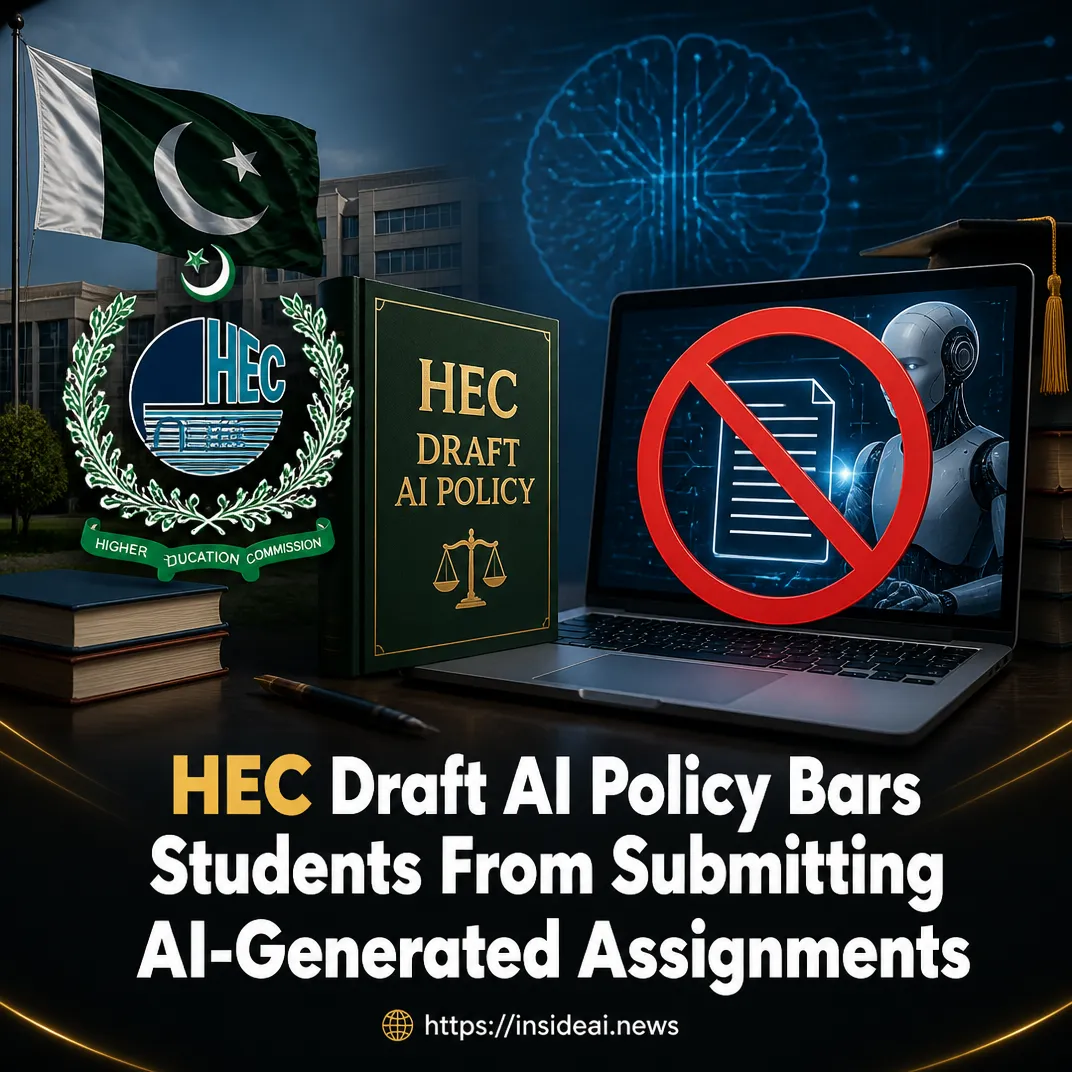
August 4, 2026, (Inside AI) — Pakistan's Higher Education Commission has issued its first draft policy on artificial intelligence in academia, prohibiting students from submitting AI-generated assignments as original work while carving out permitted uses for faculty and researchers.
The framework, released this week, mandates that every university develop its own institutional AI guidelines within two years, specifying where tools like ChatGPT are allowed, restricted, or banned. At its core is a transparency principle: students and researchers must disclose any AI use, naming the tool and describing how it was employed.
"Students and researchers will also be required to disclose whenever AI has been used in academic work by identifying the AI tool and explaining how it was used," the draft states.
The policy explicitly bars students from using AI to produce assignments, dissertations, or theses submitted as their own. It also forbids listing AI as an author on any research paper, holding human researchers fully accountable for accuracy and originality.
Faculty members gain broader latitude. They can deploy AI for tutoring, quiz generation, writing assistance, course design, and research support. Researchers may use it for literature reviews, translation, language editing, reference checking, and developing research questions, provided all AI-generated content, facts, and references are independently verified by humans.
The draft classifies fabricated references, fake research, invented data, and AI-generated false findings as serious academic misconduct. Using AI to hide plagiarism, rewrite copied content to evade detection, or cheat during examinations will trigger disciplinary action. Yet the HEC acknowledges the limits of detection tools, stating that students cannot be penalized solely based on AI detection software results.
This move places Pakistan among a growing list of nations grappling with generative AI in education. Unlike outright bans seen in some districts, the HEC's approach mirrors frameworks from universities like Oxford and Cambridge, which emphasize disclosure over prohibition. A 2023 study in the Journal of Academic Ethics found that transparent AI use policies reduce misconduct more effectively than blanket bans, supporting the HEC's stance.
Implementation falls to dedicated AI committees at each institution, which will monitor compliance, handle complaints, enforce policy, and submit annual reports to the HEC on AI usage, violations, training, and policy developments. Universities must also integrate AI literacy into curricula within two years and conduct annual training for faculty, students, and staff. Every course outline must specify acceptable AI use from the semester's start.
The policy's emphasis on human verification aligns with broader concerns about AI hallucination and bias. A 2023 paper from Stanford researchers highlighted that large language models can generate plausible but incorrect references, underscoring the need for independent fact-checking, a requirement now codified in Pakistan's draft.
Critically, the framework does not address how institutions will fund the required training, software, or committee operations, a gap that could widen disparities between well-resourced and underfunded universities. It also remains silent on data privacy when students or researchers input work into commercial AI platforms, a concern raised by the European Data Protection Board in its 2024 guidance on AI in education.
Detection Tools Face Scrutiny #
The HEC's caution against relying solely on AI detection software reflects a growing consensus. Multiple studies, including a 2023 analysis by researchers at the University of Maryland, have shown that such tools can produce false positives, particularly for non-native English writers. The draft policy's nuanced position may prevent wrongful accusations while still deterring misuse.
Curriculum Overhaul Required #
By mandating AI literacy within two years, the HEC is pushing a rapid curriculum transformation. This mirrors recommendations from UNESCO's 2023 guidance on AI in education, which urges member states to equip learners with competencies to critically engage with AI. However, Pakistan's timeline is ambitious given existing resource constraints and faculty readiness.
The draft is now open for stakeholder feedback before final adoption. If enacted, it could serve as a model for other developing nations balancing AI's potential with academic integrity.