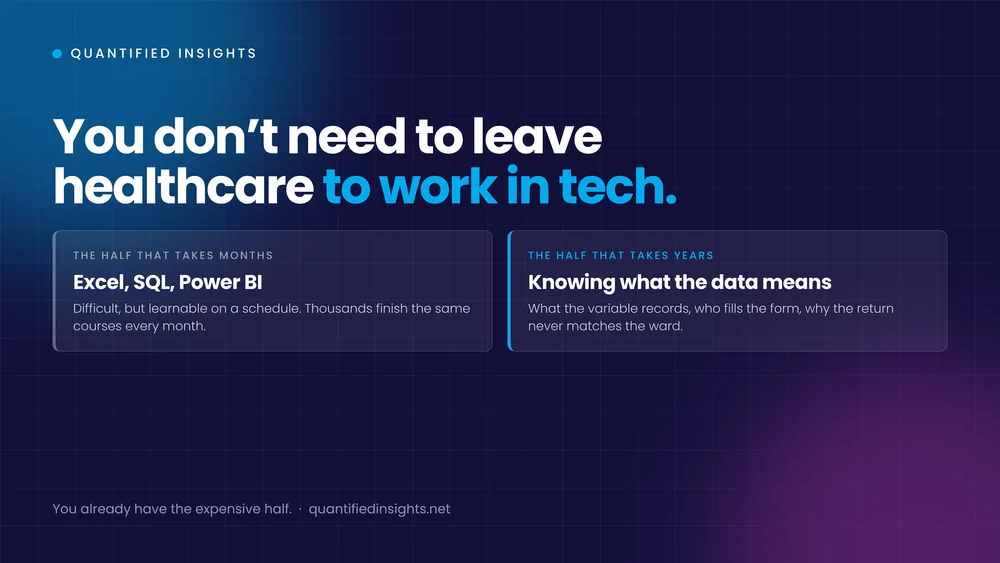
If you're a nurse, doctor, or therapist, you already possess the most expensive asset in AI development: domain expertise. When a developer tries to build an AI workflow for patient intake, they're guessing. When a clinician does it, they're solving a friction point they've felt for a decade. This is where the real money and impact are right now—bridging the gap between a raw LLM agent and a usable medical tool.
How to start bridging the gap #
You don't need to become a full-stack developer, but you do need to speak the language. If you want to move into the technical side while staying in healthcare, focus on these areas:
-
Master Prompt Engineering: Stop treating AI like a search engine and start treating it like a junior resident. Learn how to structure system prompts to reduce hallucinations in clinical summaries. This is a practical tutorial in itself—take a messy patient note (anonymized, obviously) and iterate on the prompt until the output is 100% accurate.
-
Understand the Data Pipeline: You don't need to write the Python code, but you should know how data moves from an EHR (Electronic Health Record) into a model. Understanding FHIR standards or HL7 is basically the "secret handshake" of healthcare tech.
-
Build a Portfolio of Use-Cases: Instead of a resume, create a list of "problem-solution" pairs. For example: "The current triage process takes 20 minutes; I designed a prompt-based logic flow that reduces it to 5 minutes while maintaining safety."
Clinical Role: High empathy, deep domain knowledge, understands regulatory pain.Tech Role: Scalability, automation, iterative deployment.The Sweet Spot: The Clinical Product Manager or Health Informatics specialist who can translate "medical necessity" into "technical requirements."
The goal isn't to leave your patients behind, but to use your experience to build tools that actually make the job bearable for everyone else. Whether it's optimizing a deployment of an AI scribe or refining a diagnostic assistant, the "insider" perspective is what prevents tech companies from building useless toys. If you can map a clinical workflow from scratch and explain it to a developer, you're already halfway to a tech career without ever having to leave the hospital.
Stop tracking "AI adoption rates" because they are essentially 5d ago
Stop trusting your AI call scoring blindly until you run a 6d ago
Next Since the original content provided is extremely sparse →