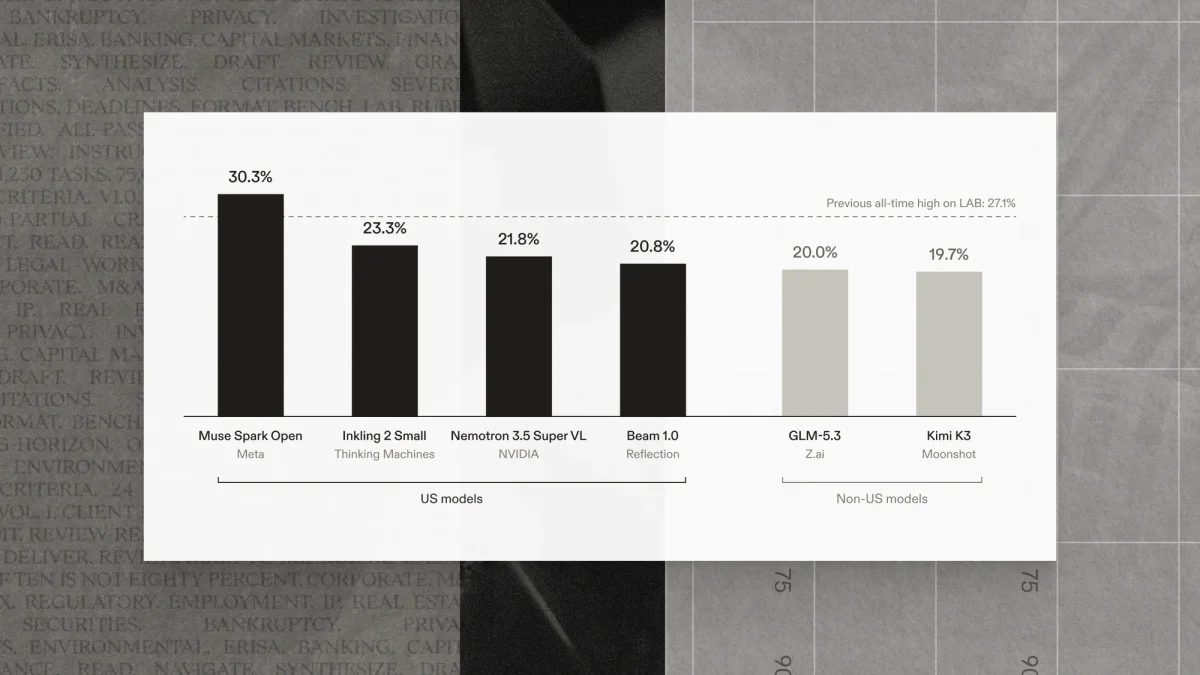
Harvey Research said Muse Spark Open became the first model above 30% all-pass on Legal Agent Benchmark holdout after reinforcement-learning post-training, in a November 24, 2026 blog post. The same study reports Nemotron 3.5 Super VL, Beam 1.0, and Inkling 2 Small each exceeded 20% after a Harvey Tenet-style recipe adapted with Baseten. This is research on open US weights, not a new Meta product launch—distinct from Muse in Instagram DMs the same afternoon.
TL;DR #
| Metric | Muse Spark Open (Harvey post-train) | Base reference |
|---|---|---|
| LAB holdout all-pass | 30.3% (Harvey, Nov 24) | 25.8% base at max reasoning effort per Harvey |
| Tokens per LAB task | 36% fewer than base max effort | Harvey efficiency chart |
| Vals HLAB v1.1 (Nov 19) | 25.00% task pass, base checkpoint | Vals leaderboard |
| Other US models post-train | Nemotron, Beam, Inkling above 20% all-pass | Harvey Figure 1 |
What Harvey published on November 24 #
Since Harvey Tenet in August, Harvey Research tracked US open-weight releases from Meta, NVIDIA, Reflection, and Thinking Machines. The November 24 post post-trained four US models—** Muse Spark Open**, Nemotron 3.5 Super VL, Beam 1.0, Inkling 2 Small—plus GLM-5.3 as a non-US control, using asynchronous RL in LAB-style environments with expert rubric judges.
Headline claims:
- Muse Spark Open: 30.3% all-pass on LAB holdout—first over 30% in their report.
- 58% more tasks completed versus base on Legal Agent Bench in-distribution.
- Nemotron, Beam, Inkling eachabove 20% after training—beats their priorKimi K3 mark atsmaller active parameter counts .
- Non-legal benchmarks largely held;SWE-bench Pro improved without legal tasks in the reward.
Harvey emphasizes checkpoints are research-only and not trained on customer data.
Harvey Figure 1 legal agent benchmark scores after post-training US open weight models
*Image: [Harvey](https://harvey.ai/blog/applying-the-harvey-tenet-training-recipe-to-us-open-weight-models?ref=explainx)*

## How LAB scoring works (and why all-pass is brutal)
Legal Agent Benchmark (LAB) is Harvey's agentic legal work suite: closed-universe client matters, docx/pptx/xlsx skills, and binary rubric criteria. A task passes only if every criterion passes—so all-pass rate is far stricter than criteria-pass rate Vals also publishes.
Vals AI's HLAB v1.1 (November 19, 2026) runs Harvey's harness on a remediated private holdout and lists Gemini 4 Argon 27.08%, Muse Ember 25%, Muse Spark Open 25% on task pass rate. Harvey's 30.3% uses a post-trained LoRA adapter (rank 64, CISPO optimizer) after ~80 optimizer steps on Muse—not the same row as Vals' base leaderboard entry.
When marketing teams cite "first to 30% legal agent", specify Harvey holdout + post-training versus Vals base harness.
Efficiency: fewer tokens at higher pass rate #
Harvey Figure 4 LAB holdout all-pass rate versus mean output tokens after post-training Muse Spark Open
Image: Harvey Harvey's Figure 4 compares post-trained Muse Spark Open to the original across reasoning settings. At LAB, post-trained Muse reaches 30.3% all-pass versus 25.8% for base at maximum effort, with 36% fewer mean output tokens per task. Harvey argues gains are not only from longer chain-of-thought.
For Muse Wonder comparisons readers, remember Muse Spark Open is Meta's open-weight MoE (Harvey cites 816B total, 42B active)—inference cost still dwarfs Muse Ember on Vals cost columns.
Lawyer preference vs rubric gains #
Harvey ran a pairwise GRM tournament on held-out LAB tasks. Nemotron, Beam, and GLM-5.3 post-trained models win ~98% of preference judgments versus base. Muse Spark Open and Inkling 2 Small improve rubric scores without significant head-to-head preference wins—Harvey notes rubric optimization does not always improve tone and alignment lawyers prefer.
Implication for law firm agent pilots: run your own matter replay with partner review, not only public LAB numbers.
Inkling and Nemotron in the same batch #
| Model | Harvey LAB all-pass after RL | Notes |
|---|---|---|
| Muse Spark Open | 30.3% | Highest in study |
| Nemotron 3.5 Super VL | above 20% | Smallest MoE in batch (120B total) |
| Beam 1.0 | above 20% | Redline Bench 40.6% → 51.1% |
| Inkling 2 Small | above 20% | LAB Contracts 4.0% → 13.0% |
Inkling connects to Thinking Machines open weights coverage; Nemotron to NVIDIA agent recipes. None replace Meta Muse consumer agent security model for client data.
Training recipe Harvey used (builder-relevant detail) #
Harvey's appendix describes a rank-64 LoRA on each base checkpoint, trained with CISPO and Dr. GRPO-style advantage normalization:
-
1,250 training tasks across LAB practice areas (excluding contracts-only and diligence-only splits).
-
8 rollouts per task group (
G0 = 8), with rollouts excluded when infrastructure fails; groups needat least 6 graded rollouts andnon-zero advantage variance to contribute. -
Up to 200 agent turns andone hour wall time per episode; networkdisabled in the sandbox harness.
-
Reward blendscriteria pass rate (weight 0.35),issue-group pass rate (0.35 when present), andall-pass bonus (0.30). Hitting turn or context limits yieldszero reward .
-
Token importance ratios clipped to**[0.8, 1.2]** for asynchronous rollouts (policy lag). Infrastructure split: Muse Spark Open, Nemotron, Beam, GLM-5.3 trained on Baseten Loops with Baseten Sandboxes for rollouts; Inkling 2 Small used Tinker before public weight release. Harvey picked checkpoints after 80 optimizer steps for most models (200 for Beam).
If you replicate externally, you need LAB-compatible environments, Harvey's judge stack, and MoE-scale GPU budget—this is not a single-GPU LoRA on a 7B coder.
Cross-benchmark behavior after post-training #
Harvey reports in-distribution legal gains and limited regression elsewhere:
- LAB Contracts: Inkling 2 Small4.0% → 13.0% all-pass (not in training mix).
- Redline Bench: Beam40.6% → 51.1% .
- APEX Agents (Corporate Law) andMercor corporate law sets:higher post-train on each model Harvey lists.
- AutomationBench, GDPval, consulting/banking APEX: mostlyflat .
- SWE-bench Pro (HARD-51):**improved without software tasks in the legal reward—Harvey notes longer reasoning may contribute and planslength penalties** .
For software teams comparing GPT-6.2 Astra coding hands-on to legal agents, do not assume one post-training recipe transfers; Harvey explicitly did not include SWE tasks in the legal RL mix yet saw SWE movement.
Model size context for procurement #
| Model | Total params | Active/tok (Harvey appendix) | Post-train LAB tier |
|---|---|---|---|
| Muse Spark Open | 816B MoE | 42B | 30.3% all-pass |
| GLM-5.3 | 744B MoE | 40B | Gains, US control |
| Beam 1.0 | 501B MoE | 23B | 20%+ |
| Inkling 2 Small | 594B MoE | 17B | 20%+ |
| Nemotron 3.5 Super VL | 120B | 12B | 20%+ |
Nemotron's Mamba-2 layers matter for long-context legal files without KV blowups; Muse Spark Open's perception encoders matter for multimodal exhibits even though LAB text harness is file-tool heavy.
Dollar math: Vals lists Muse Spark Open at ~$13.63 per HLAB test and ~22M tokens at base settings—post-training reduced tokens 36% at higher pass in Harvey's chart, but 816B MoE serving still dominates Muse Ember at $0.12 on Vals for agent demos.
Regulatory and ethics framing #
Harvey states research checkpoints are not used on customer data and customer data was not in the training loop—align with how Anthropic enterprise adoption study separates public research from tenant data.
Law firms evaluating open weights should still run conflict checks, privilege review, and jurisdiction-specific validation—30.3% all-pass means roughly seven in ten holdout tasks still fail every criterion.
Vals v1.1 remediation context (why boards moved) #
Vals documented that HLAB v1.1 fixed 17 unsolvable criteria and replaced a mismatched source document on the private holdout. Scores rose across models after remediation—when comparing October versus November leaderboard posts, cite v1.1 explicitly.
Harvey's 30.3% is not automatically comparable to pre-remediation v1 Muse Spark Open rows. explainx.ai's Gemini Argon legal board analysis noted the same harness churn risk.
Partner checklist for legal agent pilots #
- Define task class — diligence memo, redline, or contract abstraction; LAB spans24 practice areas but your firm may care aboutone .
- Replay with partner review — Harvey's GRM tournament showsrubric wins without preference wins on Muse and Inkling.
- Measure tokens and wall time — LAB episodes allowone hour ; real matters may needhuman checkpoints earlier.
- Track open-weight license — Muse Spark Open weights followMeta terms ; Harvey adapters arenot Meta-shipped.
- Compare closed APIs fairly —Wonder Full pricing benchmarks andGemini Argon serve differentSLAs than self-hosted MoE.
What this does not prove #
-
Not a Meta announcement —Harvey + Baseten experiment onreleased checkpoints .
-
Not courtroom-grade —LAB issynthetic client matters withLLM judges (GPT 5.5 and Claude Sonnet 4.6 per Vals methodology notes).
-
Not comparable to GLM legal gated access drama without matchingharness version .
Glossary for readers new to LAB #
All-pass rate means the agent satisfied every rubric criterion on a task—partial credit does not count. Criteria pass rate can be above 90% while all-pass stays near 25% because one missed footnote fails the matter. Issue groups bundle criteria that test the same legal theory; Harvey's reward up-weights full group passes to discourage technically correct but incomplete memos.
Holdout set tasks were not in Harvey's 1,250 training tasks, but they share the same tool and skill surface (Read/Edit/Write/Glob/Bash/Grep plus docx, pptx, xlsx skills). Public LAB open sets on GitHub differ from private holdout rows Vals and Harvey grade—never paste open-set scores into holdout marketing.
Related reading #
Numbers and training details follow Harvey Research post accessed November 24, 2026, cross-checked against Vals HLAB v1.1 metadata.