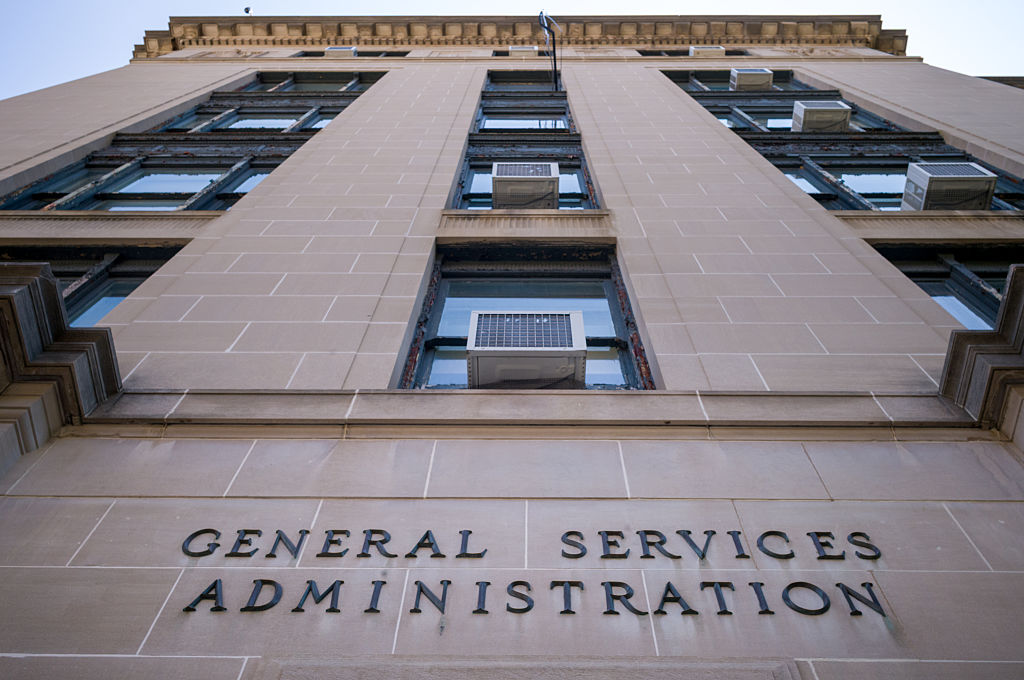
The General Services Administration has issued its artificial intelligence acquisition clause as a class deviation from its regulations, according to a regulation overhaul memo updated Monday, making it a policy that can be used immediately.
The GSA previously proposed a rule to amend federal regulations for AI acquisitions and took two rounds of public comment on drafts. Since then, the agency decided on a class deviation from the GSA’s Acquisition Regulation first. While the memo says the deviation will be effective Oct. 19, contracting officers could use it now and existing contracts may be changed at the discretion of the officer, it said.
As a deviation, it is essentially policy until GSA rescinds it or codifies it through formal rulemaking, which the memo says will include a public comment period.
After over 75 comments this summer, and critical feedback from industry, the GSA has incorporated several changes to its AI procurement policy. Now, the clause applies only when the government is buying AI. It doesn’t apply when contractors use AI internally, as long as those tools aren’t delivered to or accessed by the government or unless otherwise identified by the contracting officer. It also now expressly covers AI-enabled document and productivity tools, it said.
The term “unbiased AI principles,” which several commenters had a problem with, has mostly disappeared, along with language banning the embedding of “partisan or ideological judgments.” Instead, the clause now says the contractor must use “reasonable efforts” to make their LLM respond factually.
“The Contractor must use reasonable efforts to design, train, and configure the LLM to respond to user prompts seeking factual information or analysis, prioritize accuracy, scientific inquiry, and objectivity and must acknowledge uncertainty where reliable information is incomplete or contradictory,” the new clause says.
However, the government “reserves the right to conduct automated assessments of the LLM” for “bias, truthfulness, safety, unsolicited ideological content, and other factors determined by the Government,” the clause says.
“The Government retains the right to suspend use of the LLM at any time,” it says. The June draft allowed suspension “until performance issues are satisfactorily addressed.”
The clause also defines three kinds of “open” AI: fully open models, open-weight models and open-LLM components. Prime contractors don’t have to pass foreign-control requirements down to fully open models that publish their architecture, weights, code and data, or to other open-source components — though open-weight models that only publish their weights do not get the same exception.
GSA capped a contractor’s liability for decommissioning costs after a for-cause termination at 25% of the affected task or delivery order, the clause says.
Flowdown requirements now only apply to subcontractors if they handle government data, instead of just tying requirements to roles, as in the June draft.
“Obligations should follow the data, not the model’s authorship,” Nvidia Chief External Affairs Officer Bruce Andrews wrote over the summer.
The prime contractor remains responsible for implementing the clause, but must now use “best efforts” to vet AI subcontractors, rather than just exercising “due diligence” over the model’s developers, operators, integrators and service providers, the clause says.
The clause also includes a definition for government usage context, or information that exists because the government used AI and either reveals how the government works or supports a material inference about its nonpublic activities, taken alone or together. It resembles a suggestion from Jessica Tillipman, associate dean for Government Procurement Law Studies at George Washington University, who proposed a similar test at GSA’s July listening session.
The contractor must tell the government of any “material change that materially increases” output bias, decreases safety guardrails or behavioral constraints, or degrades performance or truthfulness of outputs, within seven calendar days, it said.
It expands access to government data to cloud hosting, technical support, security, maintenance, and similar service providers “only to the extent necessary” to perform the contract.
While the dates for a formal rulemaking process are still unknown, feedback can be provided on the GSAR Overhaul website. GSA said in the memo that it does not anticipate posting a line-by-line change, and the agency did not respond to a request for comment by the time of publication.