GS1 Sunrise 2027 means retail POS systems will read 2D barcodes (GS1 DataMatrix and QR Codes carrying GS1 Digital Link) alongside UPC and EAN by the end of 2027, so manufacturers need to prove the new code prints, sits, and scans correctly on the actual production line. This post shows how to build one Roboflow Workflow that detects both codes with RF-DETR, decodes the UPC and the Digital Link, confirms the GTINs match, and fails the package if the 2D barcode grade falls below your ISO/IEC 15415 minimum, plus how to add label placement, lot code, and pallet scanning checks.
GS1 Sunrise 2027 is the retail industry’s transition toward scanning 2D barcodes. By the end of 2027, GS1’s goal is for retail point-of-sale (POS) systems to read and process a defined set of GS1-standard 2D barcodes alongside existing 1D barcodes, such as UPC. The change is already underway: In 2025, GS1 reported that companies were testing next-generation barcodes in more than 45 countries representing about 85% of global GDP.
The transition creates different requirements across the supply chain:
- Retailers need POS hardware and software capable of reading the new 2D barcodes and processing the data they contain.
- Brand owners and manufacturers need to choose the appropriate 2D barcode format, encode the required data, and update packaging so the code can be printed and scanned reliably.
Universal Product Code (UPC) and European Article Number (EAN) barcodes will be used during the transition. Many products will carry both the familiar 1D barcode and a new 2D barcode while retailers update their checkout systems.
GS1 DataMatrix and QR Code are the actual 2D barcode formats printed on the package. GS1 Digital Link is different: it connects GS1 product identifiers, such as a GTIN, to online product information and can be encoded in a 2D barcode. A QR Code or Data Matrix can contain a GS1 Digital Link URL, while GS1 DataMatrix can also encode GS1 data using the traditional element-string format.
For manufacturers, the main challenge is making sure the barcode can be scanned reliably after it is printed on the package. Poor print quality, bad placement, motion, or damage can make a valid code difficult or impossible to scan on the production line and later in distribution.
2D Barcode Verification and Grading #
A scanner can still read a 2D barcode even when the print quality is poor. Decoding extracts the data from the barcode. Barcode verification checks how well the code was actually printed, looking at things like contrast, distortion, and damage. It then gives the code a grade based on its print quality.
That grade matters because a barcode that is scanned successfully in a controlled test may still fail in production. Changes in lighting, camera angle, distance, or print consistency can make defects more noticeable and reduce how reliably the barcode can be scanned. Roboflow barcode verification can grade 2D barcode print quality against ISO/IEC 15415 using factors such as contrast, modulation, and damage to key parts of the barcode, then flag codes that fall below the required grade.
If the inspection also needs to cover the rest of the printed package, Roboflow print quality inspection can check for broader print defects such as missing print, registration errors, color drift, and streaks.
Label Placement and Presence Inspection #
A barcode can be printed correctly and still be applied to the package incorrectly. Common placement failures include:
- a missing or duplicate label
- excessive rotation or skew
- a label placed outside the expected area
- the wrong label attached to the product
- folds or wrinkles that cover part of the barcode
Barcode decoding does not catch these problems because it only checks whether the code can be scanned. Placement inspection checks whether the label and barcode are positioned correctly on the package. Roboflow label verification and placement inspection handles that step by checking whether the expected label is present and within the allowed position and rotation limits. It can flag missing or duplicate labels, skew, rotation, and off-center placement.
For broader checks on the finished label, Roboflow packaging label inspection covers artwork accuracy, printed text, physical damage, and barcode scannability.
Mixed-Symbology Reading at Line Speed #
During the Sunrise 2027 transition, the same package may carry both a UPC or EAN barcode and a 2D code such as a QR Code. A vision system should find each code in the camera view, identify its type, and read it reliably.
That gets harder once the package is moving. Motion blur, changing angles, partial visibility, or several products in the same frame can affect the scan. Roboflow 2D barcode reading software can locate and read QR and DataMatrix codes across different positions and angles, while high-speed barcode scanning covers fast production environments where several 1D and 2D barcodes need to be scanned from the same frame. Testing should use footage from the actual production setup, including the real line speed, camera position, resolution, and lighting.
Date and Lot Code Verification Against the Encoded Digital Link #
Reading the 2D barcode is only part of the check. The data encoded in it also needs to match the information printed on the package. For example, when a lot number or expiry date is encoded in the 2D barcode, it can be compared with the corresponding value printed on the label.
Roboflow Date and Lot Code Verification uses OCR to read printed date and lot codes from the package. The extracted values can be compared with the corresponding data encoded in the 2D barcode to flag mismatches or missing print.
DC Inbound and Outbound Scanning #
Scanning gets more difficult in a distribution center because cameras may need to read labels across cases or pallets rather than individual packaged products. Labels can appear at different angles, covered by stretch wrap, damaged, or partly hidden.
For inbound checks, Roboflow inbound scanning can read case and pallet identifiers and compare them with the expected inbound record. The system needs to:
- read barcodes as shipments arrive
- check that the scanned shipment matches what was expected
- read labels from different sides of a pallet
For pallets specifically, pallet barcode scanning focuses on finding and reading labels across different faces and positions. Once those identifiers are captured, Roboflow manifest verification can compare scanned identifiers with the expected shipment records to flag wrong SKUs, missing or extra cases, and misrouted pallets.
Build a GS1 Sunrise 2027 Barcode Inspection Workflow #
Combine the inspection steps into one Roboflow workflow. Here's the workflow we'll build.
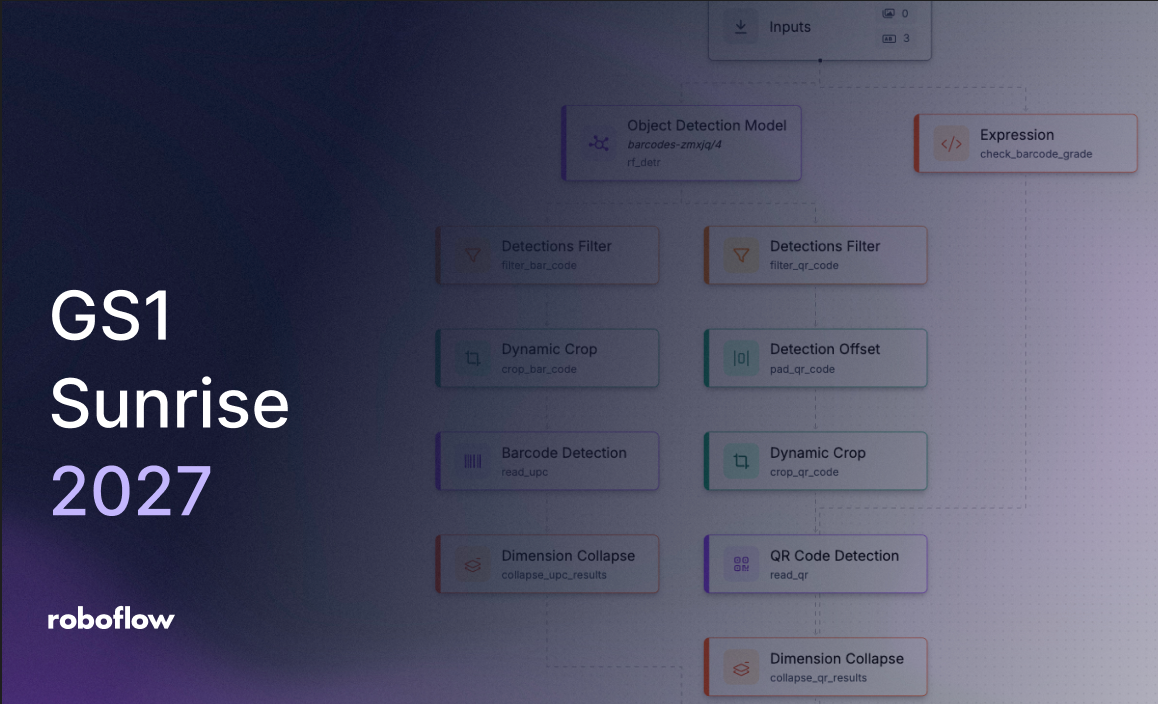
The inputs are a package image, a barcode grade, and the minimum grade accepted on the production line. The image first passes through RF-DETR, using version 4 of the public Barcodes model on Roboflow Universe. It localizes the UPC and QR Code so each code can be processed separately.
The detections then split into two branches. The UPC region is cropped and sent to Barcode Detection, which decodes the UPC value. The QR region is cropped and sent to QR Code Detection, which decodes the GS1 Digital Link. Both decoded values are passed into the inspection logic for GTIN extraction and comparison.
Before comparing the two codes, the Workflow extracts and normalizes their GTINs. A UPC-A carries a 12-digit GTIN, while the value in a GS1 Digital Link may be represented as a 14-digit GTIN. In the test shown here, the UPC “123456789012” is normalized to “00123456789012”. The QR Code contains “https://id.gs1.org/01/00123456789012”, so the GTIN extracted from the Digital Link is the same. The Workflow therefore returns gtin_match: true.
The barcode grade is checked separately from the UPC and QR decoding steps. In this example, the grade is provided as a Workflow input and compared with the minimum accepted grade. The Workflow does not calculate the ISO grade from the image itself. In a production setup, that grade should come from a barcode verification system. The final inspection returns PASS only when both codes are detected and decoded, the GTINs match, and the 2D barcode meets the minimum grade.
If any of these checks fail, the final result changes to FAIL and the Workflow returns an alert. The Workflow can also include the label placement and date or lot checks described earlier when those checks are needed.
GS1 Sunrise 2027 readiness checklist
- Confirm which 2D barcode format you will use and what data it will contain.
- Decide how the existing UPC or EAN barcode will remain on the package during the transition.
- Verify that the 2D barcode meets the required barcode grade.
- Check that the label is present and placed in the correct position.
- Test that the UPC or EAN and the 2D barcode can be read from the same package.
- Confirm that both barcodes identify the same GTIN.
- Verify printed date and lot codes when those values are also encoded in the 2D barcode.
- Test the system using the real camera setup, lighting, and production line speed.
- Confirm that barcode scanning works for inbound shipments, pallets, and outbound shipments where required.
Rollout timeline
During 2026, start with a pilot on a small set of products and one production line. Test normal products and known failure cases, then adjust the inspection logic using results from that line. Once the pilot is working reliably, expand it to the other SKUs and production lines that will use the new codes, including distribution-center scanning where needed.
Complete the required production-line rollout before 2027, so barcode reading and verification issues can be found and fixed before the new 2D codes are used at scale.
How to Get Your Packaging Ready for GS1 Sunrise 2027 #
Sunrise 2027 readiness should be proven on products under the same conditions they will face in production. A barcode that works in a test environment may fail once it is printed on the package and scanned on a moving production line.
The practical next step is to test the Workflow on one production line during 2026 using a set of products and known failure cases. Use those results to adjust the inspection logic before expanding to more lines and facilities. Starting early leaves time to correct problems in the printing, scanning, or inspection setup before broader rollout.
Cite this Post
Use the following entry to cite this post in your research:

[Mostafa Ibrahim](https://blog.roboflow.com/author/mostafa/). (Aug 20, 2026).
      GS1 Sunrise 2027: How to Verify 2D Barcodes on the Production Line. Roboflow Blog: https://blog.roboflow.com/gs1-sunrise-2027/