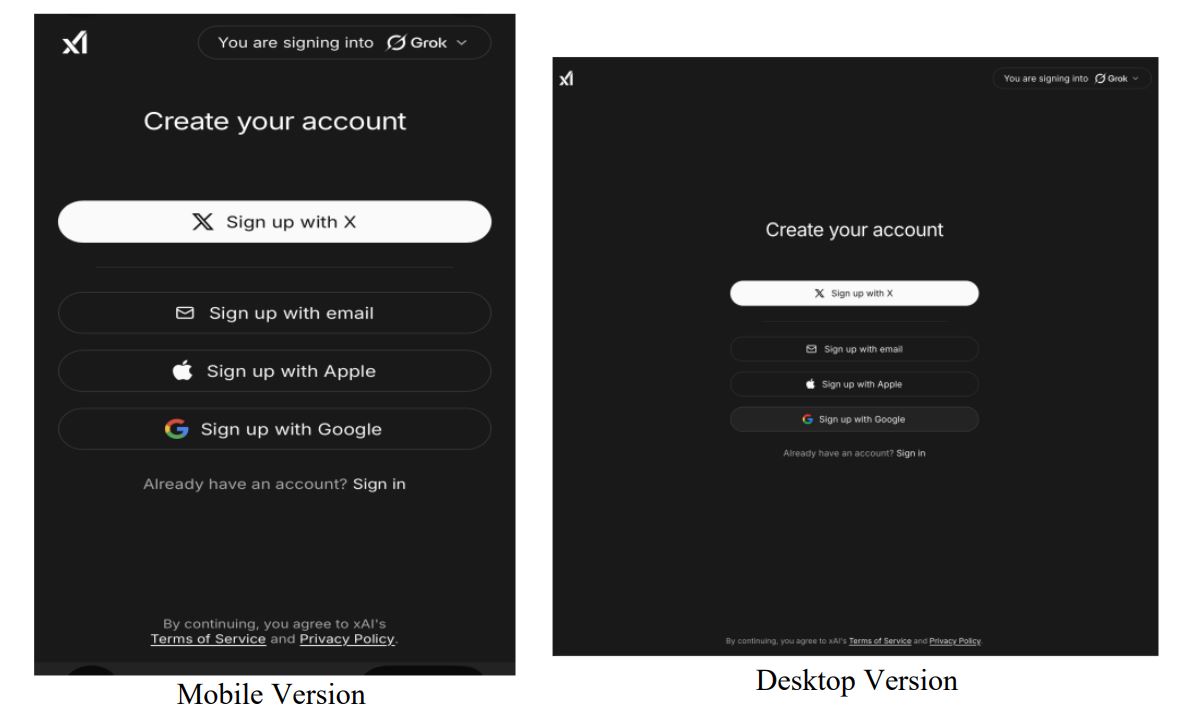
This case naturally raises some questions that Musk might choose to pose to Grok, like:
“Grok, is it bad when TOS formation fails?”
“Grok, what are best practices for TOS formation and does our current TOS formation process satisfy those?”
The plaintiff claims Grok “disclosed private and confidential information.” Grok sought to transfer the case to N.D. Tex. per its TOS forum selection clause. Everyone agrees the case should transfer if the TOS was properly formed. It was not.
The Wrap Taxonomy
Here is the applicable TOS formation screen at account signup. Everyone agrees this is a sign-in-wrap.
Here is the screenshot when Grok users submit queries:
The court says the chat screen is closest to a sign-in-wrap as well.
Thus, the court follows the now-standard Chabolla framework for reviewing sign-in-wraps.
Transaction Context
Unhelpfully, the parties obviously didn’t think this factor was important:
the Parties devote little space to addressing the transactional context at play here. Defendant offers one sentence in a footnote in its reply brief, citing to
[Oberstein]and contending that “signing up for an account is the type of transaction that contemplates an ongoing relationship.” Plaintiff does not discuss this issue.
This raises another question for Grok: “Grok: is it good when a litigant fails to provide advocacy for one of the elements the court will analyze?”
The court says the plaintiff should have assumed there were applicable terms:
The first factor is that, although an account is “not required” to use Grok, Plaintiff chose to make one anyway. The second is that, after making that account, Plaintiff used Grok repeatedly “throughout 2025 and 2026” to “enter[] queries related to sensitive information about finances, investment strategy, private health conditions, business projects, and other private information.” In the Court’s view, a user who affirmatively chooses to make an account when doing so is optional and recurrently uses the corresponding web service should reasonably contemplate “some sort of continuing relationship” accompanied by terms and conditions. That Plaintiff used Grok to discuss sensitive personal information also weighs in favor of the notice requirement.
From my perspective, anyone who voluntarily chooses to use Grok extensively has placed themselves into a caveat emptor situation. It’s like the Farmer and the Snake parable. Reasonable Notice on the Sign-Up Screen
The court then turns to the visibility of the TOS offer language, starting first with the sign-up screen. The court says there is a visual discontinuity between the TOS offer and the acceptance buttons:
although a reasonable user is presented with four sign-up methods, he ultimately selects only one. Having made that selection, the other sign-up options necessarily become “superfluous.” Even if a user chose the sign-up option closest to the bottom of the webpage (the option to “Sign up with Google”), Defendant’s contention that the notice is “positioned immediately below” is still incorrect. The language that is directly below the “Sign up with Google” button reads: “Already have an account? Sign in[.]” A reasonable user who is on Defendant’s sign-up page to sign up for a Grok account, which is how Defendant contends Plaintiff agreed to its terms, would likely see that text and read no further because, by definition, it does not pertain to him
The court is doing some tricky but important work here. Basically, she’s saying that once a user encounters language that isn’t applicable to them, they will stop reading and proceed. So here the “Already have an account? Sign in” language acts as a visual barrier that moots everything below it for a user who is signing up for the first time. Perhaps if the TOS offer language were closer to the buttons and more prominent, it could have overcome that visual barrier. But putting the language above the sign-up buttons would have avoided this limitation. (Or, better yet, two clicks).
The court doesn’t like the TOS offer language presentation either:
The contrast between the white hyperlink and the black background is notable, but it says nothing of the contrast between the hyperlink and the text immediately adjacent to it….the difference between light gray and white is a matter of degree and hardly one that maximizes visibility. Moreover, any distinction that this color variation provides is offset by the fact that other non-clickable text such as the “Create your account” heading is also in white…. the single colorful feature—the multi-colored Google logo on the “Sign up with Google” button—is near the center of the screen, likely drawing a reasonable user’s attention more than the monochromatic notice text at the bottom of the page does
I guess the judge doesn’t love monochromatic screens as much as Musk does?
The court summarizes:
Although the transactional context suggests that Plaintiff should have expected to be bound by contractual terms, the Court finds that the sign-up screen notice is not reasonably conspicuous because of “the notice’s distance from relevant action items, its placement outside of the user’s natural flow, and its font—notably timid in both size and color.”
I’m still waiting for courts to clarify what the “user’s natural flow” means. It brings to mind the great Dave Mason song (RIP).
Chat Screen TOS Formation
The chat screen formation evaluation doesn’t fare any better (and maybe a little worse?):
it is patently untrue that the notice is “directly beneath the query box.” Nothing is directly beneath the query box except a lot of empty space. Moreover, the query box is the only action item on the chat page, and as such a user’s “most obvious and natural next step” is to input text into that box. Because the query box is on the top third of the page and no additional graphics or text give the user any reason to look beyond it, the notice at the bottom of the website is “buried” beyond “the periphery” of where a user would be looking.
A “lot of empty space” “buries” the TOS offer language. 🤔
The court also noticed the lack of underlining to signal the link: “The only factor distinguishing the hyperlinked text and the adjacent text is the font color, and, as the Court noted, white and light gray are not “contrasting font colors.””
X pointed to a long list of court cases upholding its TOS formation. The court says there were factual differences in all of those cases. I imagine this will be contested on appeal.
Implications
One more question for Grok: “Grok, after reading this opinion, please suggest the six most important changes we should make to increase the likelihood of TOS formation.” The list would be trivially easy to implement; and there’s no reason Grok waited this long to figure it out.
This opinion is a good example of how Chabolla expedites the TOS formation failure in screens like this. This implementation was possibly marginally passable pre-Chabolla. Now, in my opinion, it’s clearly deficient, but in easily avoidable ways.
Case Citation: Skaggs v. X.ai, LLC, 2026 WL 2352969 (N.D. Cal. August 13, 2026). Defense counsel in this case is Kenneth Michael Trujillo-Jamison, Willenken LLP.
* * *

BONUS: [Trimble v Entrata, Inc.](https://www.ca4.uscourts.gov/opinions/251975.P.pdf), No. 25-1975 (4th Cir. Aug 11, 2026).
This case involves the RentalPortal service, which allows tenants to pay their rent but charges a convenience fee for the pleasure of doing so. It sounds like RentalPortal used a clickwrap: “Although users could not finalize their rent payments until they had checked the box indicating their agreement to the Terms, they were not required to click on, scroll through, or otherwise actually review the hyperlinked Terms.”
Tenants sued for the convenience fee collection. RentalPortal moved to send the case to arbitration. TOS formation isn’t at issue. Instead, the plaintiffs challenge consideration.
In an echo from Harris v. Blockbuster from 2009 and the more recent Johnson case, a majority of the panel (over a dissent by Judge Rushing) says the arbitration clause is illusory because “Appellant’s Terms include a Change Clause that expressly gives it the unfettered discretion to unilaterally modify the arbitration agreement without any meaningful limitation.”
The change clause reads:
At [ResidentPortal], [users] are bound by the version of this Agreement that is in effect on the date of [the user’s] visit. This Agreement may change from time to time, so please review it when you visit [ResidentPortal].
The majority says:
Under a plain reading, a person who visits ResidentPortal is automatically bound by the Change Clause the moment ResidentPortal is accessed. The fact that users must click the assent button as part of the user interface in order to make rental payments does not alter the fact that any user paying rent is already bound by any modified terms merely by visiting ResidentPortal in the first instance. We have repeatedly held this type of “change in terms” clause to constitute an illusory promise under Maryland law….
there is no language in the Change Clause here requiring Appellant to provide its users with notice before or even after modifying the terms….
the Notices Clause states that any notices Appellant chooses to provide will be posted to ResidentPortal. But it also provides that the Terms automatically apply if and when Appellee visits ResidentPortal. So, there was no way for Appellee to receive notice of modifications or review them without automatically assenting to them. Therefore, the purported ability of Appellee to opt out of accessing the website and thereby decline the modified terms is illusory because it exists solely at Appellant’s pleasure…
it is entirely in Appellant’s discretion to modify the Terms, and the only restriction on that authority is Appellee’s choice to access ResidentPortal to pay her rent — which is no choice at all, as she is automatically bound by the version of the Terms posted the moment she accesses the website, even though at the time she accesses it, she would not know whether there is any posted notice of new Terms.
The majority concludes:
because the Terms here “allow[ed] [Appellant] to escape all of its contractual obligations at will” and did not provide Appellee with effective notice of any modifications, the agreement to arbitrate here is precisely the type of promise we have previously found to be illusory under Maryland law
Arbitration denied.
Given what we learned in Harris v. Blockbuster 17 years ago, it’s incredible that in 2026 we’re seeing these kinds of TOS amendment implementations. Any TOS amendment clause that purports to permit TOS amendments without actual notice to the users is a toxic provision for the entire TOS. Here, RentalPortal can easily form a new contract through a clickwrap each time the user pays rent, so this outcome was incredibly easy to avoid.