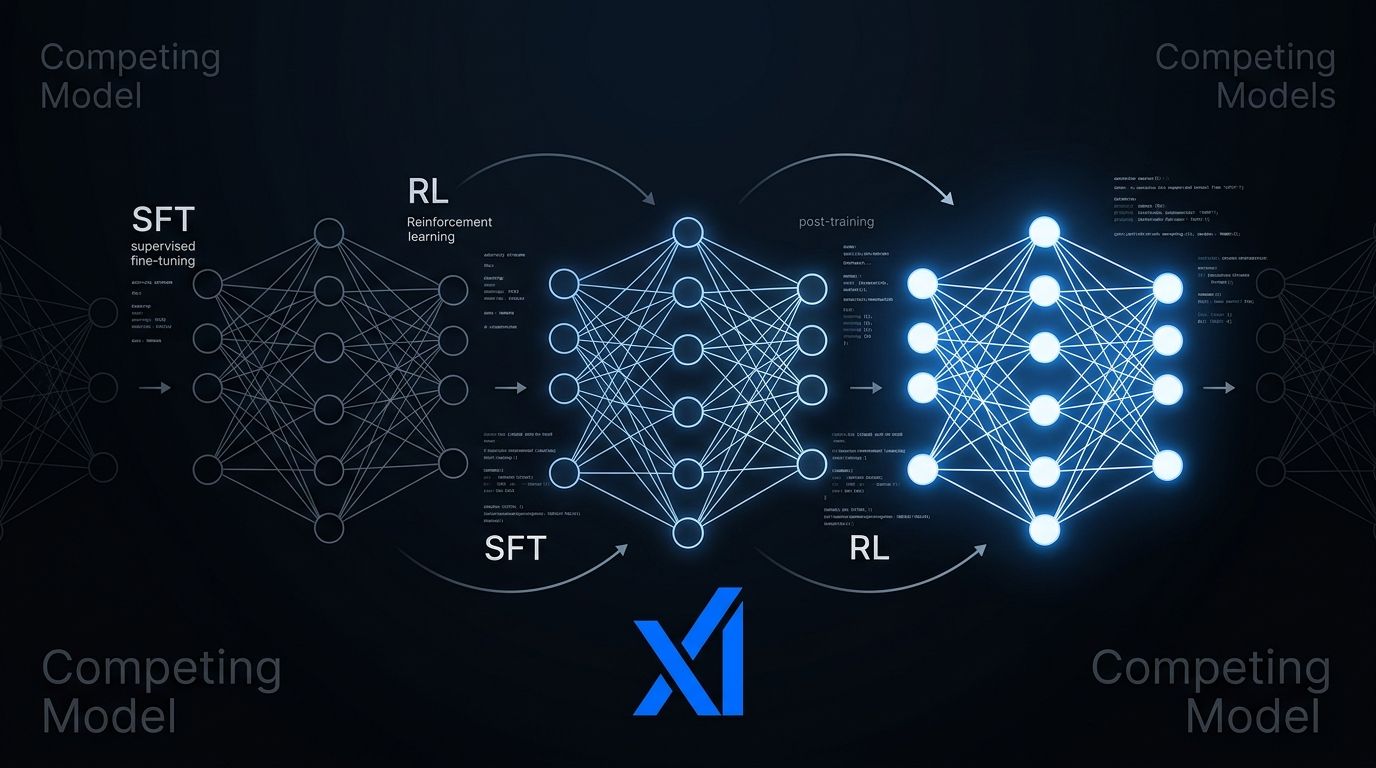
On August 7, xAI shipped two products at once. Grok 4.6, a language model that did not get bigger. And Imagine Image 2.0, an image model that still does not have a public API. The first one is the story. Rather than race Kimi K3‘s 2.8 trillion parameters or match Claude Opus 4.8’s context window, xAI held the 1.5 trillion-parameter V9 foundation constant and put the entire upgrade budget into post-training — better supervised fine-tuning, better reinforcement learning. This is not a quiet patch. It is a strategic thesis.
Same Model. Better Training. #
Grok 4.6 runs on the same V9 foundation as Grok 4.5. What changed is everything done to the model after pretraining. xAI invested in improved SFT (supervised fine-tuning) and RL (reinforcement learning), targeting better instruction following, cleaner code output, and more reliable reasoning. The result is a model that uses its existing capacity more efficiently, rather than one that simply has more capacity to be inefficient with.
This is not a surprising direction. The industry is hitting what researchers call the data wall: the supply of high-quality human text for pretraining is saturating. The companies making the most visible progress in 2026 are the ones with better post-training pipelines, better reward models, and more compute dedicated to the RL loop. Grok 4.6 is xAI’s public demonstration of that thesis — proof that targeted post-training gains are real before they scale the base model further.
The Pricing Case #
For developers, the most concrete argument for Grok 4.6 is cost. At $2 per million input tokens and $6 per million output tokens, it is priced well below its direct competitors:

| Model | Input (per 1M) | Output (per 1M) | Context |
|---|---|---|---|
| Grok 4.6 | $2.00 | $6.00 | 500K | | Kimi K3 | $3.00 | $15.00 | 1M | | Claude Opus 4.8 | $5.00 | $25.00 | 1M |
The price gap is significant, but the more important number is token efficiency. On SWE-Bench Pro, Grok 4.5 resolved tasks using an average of 15,954 output tokens, against 67,020 for Claude Opus 4.8. That is roughly 4x fewer tokens per task. A model priced at one-quarter the output rate that also generates one-quarter the tokens is not just cheaper — it is dramatically cheaper for high-throughput agentic workloads.
Where the Benchmarks Land #
Benchmark results for Grok 4.6 specifically have not been published yet, but the 4.5 baseline tells a useful story. On SWE Marathon, which measures real-world software engineering across long task horizons, Grok 4.5 led at 29.0% against Claude Opus 4.8’s 26.0%. On Terminal-Bench 2.1, which covers shell-driven agentic tasks, Grok led again at 83.3% versus 78.9%.
Where Opus 4.8 has the edge is SWE-Bench Pro, the repo-scale bug-fixing benchmark, where it sits at 69.2% versus Grok’s 64.7%. If your primary use case is precise, constrained bug fixing across an existing repository, Opus is still more accurate. If you are running long agentic pipelines, orchestrating multi-step tasks, or operating at high throughput, Grok 4.6 is the better economic and performance choice.
The Context Window Trade-Off #
Grok 4.6 caps at 500,000 tokens. Claude Opus 4.8 and Kimi K3 both reach 1 million tokens. For most developers, 500K is enough — typical agentic tasks, code generation sessions, and RAG pipelines rarely approach that ceiling. Where it matters: ingesting an entire large codebase in a single context, processing very long documents end-to-end, or running full-conversation memory at enterprise scale.
Kimi K3 has a secondary advantage worth noting: flat pricing across its full 1M token context (no surcharge for long contexts) and a 90% discount on cached input tokens at $0.30 per million. For workloads that lean heavily on caching, that changes the cost math significantly.
Imagine Image 2.0: Watch the API #
The second August 7 launch, Grok Imagine Image 2.0, ranks second globally on the Arena image editing and text-to-image leaderboards. Its headline capabilities are precision region editing (the Magic Wand feature), sharp text rendering across dense layouts, and multi-reference generation supporting up to five input images in a single pass. For developers building product photography pipelines or consistent game asset generation, the multi-reference support is genuinely useful.
API access is not live yet. xAI has said “coming soon” without a date. The underlying model already exists in xAI’s API infrastructure at $0.05 per image for the quality tier — so the access question is one of documentation and formal release, not technical readiness. Developers building image workflows should add this to their shortlist now.
What Comes After #
Grok 4.7 is on the roadmap for late August or early September. It moves to a new 2.1 trillion parameter foundation — a genuine scale-up. Musk described it as better than 4.6 in every way, with the trade-off of slightly slower serving and improved token efficiency. The implication for developers: Grok 4.6 is a stable, cost-effective choice for production use today, and the migration path to 4.7 should be straightforward when it arrives.
The model war is compressing. xAI is shipping faster than most, pricing lower than most, and now publicly backing post-training as the lever that matters. Whether Grok 4.6 genuinely closes the gap on Opus 4.8 will depend on benchmarks that have not dropped yet. But for agentic workloads at scale, the pricing alone makes it worth running the evaluation.