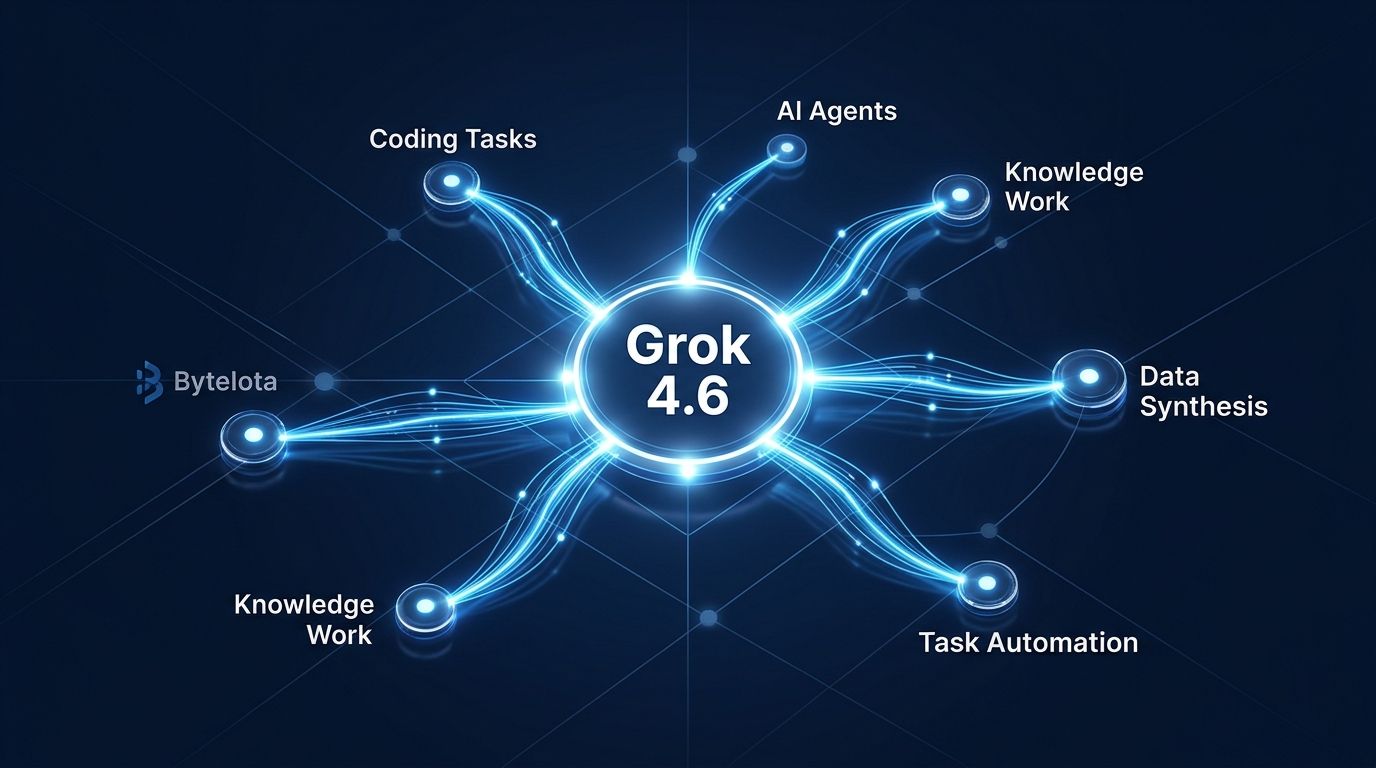
SpaceXAI released Grok 4.6 yesterday. It scores 61 on the Artificial Analysis Intelligence Index — tied with GPT-5.6 Sol Max, one point behind Claude Fable 5 Max — and starts at $2 per million input tokens. That is a competitive offer at this benchmark tier. Now read the fine print.
What Actually Changed from Grok 4.5 #
Grok 4.6 is not a new base model. SpaceXAI held the foundation constant and invested in a longer supplemental training run, regenerated fine-tuning trajectories, and reinforcement learning across agentic coding environments. The result is meaningful improvement in specific areas:
- DeepSWE v1.1 jumped from 54% to 65.9% — a real coding capability gain
- A new
xhigh
reasoning tier, above the ceiling Grok 4.5 shipped with - Better self-verification on long-horizon tasks — the model checks its own work before moving forward on multi-step sequences
- Stronger first passes on visual and interactive projects
What did not change: the $2/$6 standard input/output pricing and the 500,000-token context window. What got more expensive: cached input, up 67% from $0.30 to $0.50 per million tokens on standard requests. If your agent loop depends heavily on prompt caching, that is a cost line worth revisiting before you migrate.
The 200K Pricing Cliff You Need to Know About #
Here is the detail the launch coverage largely glossed over. That $2/M input rate applies only to prompts under 200,000 tokens. Once a single request crosses that threshold, the rate for every token in the request doubles — input, cached input, and output — to $4/$1/$12 per million.
This is not an overflow fee. It applies to the whole request. A prompt of 180K tokens with 20K output costs roughly $0.48. Grow that prompt to 200K tokens with the same output and the bill jumps to about $1.04 — a 117% increase for 20K extra tokens. The 500K context window is technically real, but the standard-rate zone covers only the first 200K. Plan accordingly: monitor context size, implement compaction before 195K tokens, and use the x-grok-conv-id
header or prompt_cache_key
on every request. Without them, caching is unreliable and full input pricing applies.
Where It Stands on Benchmarks #
The headline score of 61 on the Artificial Analysis Intelligence Index is accurate but needs context. xAI benchmarks Grok 4.6 at its default high
reasoning effort while comparing against competitors measured at their maximum tiers. It is not a straight comparison.
On coding specifically: the 65.9% DeepSWE score is the biggest measurable improvement over 4.5 and represents a genuine capability jump. Terminal-Bench is a weak spot at 26% — Codex CLI scores roughly three times higher there. If shell and terminal task automation is central to your workflow, that gap is significant. Grok Build, the agent harness built on Grok 4.6, posts 95.60% on SWE-bench Verified in third-party testing, though agent harness scores reflect the full system — scaffolding, tooling, and retry logic — not the model alone.
How to Access Grok 4.6 #
The model is available now across multiple surfaces:
**API:** Model ID`grok-4.6`

via the[xAI API](https://docs.x.ai/developers/grok-4-6)**IDE:** Default model in Cursor (all plans) and Grok Build**Routing:** Available via OpenRouter, Vercel, and Cloudflare
The first-week launch offer gives 2x included usage on Cursor and Grok Build. There are no open weights and no self-hosting path — this is API-only.
Who Should Try It Now #
Grok 4.6 makes the most sense for teams that need frontier-quality reasoning at a lower per-token cost and can keep prompts under 200K tokens. At $2/M input, it undercuts most alternatives at this benchmark tier. The native Cursor integration lowers friction for individual developers already using the editor.
Teams deep in Claude Code or Codex CLI workflows have a harder case for switching — the benchmark differences at this level fall within noise, and migration cost is real. The stronger argument is for new agentic projects starting from scratch, where no infrastructure lock-in exists yet. SpaceXAI designed Grok 4.6 specifically for long-running, multi-step agent tasks, and at this price point, it is worth a serious pilot.
One last note: Musk announced Grok 4.7 is “significantly better” and 3-4 weeks away. If you are not under deadline to pick a model, comparing both before locking in agent infrastructure is a reasonable call.