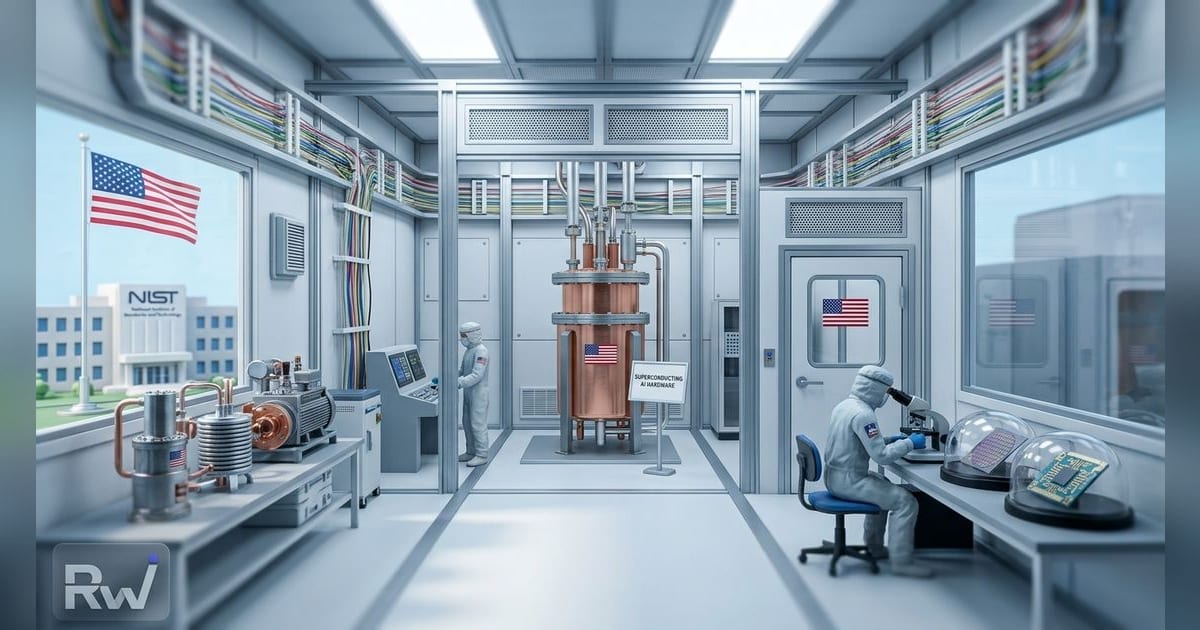
Jeffrey Shainline has secured nearly $25.91 million for Great Sky, the Boulder startup carrying his decade-long research into superconducting AI hardware out of a federal laboratory and toward commercial-scale systems.
A Form D filed with the Securities and Exchange Commission on July 23 shows that Great Sky has sold $25,907,182 of a planned $30.72 million securities offering to 17 investors. The first sale occurred on July 10. The filing lists no commissions or finders' fees.
The offering is divided into a $20.72 million Series Seed component, with $20.12 million sold, and a $10 million SAFE component, with $5.78 million sold. Great Sky has $4.81 million left to sell across the two instruments.
The filing is a notice of securities sales, rather than an announcement that the entire financing has closed. It does not disclose the investors or Great Sky's valuation. It does establish that Shainline has assembled a substantially larger pool of capital than the $14 million seed financing Great Sky disclosed when it emerged publicly in March.
A larger bet after 12 years at NIST
Shainline founded Great Sky in late 2024 after nearly 12 years at the National Institute of Standards and Technology in Boulder. He earned a physics degree from the University of Colorado Boulder and a doctorate in physics from Brown University, where he worked on integrated photonics. NIST later recognized him with a 2024 Presidential Early Career Award for Scientists and Engineers for his work on low-power neuromorphic computing.
At NIST, Shainline began combining superconducting circuits, single-photon detectors and integrated photonics into neural networks. He has described the initial work as an unofficial line of inquiry that grew into a patent and a research program. The federal laboratory supplied the cleanroom, technical expertise and long time horizon needed to test an architecture that no commercial foundry was set up to produce.
Shainline left NIST with three researchers who had worked on that program: CTO Jeffrey Chiles, fabrication chief Saeed Khan and architecture chief Bryce Primavera. Great Sky's public team page now lists about 16 operating employees, though Great Sky has not formally disclosed its headcount.
In a founder-authored account of Great Sky's origins, Shainline wrote that NIST was the right setting to conceive and de-risk the technology, while a startup offered the capital and operating focus required to manufacture products. The new offering funds that second stage of the project.
Great Sky's earlier $14 million seed was led by Bison Ventures, with Matchstick Ventures, Range Ventures, Bluebirds SVM Limited, Access Venture Partners, Olive Tree Capital, Buff Gold Ventures, Mythos Ventures, Wireframe Ventures and Service Provider Capital among the institutional backers identified by Great Sky. The disclosed angels included Mark Leslie, Adam Pritzker and Ivan Vendrov.
The July filing names Bison founding partner Tom Biegala and Ayar Labs co-founder Mark Wade as Great Sky directors, alongside Shainline. It does not establish whether any previous backer participated in the current offering. The $14 million announcement and the new $30.72 million offering should not be added together as a total raised without confirmation of how the financings relate.
Great Sky filed a separate Form D on September 26, 2025, for a $6.51 million offering, of which $3.01 million had been sold to 14 investors at the time. The July filing is marked as a new notice, carries a different SEC file number and reports a July 10, 2026 first-sale date.
Computing with superconductors and communicating with light
Great Sky calls its architecture a superconducting optoelectronic network, or SOEN. The design uses Josephson-junction circuits to perform neuron- and synapse-like computations, places memory close to those circuits and sends signals through photonic waveguides. Single-photon detectors receive the optical signals.
The premise attacks two constraints in conventional AI systems: moving model data between processors and memory, and routing information electrically across large clusters. Shainline's published research argues that optical links can give artificial neurons thousands of direct connections while superconducting circuits perform fast, low-energy computations.
Great Sky says its first chips are running inference. Great Sky also claims that its early hardware can process 60 million video frames per second and that it completed four chip tapeouts in 15 months for less than $4 million. Those figures come from Great Sky and have not been established through independent benchmarking. Great Sky has not publicly identified commercial customers, revenue, production volumes or system pricing.
The architecture carries engineering costs that explain the size of the financing. Its circuits operate at cryogenic temperatures near 4 kelvin. Great Sky must integrate superconducting electronics, semiconductor light sources, detectors and dense optical routing, then connect chips and wafers without giving back the promised energy and latency gains at the system level.
Shainline's research has treated cooling as a manageable trade-off because cryogenic single-photon detectors can register signals that would require many more photons at room temperature. Great Sky still has to prove that advantage in complete, manufacturable systems rather than isolated components or small neural networks.
From laboratory chips to larger systems
The filing arrives as Great Sky begins putting its hardware into government-backed research programs. On July 22, Great Sky said it had been selected for the first phase of the Department of Energy's Genesis Mission, working with Brookhaven National Laboratory on systems for processing data from facilities such as fusion reactors, particle colliders and synchrotrons.
The nine-month project is expected to test chip-to-chip optical communication, larger on-chip photonic networks and neural systems for predicting disruptions in fusion experiments. The work gives Great Sky a technically demanding application for its architecture while its broader commercial market remains unproven.
That sequence defines Shainline's immediate task. NIST gave the founding team years to establish the underlying physics. The previous seed financed the formation of Great Sky, its first hires and early tapeouts. The new securities offering gives Shainline considerably more room to turn a working inference chip into a repeatable computing platform.
Investors are financing a long hardware program with cryogenic infrastructure and fabrication risk, rather than a software product that can reach customers through a cloud account. Great Sky's advantage is that its founders spent more than a decade building the underlying technology before forming the corporation. The next proof will come from manufacturing larger systems, running useful workloads and showing that performance survives outside the laboratory.