Graphs move from niche database to enterprise knowledge layer for AI systems
As generative AI matures beyond its early experimentation phase, enterprises are converging on a shared architecture for grounding large language models in trustworthy data: the enterprise knowledge layer.
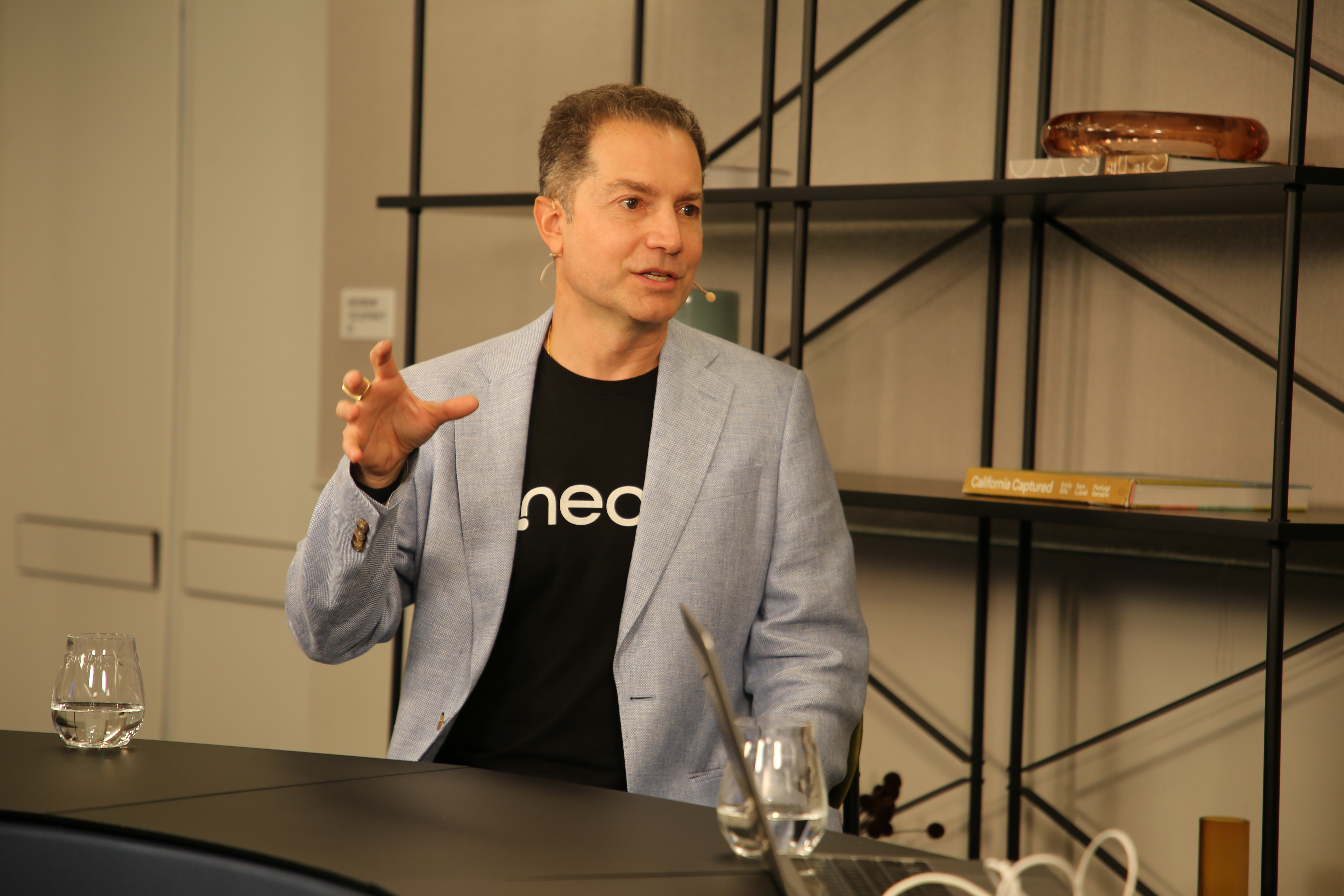
Four years after the release of ChatGPT, most organizations have moved past haphazard experimentation and settled on a shared vocabulary and set of architectural patterns for production AI systems, according to Philip Rathle (pictured), chief technology officer of Neo4j Inc. That shift is placing the enterprise knowledge layer — the substrate where an organization’s ontology, data and agent memory live outside the model itself — at the center of enterprise AI conversations.
“Enterprise knowledge layer is the big topic,” Rathle said. “GraphRAG describes the pattern of having an LLM call out to a knowledge graph so that you externalize your knowledge in context. It doesn’t live in the model. It lives in a system of knowledge. And that gives you better accuracy, explainability and governance.”
Rathle spoke with theCUBE’s John Furrier at the Neo4j GraphTalk event, during an exclusive broadcast on theCUBE, SiliconANGLE Media’s livestreaming studio. They discussed the evolution of GraphRAG, new independent research on graph-based retrieval, and the anatomy of the enterprise knowledge layer. ( Disclosure below.)*
Independent research backs the enterprise knowledge layer
Neo4j, whose graph intelligence platform is increasingly framed as connective tissue for AI agents and decision intelligence, is leaning on outside validation to make its case. The UK’s National Innovation Centre for Data recently compared the two leading techniques for improving agent reliability and found that GraphRAG dramatically outperforms vector-only retrieval, with agents 80% more “truthful” and answering over twice as many questions, while using tokens more efficiently.
“We’ve had lots of evidence through our customers that GraphRAG improves accuracy, provides governance, improves explainability,” Rathle said. “But it’s always really nice when you can have a third-party, world-class academic institution do some research, because then you can understand the why behind it.”
That accuracy translates directly into economics once systems reach production, Rathle noted, since a knowledge graph is often the difference between a proof of concept stalling and a system delivering measurable value. A recent engagement with a national tax agency illustrates how quickly that value can surface once data is modeled as a graph rather than flattened into tables.
“48 hours from the start of a POC, they identified more than $100 million in tax fraud,” Rathle said. “If you generalize it, if you’ve been walking around limited with your blinders because you’re looking at this data in 2D, you bring the data into a graph view and all of a sudden all these things become blindingly obvious, which before you just simply couldn’t see.”
Here’s the complete video interview, part of SiliconANGLE’s and theCUBE’s coverage of the Neo4j GraphTalk event 2026:
( Disclosure: TheCUBE is a paid media partner for the Neo4j GraphTalk event. Neither Neo4j, the sponsor of theCUBE’s event coverage, nor other sponsors have editorial control over content on theCUBE or SiliconANGLE.)*
Photo: SiliconANGLE
Support our mission to keep content open and free by engaging with theCUBE community. Join theCUBE’s Alumni Trust Network, where technology leaders connect, share intelligence and create opportunities.
15M+ viewers of theCUBE videos, powering conversations across AI, cloud, cybersecurity and more** 11.4k+ theCUBE alumni**— Connect with more than 11,400 tech and business leaders shaping the future through a unique trusted-based network.
About SiliconANGLE Media
theCUBE AIand theCUBE SuperStudios — with flagship locations in Silicon Valley and the New York Stock Exchange — SiliconANGLE Media operates at the intersection of media, technology and AI.
Founded by tech visionaries John Furrier and Dave Vellante, SiliconANGLE Media has built a dynamic ecosystem of industry-leading digital media brands that reach 15+ million elite tech professionals. Our new proprietary theCUBE AI Video Cloud is breaking ground in audience interaction, leveraging theCUBEai.com neural network to help technology companies make data-driven decisions and stay at the forefront of industry conversations.