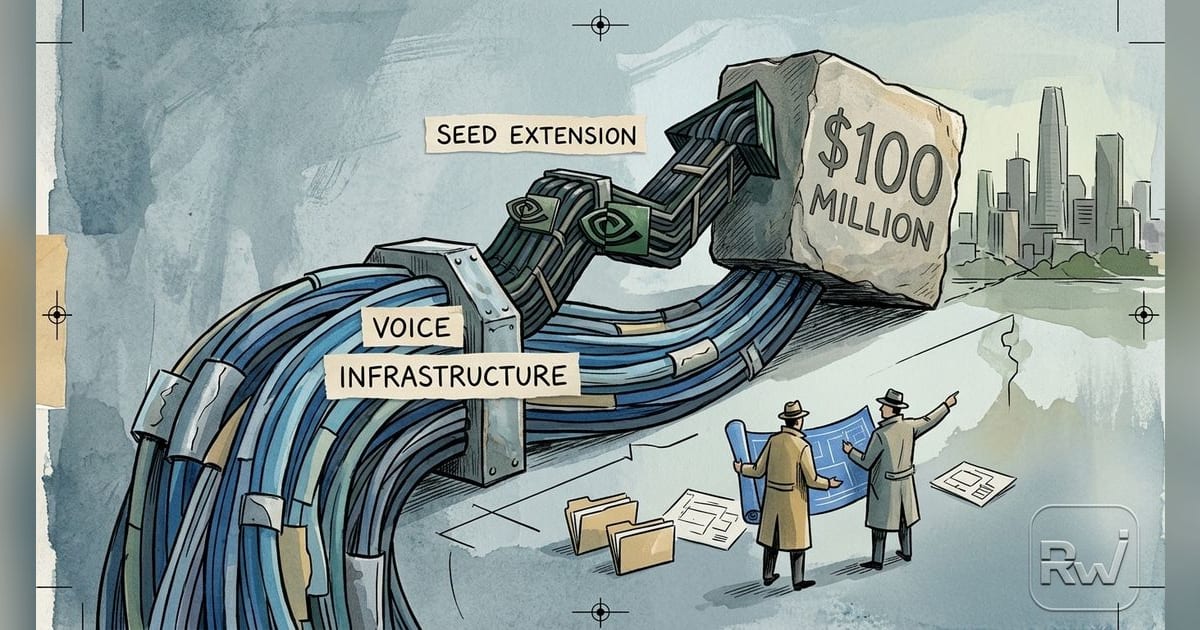
Gradium co-founder and CEO Neil Zeghidour has extended the Paris voice AI startup's seed financing to $100 million, adding Nvidia (@nvidia) as a new investor and opening a San Francisco Bay Area office, according to a July 8th Gradium announcement and an Aligned News post on X.
The financing is an extension of Gradium's seed round, rather than a newly labeled Series A. Gradium launched publicly on December 2nd, 2025 with a $70 million seed led by FirstMark Capital and Eurazeo, with DST Global Partners, Eric Schmidt (@ericschmidt), Xavier Niel, Rodolphe Saade, Korelya Capital, Amplify Partners, Liquid2, Drysdale Ventures and several angels participating, according to Gradium's launch post. The new headline number means Gradium has brought the seed total to $100 million. Gradium has not disclosed the valuation, the incremental amount supplied by Nvidia, or whether Nvidia's participation includes compute credits, preferred hardware access, technical collaboration, or equity financing alone.
Zeghidour is the center of the investor bet. Before Gradium, he was a founding member and chief modeling officer at Kyutai, the Paris open-science AI lab backed by Niel, Saade and Schmidt. Gradium says Zeghidour, Laurent Mazare, Olivier Teboul and Alexandre Defossez founded Gradium in September 2025 after building at Kyutai, Google Brain, Google DeepMind, Meta and Jane Street. Gradium's own origin story is direct: years of generative audio research are being turned into production APIs for developers and enterprises.
The Kyutai-to-Gradium path
Gradium's pedigree matters because voice agents fail in places that demo videos usually hide: latency, turn-taking, interruptions, speech recognition errors, accents, domain-specific terms, speech synthesis quality and inference cost. Kyutai's Moshi work, released in 2024 as a real-time full-duplex spoken dialogue model, gave Gradium's founders a research base in live speech systems before Gradium started selling enterprise APIs.
Gradium now describes itself as the backbone for voice applications. Gradium's current product surface includes streaming text-to-speech, speech-to-text, live translation, voice cloning, on-device text-to-speech and agent tooling. Gradium's docs list 237 voices across five languages, while Gradium's pricing page shows a free tier and paid self-serve plans at $13, $43, $340 and $1,615 per month, plus enterprise pricing.
That pricing page is the clearest evidence that Gradium is not trying to stay a lab project. Gradium is packaging voice models like developer infrastructure: credits, concurrency limits, studio access, API access and commercial-use tiers. That matters because the buyer is not a podcast creator alone. Gradium is trying to reach teams building customer support agents, healthcare assistants, game characters, translation tools, media workflows and consumer apps.
Gradium says it generated revenue within weeks of launch and has enterprise customers across customer experience, healthcare, media, AI agents and consumer apps. TechCrunch reported that Renault is among Gradium's customers. Gradium has also announced an enterprise interpreting partnership with Acolad, combining Gradium's speech models with Acolad's language, data and operational work for enterprise and public-sector interpreting use cases.
Why Nvidia matters here
Nvidia's check is strategically useful even without disclosed commercial terms. Real-time voice infrastructure is compute-sensitive: a voice agent has to listen, transcribe, decide, call tools, generate language and speak back fast enough that a user does not feel the lag. Every extra model hop adds cost and delay. A voice API provider that can run more efficiently, reduce latency and secure GPU capacity has a practical advantage over a voice app maker stitching together third-party parts.
Gradium's Bay Area office is part of the same move. Gradium was born in Paris, backed by European technical and investor networks, then moved quickly toward the market where AI platform buyers, model labs and senior infrastructure talent are concentrated. TechCrunch noted that the Bay Area office puts Gradium closer to Anthropic, Google, Meta and OpenAI. Gradium's July 8th announcement says the office will support international expansion and product development.
The move also puts Gradium deeper into a competitive market that is already capitalized. ElevenLabs was valued at $11 billion after a $500 million Series D earlier in 2026. Deepgram announced in January that it had raised $130 million in Series C funding at a $1.3 billion valuation for its real-time voice AI API platform. Gradium is also competing with model providers that already bundle speech, transcription and real-time APIs into larger AI platforms.
The seed round buys time, not proof
A $100 million seed gives Zeghidour and his co-founders room to hire, train and serve models, open the Bay Area office and keep expanding the API surface. It also raises the operating bar. Voice infrastructure companies need scale before their unit economics become clear, because production customers care about reliability, latency, pricing, compliance and support as much as model quality.
Gradium's open questions are the ones that decide whether the round becomes a company. Gradium has not disclosed ARR, retention, gross margin, customer count, headcount, compute commitments or valuation. Gradium says demand arrived quickly after launch, and the early Renault and Acolad references give Gradium credible enterprise proof points. The harder test is whether Gradium can turn a research-derived voice stack into repeatable enterprise contracts while competitors with larger distribution push voice deeper into existing developer accounts.
The timing fits a larger shift in agent building. RuntimeWire reported in June that AGI House's builder calendar was moving toward agents and automation, with founders focusing less on model demos and more on live workflows. Gradium's bet belongs in that same pattern. Text chat is a sufficient interface for many software tasks. Voice becomes necessary when the agent needs to sit inside a call, a car, a headset, a classroom, a game, a clinic or a customer-support queue.
Zeghidour's bet is that voice will be infrastructure, and that the winners will be teams that solve the parts users notice immediately: delay, interruption handling, expression, language coverage and reliability. Nvidia's participation gives Gradium more credibility with the market Gradium is chasing. The undisclosed valuation and deal terms keep the financing from answering the commercial question. Gradium has capital, research lineage and a Bay Area beachhead. The next measure is whether developers and enterprises keep using Gradium when a live conversation has no tolerance for a laggy model call.