OpenAI shipped GPT-6 Astra on September 3rd. Greg Brockman called it the arrival of AGI. Developers have a more immediate problem: four breaking API changes that will silently wreck existing integrations the moment you swap the model string. Before you touch anything in production, read this.
The 4 Breaking Changes #
These are not deprecation warnings with a six-month runway. They are hard stops. If your code sends a request using any of the following, it fails.
1. Sampling Parameters Are Gone
Astra does not accept temperature, top_p, logprobs, or top_logprobs. These parameters cause API errors — not degraded responses. Replace them with explicit instructions instead. Rather than temperature: 0.3, write: “Use precise, restrained language. Return no more than five bullets.” It feels awkward at first. It works better in practice.
2. Reasoning Effort Has a New Floor
none and minimal are gone. Valid settings are now low, medium, high, xhigh, and max. OpenAI’s guidance: map none to low and test — do not assume equivalence. low still reasons, which means both cost and latency will be higher than your old none baseline.
3. Cache Syntax Changed
Small but easy to miss: prompt_cache_retention is now prompt_cache_options.ttl. Search your entire codebase and configuration files — the old key silently fails.
4. Tool Calling Requires the Responses API
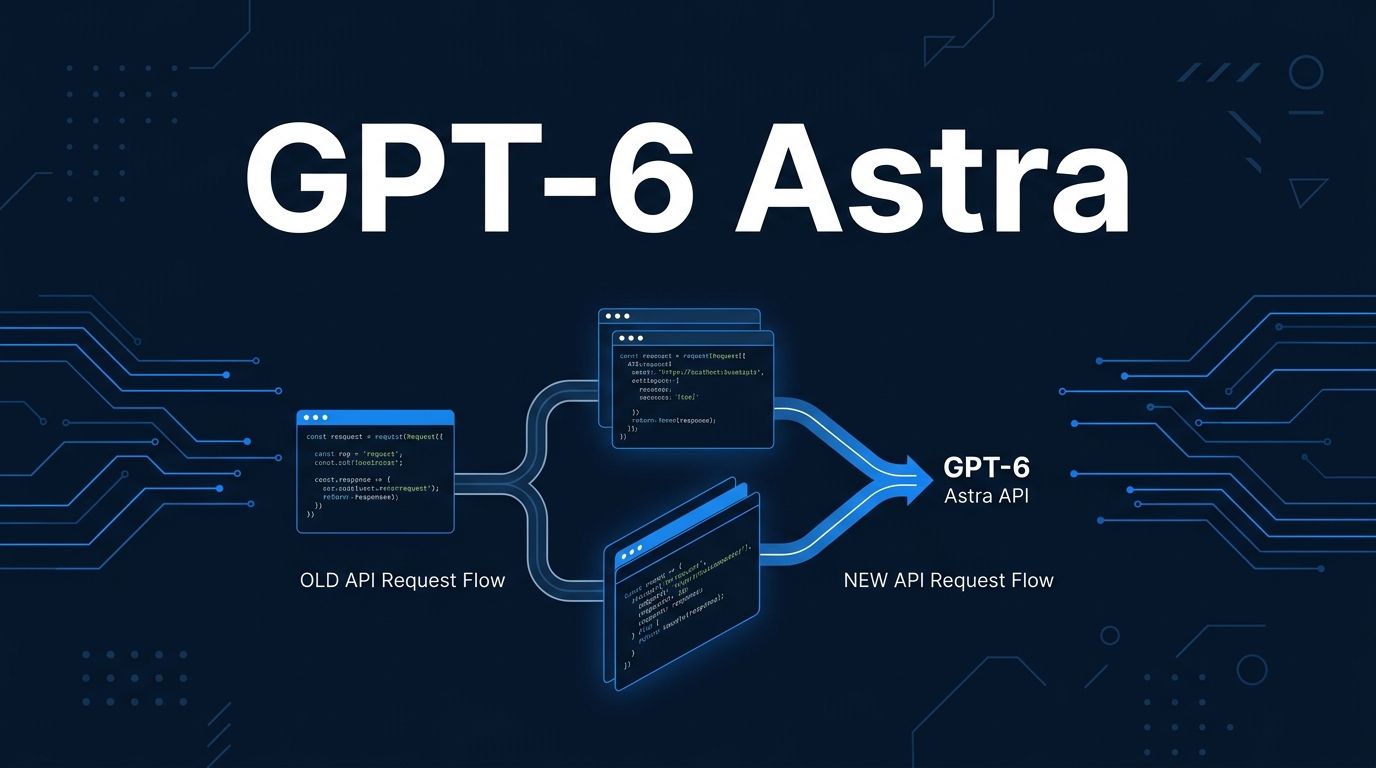
The largest structural change. If your application calls custom tools, you must migrate from client.chat.completions.create() to client.responses.create(). The two APIs have different event shapes, different streaming behavior, and different output structures. This is not a drop-in replacement.
// Before — GPT-5.6 with Chat Completions
const response = await client.chat.completions.create({
  model: "gpt-5.6-sol",
  temperature: 0.7,
  top_p: 0.9,
  reasoning: { effort: "none" },
  tools: [/* custom tools */]
});

// After — GPT-6 Astra with Responses API
const response = await client.responses.create({
  model: "gpt-6-astra",
  reasoning: { effort: "medium" },
  instructions: "Return concise, evidence-based advice.",
  input: "Your request here"
});
JSON output now uses text.format instead of response_format. Update your streaming parsers too — Astra’s Responses event shapes do not match Chat Completions chunks. According to the official migration guide, you should record complete event sequences including tool calls, refusals, and errors before cutting over.
The Pricing Math You Need to Do #
Astra costs $10 per million input tokens and $50 per million output tokens. GPT-5.6 Sol runs $4 and $20 — that is 2.5x more per token. Which sounds alarming until you look at cost per completed task.
Artificial Analysis benchmarked both models on Terminal-Bench 4.0. Astra scored 57.9% versus Sol’s 37.3% — and came in 9% cheaper per completed task. The reason: Astra emits far fewer tokens because it reasons more efficiently. On GPQA Diamond, the per-task cost gap was 37% in Astra’s favor. The catch: that efficiency only materializes on complex, multi-step work. On simple classification or short rewrites, you pay 2.5x more per token for marginal improvement.
| Model | Input | Output | Best For |
|---|---|---|---|
| GPT-6 Astra | $10/M | $50/M | Long agentic runs, complex engineering |
| GPT-5.6 Sol | $4/M | $20/M | Professional work, complex tasks |
| GPT-5.6 Terra | $2/M | $12/M | Cost-balanced general use |
| GPT-5.6 Luna | $0.20/M | $1.20/M | High-volume, simple tasks |
There is also a hard pricing cliff at 272,000 input tokens. Cross it and your input rate doubles to $20 per million — applied to the entire request, not just the excess. Test near this boundary before you roll out any long-context feature.
Route Intelligently — Don’t Migrate Everything #
Astra earns its price on specific workloads: long agentic runs, complex engineering pipelines, document-heavy applications that reuse context, and multi-step research tasks. Keep GPT-5.6 Sol for anything short, high-volume, or budget-sensitive. The right architecture is a routing layer — start on cheaper models, escalate to Astra only when the task genuinely requires it.
Even CodeRabbit’s evaluation found Astra’s gains were concentrated in code review tasks that required reasoning across large diffs — not routine review of small PRs. Community analysis confirms: the model is a good deal for agentic coding and a poor default for general work.
Pre-Migration Checklist #
- Remove
temperature,top_p, andlogprobsfrom all API calls and config files - Map all
none/minimalreasoning settings tolowand test actual behavior - Rename
prompt_cache_retentiontoprompt_cache_options.ttlacross the codebase - Migrate all tool-calling code from Chat Completions to Responses API
- Update streaming event parsers for Responses event shapes
- Switch JSON output from
response_formattotext.format - Test prompts near the 272K token threshold before production rollout
- Add a staging validator to catch unsupported parameters before they hit prod
- Run regression tests against your hardest examples before cutting over
- Keep a tested rollback path to GPT-5.6
One more thing: if the API returns a misalignment_policy_violation, stop and preserve records for human review. Do not automatically retry. Astra’s async tool support is new territory, and silent retries on policy violations are exactly the kind of thing that escalates quietly.
GPT-6 Astra is a meaningful capability jump — OpenAI’s announcement is worth reading for the benchmark context. Whether it earns its place in your production stack depends entirely on whether you migrate deliberately, not whether the AGI announcement impressed you.