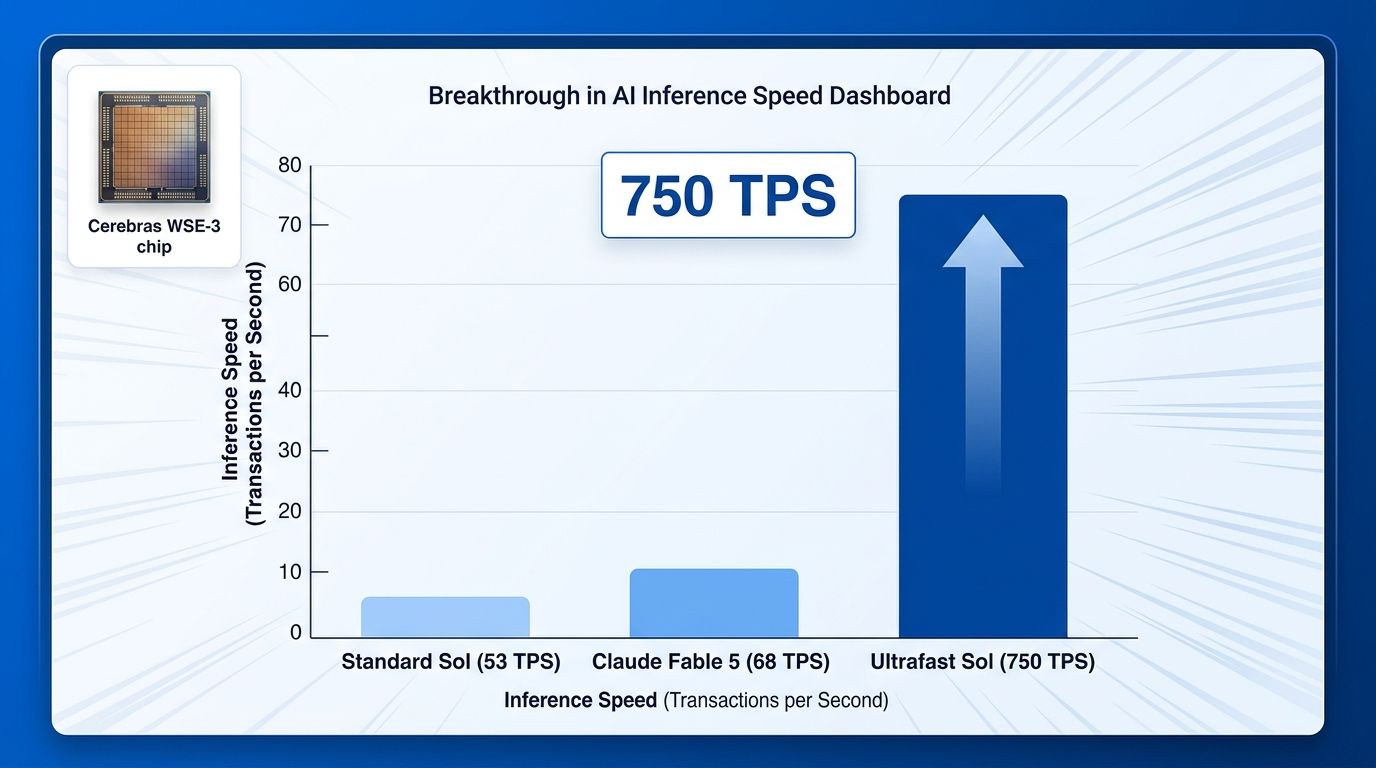
OpenAI and Cerebras announced on August 13 that GPT-5.6 Sol — OpenAI’s flagship frontier model — now runs at 750 output tokens per second through a new “Ultrafast” API tier. That’s 14 times faster than standard GPT-5.6 Sol inference and 11 times faster than Claude Fable 5. The catch: it’s limited preview only, pricing is undisclosed, and you likely can’t access it yet. Here’s what it means and what it doesn’t.
Same Model, Different Hardware #
This is not a distilled or compressed version of Sol. Ultrafast runs the complete GPT-5.6 Sol model on Cerebras’ Wafer-Scale Engine (WSE-3) — a chip built from nearly an entire 300mm silicon wafer. The WSE-3 packs 900,000 cores and 44GB of on-chip SRAM onto a single piece of silicon, which means model weights sit on-chip rather than shuffling between compute and external memory on every forward pass.
That memory movement is the bottleneck that limits GPU-based inference. Standard GPU setups constantly stream model weights from high-bandwidth memory during each inference call, and that round-trip adds latency at scale. Cerebras eliminates it. The result is 750 tokens per second on a frontier-class model where comparable GPU clusters top out around 53 TPS. Cerebras and OpenAI confirmed no quality tradeoff in their joint announcement — intelligence is identical to standard GPT-5.6 Sol.
What 750 Tokens Per Second Actually Unlocks #
Human reading speed is around 250 words per minute — roughly 6 tokens per second. At 750 TPS, GPT-5.6 Sol Ultrafast generates a 100-token response in 0.13 seconds, completing it before you’ve read the first word. That changes what’s buildable.
The early use cases being tested include incident response, fraud scoring, real-time voice AI, and financial analysis. About 70% of voice agent latency comes from LLM inference, so cutting generation time to sub-second per response directly improves call quality. Courtland Lykins at Podium called Ultrafast “invaluable for voice AI call experiences, especially complex tasks.” Alex Wang at Rogo said it makes “complex financial research feel like a live interaction.”
The broader case is for multi-step agent loops. If each step calls the model and waits, TPS directly determines how fast the loop runs. At 14x the standard speed, a 5-step agent workflow that took 30 seconds completes in roughly 2.
The Catch — Several of Them #
OpenAI has not disclosed pricing for Ultrafast. Standard GPT-5.6 Sol already costs $5 per million input tokens and $30 per million output tokens. Fast mode, the existing 2.5x speed tier, doubles that. What Ultrafast adds on top is unknown, though Cerebras’ specialized silicon suggests it won’t track standard cloud GPU prices.
Access is limited to selected API customers. There’s no self-serve sign-up, no published API endpoint, no confirmed general availability date. OpenAI’s $200/month ChatGPT Pro subscribers are excluded — this is API-only. The 750 TPS figure is vendor-claimed and has not been independently benchmarked by third parties like Artificial Analysis.
For developers who need speed today, alternatives are available now: Groq delivers the fastest open-model inference (Llama, Mistral) at public API prices. Claude Opus 5 Fast mode offers competitive throughput at meaningfully lower per-token cost. GPT-5.6 Fast mode is also accessible. None reach 750 TPS on a frontier model, but all ship today.
Why This Partnership Matters Beyond the Numbers #
OpenAI offering a production inference tier on non-NVIDIA hardware is notable. GPU clusters have been the default for frontier inference, and speed improvements have historically come from faster GPUs, not architectural rewrites. Cerebras CEO Andrew Feldman framed it directly: “Speed and intelligence are no longer mutually exclusive in AI development.”
That claim has been loosely true for open-weight models on Groq, but this is the first time it applies to a frontier closed model at production scale. Whether Cerebras can consistently run frontier models faster than GPU-based inference at competitive cost remains open — we won’t know until pricing is disclosed. That announcement will matter more than the speed claim.
Key Takeaways #
- GPT-5.6 Sol Ultrafast runs at 750 TPS on Cerebras WSE-3 — 14x faster than standard, with no reduction in model quality
- Limited preview only; no pricing disclosed; no self-serve API access or general availability date
- Primary use cases: voice AI, real-time agents, financial research, incident response
- Need speed now? Use Groq for open models, Claude Opus 5 Fast mode, or GPT-5.6 Fast mode — all available today
- Watch for the pricing announcement — that’s the real signal for most developers