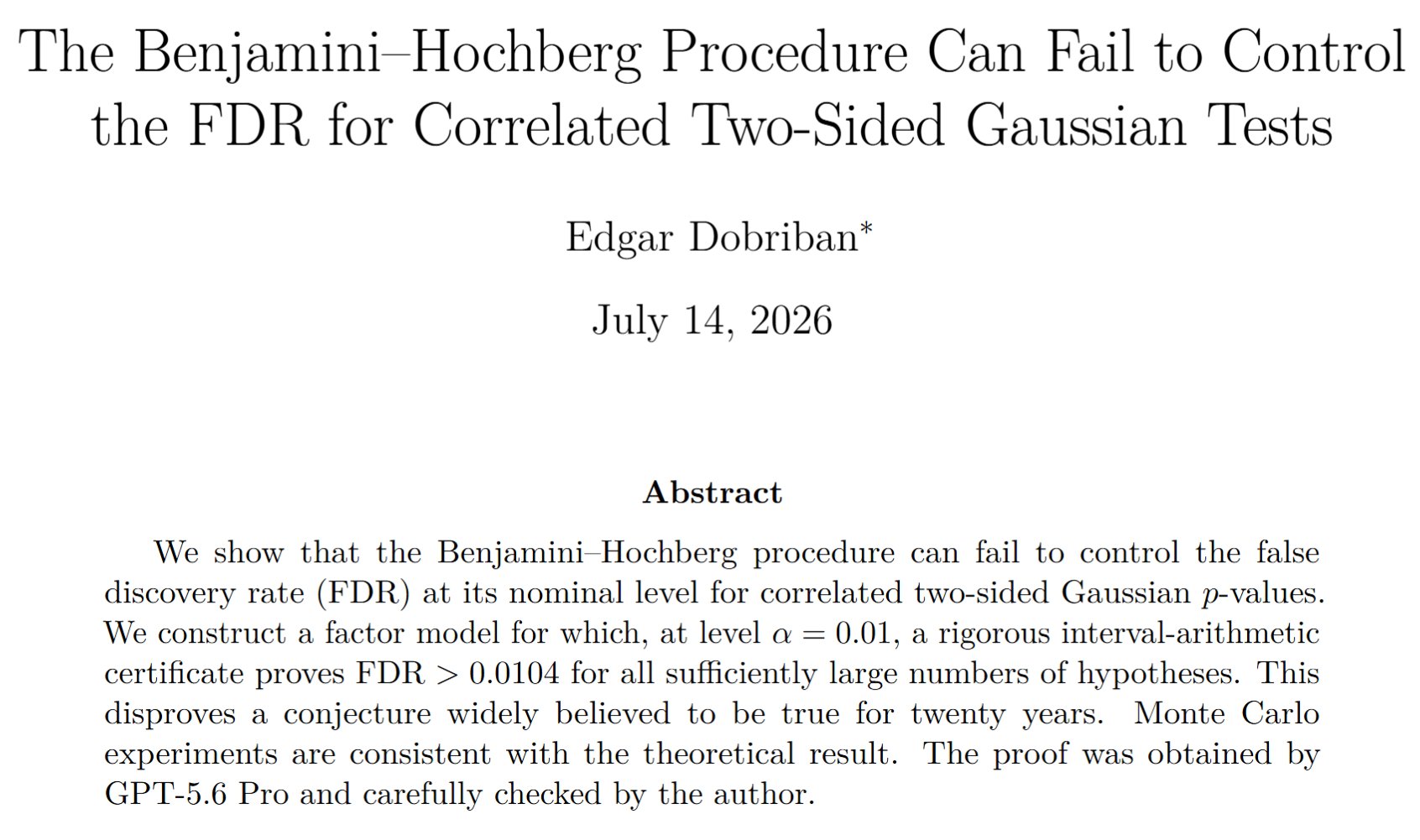
AI has helped resolve an important question in statistics. In the area of multiple hypothesis testing, the goal of controlling the false discovery rate (FDR) has been introduced in a seminal paper by Benjamini and Hochberg (1995). They also introduced a method (the Benjamini-Hochberg or BH method) and proved it controls the FDR. This method has been widely adopted in modern high-throughput science, including in genomics, astronomy, economics, etc. The paper has has garnered more than 130,000 citations to date. However Benjamini and Hochberg showed FDR control only when the data for the individual tests are independent. In practice, these data are often dependent; a good example is data on genetic variants due to linkage disequilibrium. Later work has focused on extending the validity of the BH procedure, e.g., to a form of positive dependence by Benjamini and Yekutieli (2001). The question of when the BH procedure controls the FDR has remained open. Over the last twenty years, many authors, including Reiner-Benaim (2007), Kim and van de Wiel (2008), Benjamini (2010), Sarkar (2023), Sarkar and Zhang (2025), have conjectured that the BH procedure controls the FDR for two-sided tests using any correlated Gaussian data. These authors have presented both theoretical and empirical evidence supporting, but not directly showing, the conjecture. With the help of AI (specifically GPT-5.6 Sol Pro), I have settled the question in the negative: The Benjamini-Hochberg procedure does not generally control the false discovery rate at the desired level for correlated two-sided Gaussian tests. This was done by exhibiting a Gaussian factor model for which, at a nominal level alpha=0.01, the false discovery rate is proved to be FDR>0.0104. There is a lot of interesting commentary to be made:
- This result should be of interest to everybody in the field of statistics. Emmanuel Candes of Stanford University once called the false discovery rate and the Benjamini-Hochberg procedure "one of the two most important developments in statistics after 1950" (the other being James-Stein shrinkage). The present conjecture is probably the most central question about FDR/BH that was unresolved to date.
- GPT-5.6 one-shot the problem after 90 minutes of reasoning, whereas with 5.5 I was not able to solve it even after iterating with multiple parallel agents for perhaps 20 hours. So the capability improvement is quite real. Exciting times to live in!
- The argument is not especially surprising, but it does combine an asymptotic approach (standard for FDR analysis, see e.g., Genovese and Wasserman, Efron, etc) with a numerical certificate in a way that would be pretty non-standard in the field. Once we have the specific example, then straightforward simulations also support that the false discovery rate is indeed higher than the nominal value (see attached fig).
- The current degree of violation over the nominal level is relatively small (0.104 vs 0.1). So the importance of this result is mainly conceptual. The practical implications remain to be determined. Overall, an exciting development! Preprint is available here (