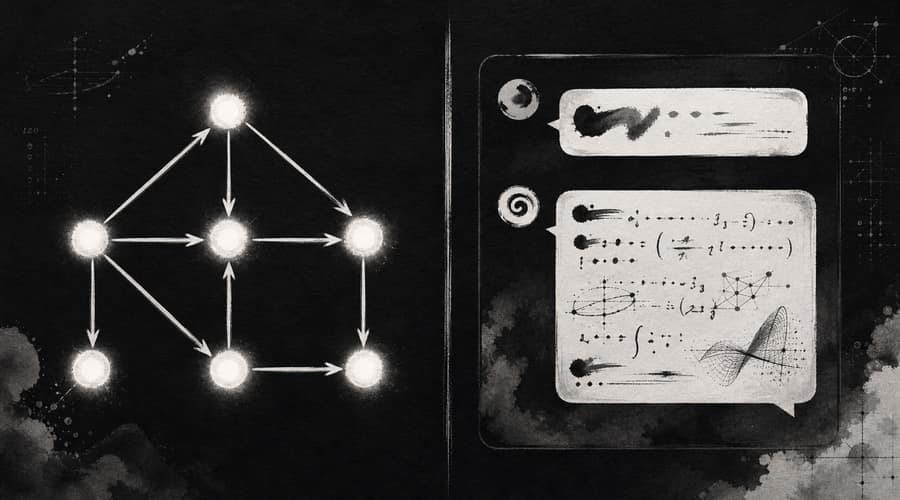
In the span of a few days, two AI models independently produced counterexamples to the Dinitz-Garg-Goemans conjecture, a network optimization problem open since 1999, using a handful of casual prompts. The mathematical community has not yet verified either result.
Dmitry Rybin, a mathematician and Ph.D. graduate of the Chinese University of Hong Kong, Shenzhen, typed four prompts into GPT-5.6 Pro last week. The instructions were barely instructions at all: "make a breakthrough," "disprove the general case," "continue exploring." Fifty-eight words total. The model returned a 7-node, 9-edge directed graph showing a fractional flow costing 58 where any unsplittable flow costs at least 60, directly contradicting a conjecture that has shaped network-optimization research for roughly three decades. That's the whole prompt. Around the same time, a team running Capy, an AI agent built on Grok 4.5 Medium, shared news of the same problem in a Slack channel. The agent decided, apparently of its own initiative, to take a shot at it. Eight minutes later it had a counterexample. Elon Musk posted on X: "Grok 4.5 just solved a graph theory conjecture that has been open for ~30 years."
Two models. Same conjecture. Neither result peer-reviewed.
The Dinitz-Garg-Goemans conjecture is a statement about routing. In network flow problems, you can often satisfy demand by splitting it, sending traffic along multiple paths simultaneously. The question the conjecture addresses is whether that splitting ever actually buys you anything on cost. The conjecture said no: any flow you can route fractionally across multiple paths can also be routed unsplit, with each unit of demand following a single path, without increasing total cost beyond a bounded factor. That guarantee matters enormously in practice. Internet traffic engineering, logistics, chip design, telecommunications switching: all of them involve routing problems where the gap between fractional and integer solutions determines whether an optimization is tractable. If the conjecture held, it meant fractional solutions were a reliable proxy for real-world routing costs. The counterexample breaks that. A graph with 7 nodes and 9 edges, if verified, means the fractional and unsplittable costs can genuinely diverge, and any algorithm or design assumption built on the conjecture is at least partly unsound.
Rybin's result came with documentation that looks serious: four pages of proof certificates, an exhaustive enumeration verification program, machine-readable counterexample data, and LaTeX source. That is more scaffolding than most social-media math claims carry. The Capy team ran adversarial review tasks on their own result, scanning 349 indexed citations of the survey that stated the conjecture, and found nothing that contradicted their counterexample. That's the kind of self-scrutiny you want to see. None of it replaces formal peer review, but it's not nothing.
Why the peer-review gap is the actual story #
Here's the thing: a counterexample to a finite combinatorial conjecture is, in principle, checkable by direct computation. You don't need a journal's blessing to run the verification program Rybin published. Any mathematician with the right background can check the graph, enumerate the flows, confirm the cost differential. That's different from a claimed proof of a positive statement, where errors can hide in long chains of logical steps. If Rybin's counterexample is what it appears to be, verification should be fast. The silence from the combinatorics community so far is not necessarily damning. It may just be slow.
What's harder to dismiss is the speed at which both models arrived at the result, and what that says about where AI is going as a research tool. GPT-5.6 and Grok 4.5 are not simply pattern-matching against known solutions here. The Dinitz-Garg-Goemans conjecture was still listed as open in January 2026. No published counterexample existed in any of the 349 papers the Capy team scanned. These models found something, or at least something that looks like something, that the research literature had not found in 27 years of trying. That's not code generation. That's not summarization. If the results hold, it's closer to mathematical discovery.
Frankly, it's also a stress test for how the field handles AI-generated claims at speed. The risk isn't that GPT-5.6 hallucinated a fake graph. The risk is subtler: a model confident enough to produce four pages of proof certificates around a counterexample that has a flaw neither the model nor its user caught. Plausible-looking errors at superhuman generation speed are a specific kind of problem, and the mathematical community's peer-review machinery is not designed to process them at the rate AI can now produce candidates.
For founders and investors watching the AI-for-science market, the practical read is straightforward. The benchmark shifted. Models that a year ago were celebrated for writing code and summarizing papers are now surfacing counterexamples to open conjectures, on a casual Slack prompt, in eight minutes. Whether or not these specific results survive peer review, the capability is real and it's accelerating. R&D workflows that treat AI as a drafting assistant are probably underestimating what's now on the table. The combinatorics community will verify or refute Rybin's graph in the coming weeks. Either outcome will be instructive. Also read: Australia tells AI data centers to generate their own power and get creators' permission first • Meta AI arrives in Threads DMs for half a billion users as the inbox becomes its new battleground • Dario Amodei says he doesn't want open-weight AI banned but fears what China just released for free