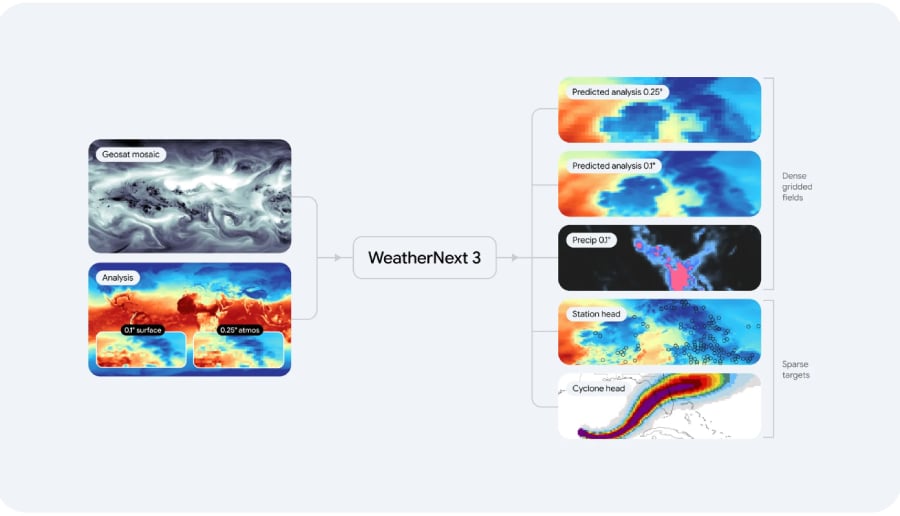
Google has turned real-time satellite imageryl by teaching AI to read the atmosphere as it changes.
Google DeepMind and Google Research released WeatherNext 3 last week, introducing a global AI weather model that delivers hourly forecast updates at a resolution five times finer than its predecessor.
Instead of waiting for traditional, slow-updating supercomputer simulations, the model directly processes live geostationary satellite feeds to refresh predictions every hour.
How WeatherNext 3 cuts forecasting latency #
Traditional meteorology relies on numerical weather prediction models run on massive supercomputers. While accurate, these systems create a data lag of roughly seven hours because they refresh only four times a day.
WeatherNext 3 slashes that turnaround time to three or four hours by ingesting raw satellite imagery and actual ground station observations. The model maps surface conditions like temperature down to 5 kilometers (3.1 miles), compared to the 25-kilometer grid used by WeatherNext 2.
“It gets much more accurate by not waiting for the next analysis date and using the most recent information,” DeepMind senior research scientist Ilan Price told Bloomberg.
Built for rain, wind and solar power #
Precipitation has historically been one of the harder problems for global weather models. Google says WeatherNext 3 improves precipitation forecasting by training on NASA’s IMERG satellite dataset and Google’s own precipitation reanalysis.
In Google’s evaluations, the model showed up to a 60% improvement against IMERG, 30% against MRMS and 10% against rain-gauge measurements at early lead times. Google also says users planning a day or more could see precipitation forecasts that are up to 50% more accurate.
Renewable energy is another major target. WeatherNext 3 forecasts wind speeds at 100 meters, roughly the height relevant to many wind turbines, while also providing cloud-cover and solar-radiation data that can help operators estimate renewable generation.
More frequently updated forecasts could help grid and energy operators anticipate changes in wind and solar output sooner, giving them additional information for balancing electricity supply and demand.
More Google coverage
-
[New Google Search AI Mode is ‘Total Reimagining,’ Says CEO Sundar Pichai](https://www.techrepublic.com/article/news-google-io-2025-keynote-sundar-pichai/) -
[In Major Ruling, Judge Finds Google ‘Willfully Acquired and Maintained Monopoly Power’ Over Digital Ad Market](https://www.techrepublic.com/article/news-google-antitrust-ruling/) -
[Google’s Big Bet on Nuclear Energy: ‘The Race to Power AI-Driven Data Centers is Accelerating’](https://www.techrepublic.com/article/news-google-nuclear-energy-data-centers/)
[Computer History Museum Releases Original AlexNet Code: Why It Matters](https://www.techrepublic.com/article/news-alexnet-github-ai/)
The commercial shift in meteorology #
By delivering high-frequency, station-specific data directly through cloud platforms, technology giants are quietly transforming the economics of weather forecasting. When commercial infrastructure operators can stream turbine-level wind data directly into operations via enterprise databases, the role of public weather agencies changes fundamentally.
Historically, public meteorological bureaus set the baseline data that industries relied upon. Now, consumer-facing technology companies are capturing the high-value, high-resolution operational market, leaving government agencies to maintain expensive physical sensing networks while losing their near-monopoly on real-time forecasting.
Google puts it into its products #
WeatherNext 3 is now powering weather experiences in Google Search, Gemini, Google Maps and Google Maps Platform’s Weather API. Developers and researchers can also access forecast data through BigQuery, Google Earth Engine and Google Cloud Storage.
Google says the model is available globally, but it is not positioning WeatherNext 3 as a replacement for official emergency forecasting. For severe-weather warnings and other public-safety information, users should continue relying on their local meteorological agencies and national weather services.
More News: Circular unveiled its Ring 3 Slim and Pro with non-invasive glucose insights, NFC payments, haptic alerts, and up to 12 days of claimed battery life.