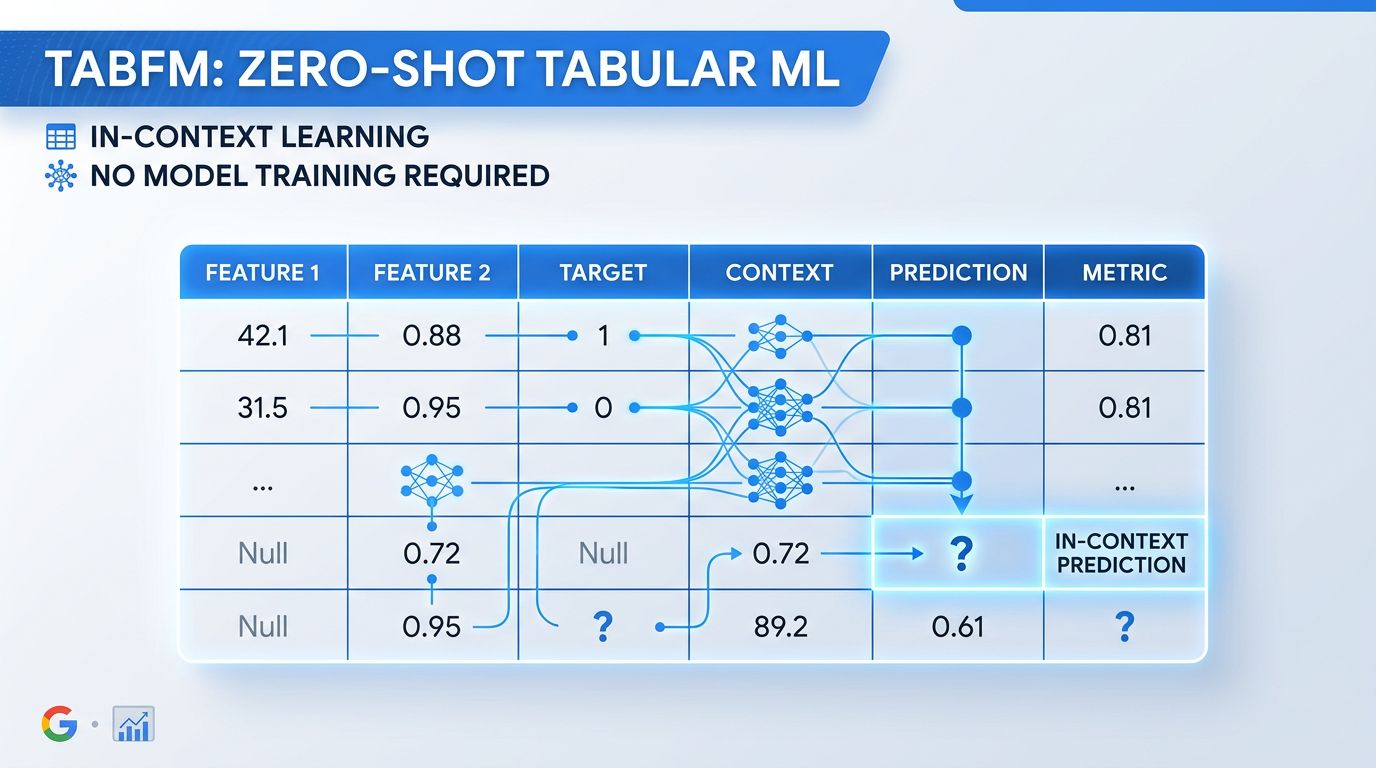
Google shipped TabFM on July 1 — a foundation model that generates predictions on tabular data without ever training on your dataset. You pass labeled rows as context, pass your test rows alongside them, and get classifications or regressions in a single forward pass. No training loop. No hyperparameter search. No week-long feature engineering sprint before your first useful number. The model is live now on Hugging Face with a scikit-learn compatible API, and if you work with structured data for a living, it is worth 30 minutes of your time.
What TabFM Actually Does #
TabFM is a zero-shot tabular foundation model. “Zero-shot” here means it has never seen your specific dataset before and will not be updated on it. Instead, it was pretrained on hundreds of millions of synthetic datasets generated by structural causal models — a technique that creates diverse, realistic data distributions without requiring large public tabular datasets. The result is a model that generalizes broadly across domains at inference time.
The API is deliberately familiar. Install with pip install tabfm[pytorch]
, then use the scikit-learn pattern you already know:
from tabfm import TabFMClassifier, tabfm_v1_0_0_pytorch as tabfm_v1_0_0

model = tabfm_v1_0_0.load(model_type="classification")
clf = TabFMClassifier(model=model)
clf.fit(X_train, y_train)          # No training — sets the context
probs = clf.predict_proba(X_test)  # Single forward pass
The fit()
call does not train the model. It stores your labeled rows as the in-context examples that the model conditions on at prediction time. All compute happens during predict()
. This is the same in-context learning mechanic that lets an LLM answer questions by conditioning on examples in the prompt — applied to structured data.
The Architecture Behind It #
TabFM synthesizes two prior approaches. From TabPFN it inherits alternating row-and-column attention: a multilayer attention module that processes your table by attending across features and examples simultaneously, capturing complex interactions that a flat encoder would miss. From TabICL it borrows the in-context learning Transformer that operates on compressed row embeddings, keeping computation tractable as the context grows. Three stages in total — attention, compression, ICL Transformer — forming what Google calls a hybrid-attention architecture.
This is not a language model with tabular prompting bolted on. There is no tokenization of rows as strings, no “column name: value” formatting tricks. It processes numerical and categorical columns natively as a table.
How It Performs Against Tuned XGBoost #
The headline benchmark is TabArena, which computes Elo ratings from head-to-head win rates across 38 classification and 13 regression datasets (700 to 150,000 rows). TabFM scores 1,727 Elo on classification and 1,940 on regression — second place. The ensemble variant (TabFM-Ensemble, which adds feature crosses, SVD features, and 32-way blending) takes first at 1,815 and 2,125 respectively. Heavily tuned XGBoost sits below both.
Independent testing from Yash Raj Pandey, who specifically tried to break the model, confirmed TabFM beat Optuna-tuned XGBoost on all 10 fold-matched datasets, zero-shot, with the largest margin at +0.055 accuracy. His honest caveat: he tested a curated subset of 9 out of 13 regression datasets — likely the ones where TabFM had the best chance to shine.
The benchmark wins are real. They are also not the whole story.
The Limits You Need to Know Before You Build #
TabFM has hard constraints that matter in practice:
10-class maximum: Binary and multiclass classification up to 10 categories only. This is architectural, not a soft guideline.** 500-feature ceiling**: Performance degrades on wider tables. High-dimensional data at 1,777 features fails outright in independent testing.** Memory scales with context**: All training rows are held in memory at prediction time. The PyTorch backend keeps this to 3–7 GB on most datasets, but very large training sets require batching or sampling strategies.Non-commercial license: The model weights carry the TabFM Non-Commercial License v1.0. Thesource code on GitHubis Apache 2.0, but you cannot ship the weights in a commercial product without a separate agreement from Google.
The licensing constraint matters more than it looks. Internal tools, research pipelines, and prototypes are fine. Shipping predictions to paying customers is not.
The BigQuery Integration (Not Quite Ready) #
Google is integrating TabFM into BigQuery as a remote model callable via ML.PREDICT
. The pattern: create a table mixing context rows (known outcomes) and target rows (unknown), register the model with a connection, and predict with SQL. As of July 2026, this is in whitelist preview — attempting the endpoint without org approval returns an “Unsupported remote model endpoint” error. Google has not committed to a GA date. The Python API on Hugging Face is the practical path right now.
When to Reach for TabFM #
Use TabFM when you need a strong baseline fast, your problem fits within the 10-class and 500-feature constraints, and the non-commercial license permits your use case. Fraud detection, churn prediction, lead scoring, and support ticket triage — especially in teams without a dedicated ML engineer — cut from days to minutes.
Stick with XGBoost or LightGBM when you have more than 10 classes, very wide feature sets, production traffic at commercial scale, or when maximum accuracy after full tuning is the goal. TabFM does not close the gap on all of those. It was not built to.
What it does is shift the baseline. Developers who used to spend a week on their first model for a new dataset now spend an afternoon — which is often when the decision to invest further gets made. The model weights are on Hugging Face, the code is on GitHub, and the official announcement has the full benchmark breakdown.