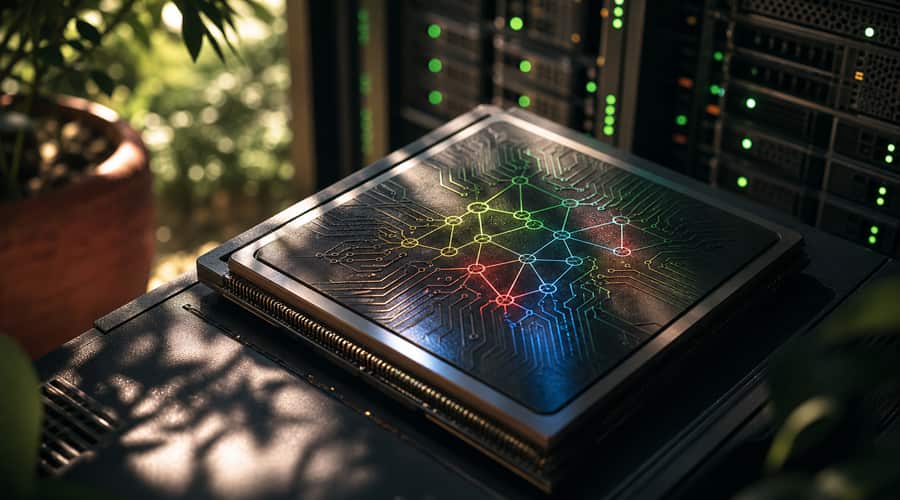
Alphabet shares climbed after The Information reported Google is building a chip called Frozen V2 that bakes Gemini's own architecture into silicon, a design the company believes could run its AI models six to ten times more efficiently than its current chips.
Alphabet stock rose as much as 2%, touching $353.12 in morning trading on July 20, according to Investing.com, after the report surfaced. That's a notable move for a stock this size on a single hardware story. It's also a rare bit of green for a sector that has spent the past week bleeding red.
Frozen V2 is not another TPU. According to The Information, Google is designing a server chip that hardwires Gemini's neural network architecture directly into the circuitry itself, rather than building general-purpose silicon that can run any model. The idea is to strip out the processing overhead and data movement that slow down inference on conventional chips. Google's own estimates put the efficiency gain at six to ten times better power use per token than its existing Tensor Processing Units. The catch: deployment isn't expected before 2028. This is a bet on the future, not a product shipping next quarter.
A Rough Fortnight for Chips #
If you've been watching chip stocks whipsaw over the past two weeks, you already know why this landed the way it did. The PHLX Semiconductor Index fell more than 20% from its June 22 closing high through July 17, according to Bloomberg, tipping the sector into a bear market. That's the technical definition, not just a bad week. Nvidia, AMD and Intel each dropped sharply on July 13 alone, down 4.21%, 3.52% and 6.12% respectively, as investors grew nervous about whether AI infrastructure spending will actually pay off. Chinese startup Moonshot AI unveiling a model that narrows the gap with top U.S. offerings didn't help the mood. Nerves were already frayed. Frozen V2 arrives on top of a silicon push Google has already been executing for months. Its seventh-generation Ironwood TPU, unveiled last November, delivers ten times the peak performance of the prior TPU v5p generation. It now scales to pods of 9,216 chips producing 42.5 FP8 ExaFLOPS, according to Google's own figures, well beyond the 0.36 ExaFLOPS Nvidia's GB300 NVL72 system offers. That's a serious gap. Anthropic has committed to using up to a million of the new TPUs to run Claude. Google has also started selling TPU capacity to outside data center operators for the first time, a direct move into the merchant chip market Nvidia has dominated for years. It also tapped Intel to manufacture more than three million custom AI chips as it looks for capacity beyond Taiwan Semiconductor.
None of that unseats Nvidia overnight. Nvidia still holds the vast majority of AI training and inference workloads, and its own order book reportedly stretches past a trillion dollars in demand through 2027 from hyperscalers including Microsoft, Amazon and Meta. But Frozen V2 is a signal, not a shipment. It tells the market Google isn't satisfied competing on general-purpose silicon and is willing to trade flexibility for raw efficiency on its own models, a bet only a company that controls both the model and the chip can actually make.
The Earnings Test #
The timing matters too. Alphabet reports second-quarter earnings on July 22, just two days after this report broke, and investors will be listening for how much of this AI infrastructure spending is starting to show up in cloud revenue rather than just capital expenditure. The company's shares had already been jittery this month after a report that its flagship Gemini 3.5 Pro model had slipped behind schedule, knocking the stock down more than 4% on July 16. A chip story alone won't settle that debate. But it gives Alphabet a new argument heading into earnings: that even if a single model launch slips, the hardware underneath its AI business is getting harder for Nvidia, or anyone else, to match.
Also read: Elon Musk Calls a Reported $52 Billion SpaceX Foxconn Server Deal Fake News • IREN inks $2.8 billion in AI cloud deals, lifts revenue target past $4 billion • Brussels Fines Alibaba's AliExpress a Record 550 Million Euros