Gemini 3.7 isn’t at the frontier on general intelligence, but there seem to be quite a few use-cases it is at the frontier at.
Google DeepMind has rolled out a new “agentic video understanding” capability across its latest Flash-tier models, and the company’s own benchmarks put Gemini 3.7 Flash right at the sweet spot of accuracy versus cost for the task. The feature is live today for Gemini 3.7 Flash, 3.6 Flash, and 3.5 Flash-Lite via the Gemini API in Google AI Studio and the Gemini Enterprise Agent Platform, and Google says it will reach the consumer Gemini app “soon,” with YouTube’s “Ask YouTube” feature getting it in the coming months.
What’s actually changing #
Until now, Gemini processed video the way most multimodal models still do: it ingested the file at a fixed frame rate, one frame per second by default, regardless of what was actually happening on screen. That’s fine for short clips, but it gets expensive and lossy fast on anything long — a 90-minute lecture or a multi-hour recording either burns through a huge token budget or forces developers to drop detail just to keep costs sane.
Agentic video understanding changes the approach. Rather than scanning a video start to finish at a constant rate, Gemini now behaves more like an investigator than a stenographer — it decides what to watch, at what speed, and through which channel (frames, audio, or transcript), and it fetches only the segments it actually needs to answer a query. Google describes this as an internal agentic loop: the model invokes a tool to load the relevant slice of video, inspects it, and decides whether it needs to look elsewhere or rewatch a moment at a higher frame rate. It’s the video-analysis counterpart to “agentic vision,” which Google already uses to pair code execution with native image understanding.
The numbers Google is putting forward #
Google’s own benchmark charts show the gap is largest exactly where you’d expect: long-form content. On its 1H-VideoQA and LVBench tests, both built around long-video understanding, token usage drops from roughly 300–400K tokens per query down to under 50K — an 88% reduction — while accuracy ticks up as well, into the high 80s. On Minerva, a complex-reasoning benchmark, the token savings are smaller (around 58%) but the accuracy gain is the largest of the three tests, jumping about 7 relative points.
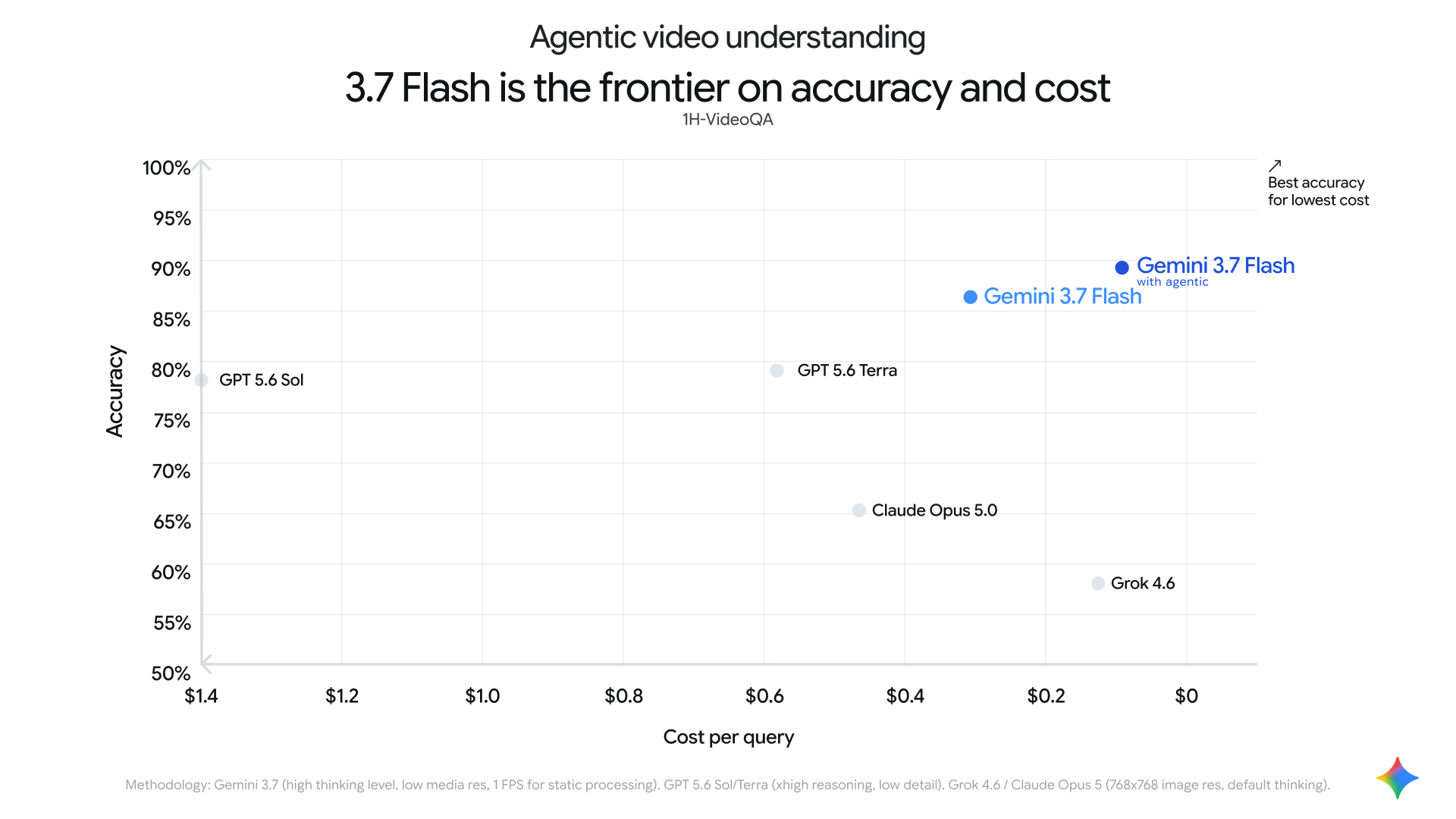
Google also published a cost-versus-accuracy scatter plot comparing Gemini 3.7 Flash against GPT-5.6 Sol, GPT-5.6 Terra, Claude Opus 5, and Grok 4.6 on the 1H-VideoQA benchmark. On that chart, Gemini 3.7 Flash with agentic video understanding sits furthest toward the top-left corner — highest accuracy at the lowest cost per query among the models tested — with the non-agentic version of 3.7 Flash close behind it. It’s worth noting this is Google’s own methodology and Google’s own chart, so it’s best read as a vendor benchmark rather than an independent third-party result, but it’s a notably strong claim for the company to make against Anthropic and OpenAI’s latest models.
Flash keeps carrying Google’s frontier story #
The launch lands at a moment when Gemini 3.7 Flash has been on something of a run. The model was recently found sitting on the Pareto frontier of intelligence versus speed by Artificial Analysis, and days later it went on to top the firm’s AA-AnalystAgent benchmark outright, beating Claude Opus 5 and GPT-5.6 Sol on real-world spreadsheet and document tasks. Sundar Pichai has also called it Google’s fastest-growing model ever, and it’s held up respectably even against reasoning-focused flagships, scoring nearly as well as Claude’s Fable 5 on ARC-AGI-2 at a fraction of the cost, even if Fable 5 and OpenAI’s top models still pull ahead on harder, more novel benchmarks.
Agentic video understanding fits neatly into that pattern: it’s another case of Google squeezing more capability out of its cheaper, faster model line rather than shipping a new frontier-scale system. And on video specifically, Google arguably starts from a structural advantage that no competitor can fully replicate. Between YouTube, Google Photos, and years of Street View and satellite imagery, Google has access to a scale and diversity of video and visual data that few, if any, other AI labs can match. It would be surprising if that didn’t translate into a genuine edge on video-native tasks like the ones agentic video understanding targets — sub-second moment retrieval, anomaly detection, and counting actions or objects across long recordings.