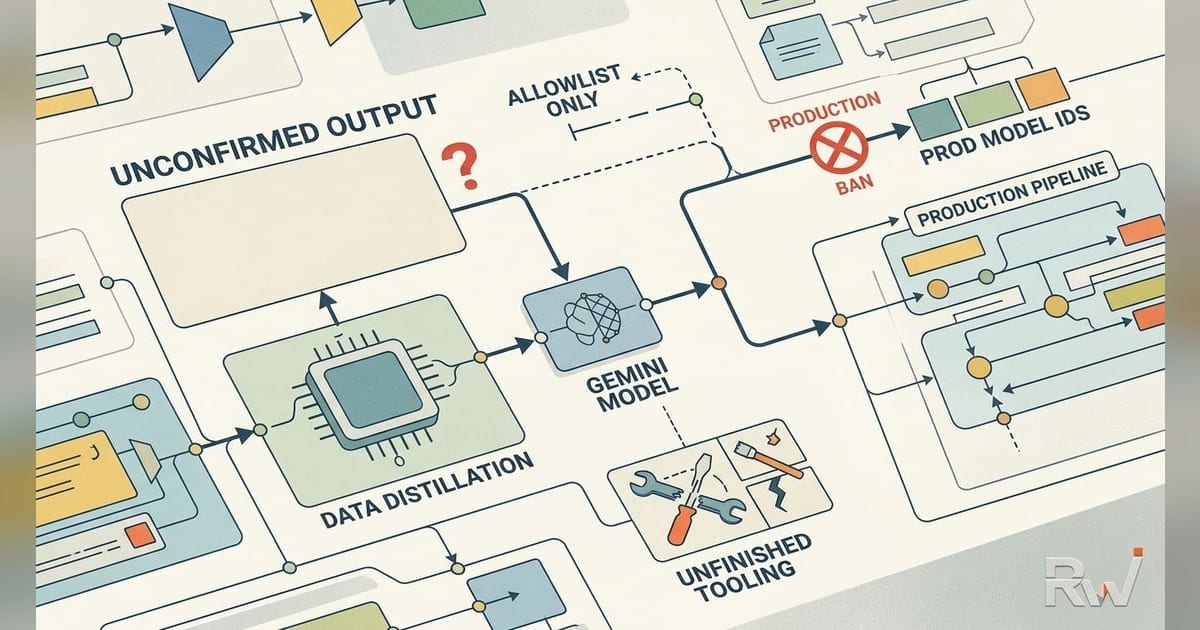
An archived Google Cloud documentation page describes an allowlisted service that would use Gemini 3.1 Pro outputs and reasoning patterns to train custom Gemini 2.5 Flash models. The page says it was updated July 23, but its contents do not establish that Google has formally launched the product.
The document contains several reasons for caution. It bars production use, limits access to allowlisted projects and gives initial users only 30 days of access. It also identifies gemini-3.1-pro
as the supported teacher model while its sample API requests use gemini-3.1-pro-preview
. The console reportedly does not display progress while the teacher generates samples, and a checkpoint table shows zero for an epoch field because of a known issue.
Those inconsistencies do not prove the page is a prank. They do make the release status unclear and argue against treating the document alone as confirmation of a generally available Google Cloud product.
What the document claims
According to the page, Gemini Distillation Service packages model compression as a managed cloud workflow. Customers would use a Pro-tier model to generate training material for a cheaper, faster Flash model, potentially reducing latency and inference costs for repeated, high-volume workloads.
Standard supervised fine-tuning typically trains a model against labeled examples containing a desired final answer. The documented distillation workflow instead allows a customer to upload a prompt-only dataset. Gemini 3.1 Pro then generates answers, and Gemini 2.5 Flash learns from the teacher model's responses and what the page calls its "raw thoughts," or internal reasoning paths.
The workflow could reduce the need to build large sets of ground-truth answers by hand. The document recommends at least 1,000 varied prompts to produce a noticeable improvement and says the service accepts up to 50,000 examples in a JSONL file of no more than 1 GB.
Each example is limited to 8,000 input tokens. The page says Google will terminate a job if more than 10% of the dataset exceeds that threshold. Teacher outputs are capped at 24,000 tokens and truncated beyond that point, potentially reducing the student model's performance.
The described service supports only text. Images, video and function calls are excluded, limiting its initial use to workloads such as technical-document summarization, complex coding and other multi-step reasoning tasks where Google says the base Flash model trails Pro.
The document says teacher sampling and student training run through a single Agent Platform API call in the us-central1
region. Completed models are registered in the Gemini Enterprise Agent Platform Model Registry, with prediction endpoints and intermediate checkpoints created for evaluation. Customers can continue training a previously distilled checkpoint if they retain the same base student model.
A potentially deeper tie to Google's AI stack
If genuine and released as described, the service would extend Gemini Enterprise Agent Platform, which Google introduced April 22 as the successor to Vertex AI. Google said future Vertex services and roadmap updates would move through the renamed platform, which combines model development, agent deployment, identity, governance, evaluation and observability. Distillation would give Google another way to keep the customization cycle inside that stack. Customer prompts would remain in Cloud Storage, teacher inference and student training would run through Google's API, and completed models would land in Google's registry and serving infrastructure.
The model pairing also reflects the cost gap between frontier and smaller models. Rather than send every request to Gemini 3.1 Pro, a company could use the larger model to generate a specialized training set and serve repeated workloads through Gemini 2.5 Flash. Whether the student retains enough of the teacher's performance would remain workload-specific. The document calls for comparisons against both the original Flash model and Gemini 3.1 Pro using a held-out test set.
The page places the service under Google's Pre-GA Offerings Terms, under which products are provided as-is and may receive limited support. For founders and operators, the production ban, narrow model pairing, regional restriction and documentation anomalies make this something to monitor, not a service to build around until Google clarifies its status.