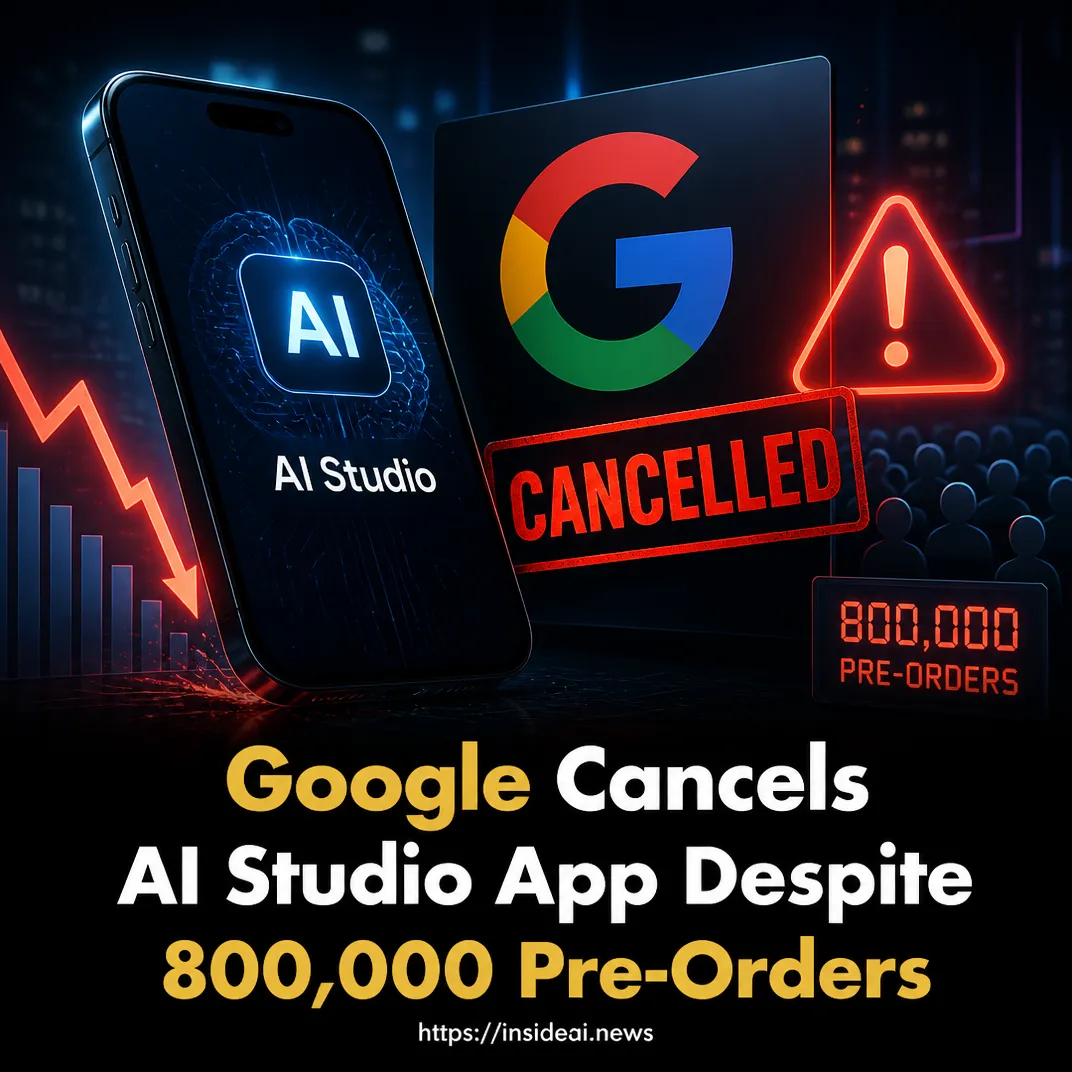
August 4, 2026, (Inside AI) — Google has scrapped its standalone AI Studio mobile app, a tool designed for developers to prototype and deploy AI applications, despite amassing 800,000 pre-orders across the Google Play Store and Apple's App Store. The company confirmed it will instead integrate AI Studio's capabilities directly into its Gemini platform, unifying its AI tooling under a single brand.
The cancellation marks a rare pre-launch retreat for Google, which typically pulls the plug on products only after they've reached the public. The AI Studio team stated it opted for "an entirely different approach" rather than fragmenting its ecosystem with another standalone app.
AI Studio, originally a web-based developer environment, lets users build, test, and deploy applications powered by Gemini models. By folding its features into Gemini, Google aims to streamline the developer experience and reinforce Gemini as its central AI hub. No timeline has been announced for the integration.
The decision underscores Google's persistent struggle with product fragmentation. Historically, the company has launched and killed numerous services, from Google Reader to Google+, often confusing users. This preemptive cancellation suggests a strategic pivot toward consolidation, but it also risks alienating the 800,000 users who signaled intent to adopt the app.
Industry analysts note that Google's move mirrors a broader trend among tech giants to collapse point solutions into flagship platforms. Apple, for example, integrated machine learning tools into Xcode rather than maintaining a separate app. However, Google's abrupt shift may frustrate developers who anticipated a dedicated mobile interface for AI prototyping.
From a technical standpoint, AI Studio's reliance on Gemini models made integration logical. The platform's core functionality—prompt engineering, model tuning, and deployment—aligns closely with Gemini's existing developer APIs. Google's AI developer documentation already positions Gemini as the entry point for building with its models. Yet, the cancellation raises questions about Google's commitment to third-party developer ecosystems. While Gemini offers robust tools, a standalone app could have provided a sandboxed environment for experimentation. Competing platforms like OpenAI's ChatGPT and Anthropic's Claude maintain distinct developer interfaces, suggesting that dedicated apps still hold value.
Google has not disclosed whether the Gemini integration will replicate all AI Studio features, such as real-time collaboration or version control. Developers who pre-ordered the app are now left waiting for Gemini updates, with no guarantee of feature parity.
The move also coincides with increasing regulatory scrutiny of AI platforms. By centralizing tools under Gemini, Google may aim to simplify compliance with emerging AI governance frameworks, such as the EU's AI Act. A unified platform could streamline audits and safety evaluations, a growing priority for enterprise clients.
In a related development, Google recently expanded Gemini's capabilities with multimodal reasoning enhancements, which could absorb some AI Studio functions. The company's research on efficient model adaptation further supports a consolidated toolchain.
For the 800,000 pre-order users, the cancellation is a reminder of Google's unpredictable product roadmap. As the company doubles down on Gemini, developers must adapt to a shifting landscape where standalone AI tools may vanish before they ever launch.