Munich startup Proxima Fusion closed Europe's largest-ever private fusion round on July 7, pulling in €411 million at a €2.4 billion valuation, with Google joining as a strategic investor for the first time in European fusion.
The money is real and the physics is specific. Proxima Fusion, a spin-off of the Max Planck Institute for Plasma Physics founded in April 2023 by scientists from Max Planck, MIT, and Google X, raised €411 million ($468 million) in a round led by XTX Ventures and East X Ventures. Google and German utility RWE joined as strategic backers, pushing Proxima's valuation to €2.4 billion and cementing its position as Europe's best-funded fusion company. No European fusion startup has raised this much private capital in a single round. That's not just a headline number. It reflects a real shift in who is paying for physics.
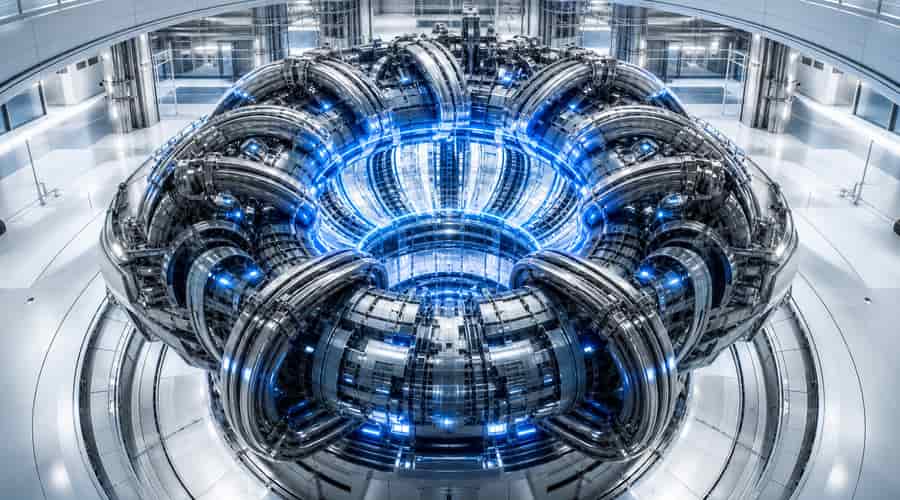
Google's participation is the detail that deserves scrutiny. The company's own 2026 environmental report acknowledged that its AI infrastructure buildout is "currently accelerating faster than the grid is decarbonizing." With capex across the top five hyperscalers projected by CreditSights to reach $602 billion this year, the energy constraint is already here. Rather than signing another power purchase agreement for wind or gas, Google placed equity in a company trying to build a stellarator - one of the more technically demanding fusion reactor designs - that holds plasma hotter than 100 million degrees in a complex helical magnetic field. That's not a hedged procurement bet. It's a conviction bet on a technology that doesn't fully exist yet.
Stellarators differ from the more common tokamak design in one important way: they're engineered to sustain plasma continuously rather than in pulses, which makes them more suitable for baseload power generation. Proxima's approach, a so-called QI-HTS stellarator, builds on research from the Wendelstein 7-X program at Greifswald, the Max Planck machine widely considered the world's most advanced stellarator. The founders didn't just read the papers - several of them ran the experiments.
The €411 million goes toward building Alpha, a net-energy stellarator demonstrator targeted for the early 2030s. Alpha is planned for Garching, near Munich. Stellaris, the first commercial stellarator power plant, comes after that, and RWE's involvement tells you where it's headed: Gundremmingen, Bavaria, the site of a former nuclear fission plant that RWE operated until 2021. Reusing decommissioned fission sites is a practical move - the grid infrastructure, cooling systems, and community permitting relationships are already in place. RWE signed a memorandum of understanding with Proxima, Bavaria, and Max Planck IPP in February 2026 outlining that two-stage roadmap.
RWE isn't doing this for goodwill. Germany has shut down all its nuclear plants and is watching electricity prices remain structurally high. A utility with stranded fission assets and a decarbonisation mandate has obvious reasons to want domestic fusion capacity, and to want it developed by people who know Germany's regulatory environment rather than an American startup parachuting in.
Why hyperscalers are funding the physics labs now #
Google's decision to back Proxima reflects something broader than one deal. U.S. data center power demand is projected to exceed 30 gigawatts by 2028, according to industry forecasts. More than 700 data centers were under construction in the United States alone as of March 2026 - and the grid, particularly in the markets these companies need most, isn't keeping pace. Microsoft has pursued nuclear restarts at Three Mile Island. Amazon has signed deals with small modular reactor developers. Google itself is backing advanced geothermal and other nuclear plays. But fusion - specifically a European fusion company - is a different signal. It suggests Google doesn't think the current portfolio of solutions gets it all the way there.
Frankly, that's the honest read of this investment. Fusion at commercial scale in the 2030s is still a significant engineering bet, not a sure thing. But a company founded three years ago by people who spent careers at one of the world's best fusion research programs, with €411 million in the bank and a utility partner already holding the land, is starting from a much stronger position than most fusion ventures have. The previous European fusion funding record was considerably lower. Proxima crossed it by a margin that makes the next-closest competitor difficult to compare.
The Gundremmingen site may be the most underappreciated detail in the whole announcement. Getting a fusion plant sited, permitted, and grid-connected in Europe is at minimum as hard as building the reactor itself. The fact that Proxima and RWE already have a location with existing infrastructure and a signed partnership means they've solved a problem most fusion startups haven't even started working on.
That matters more than it sounds. Proximity to a serious energy partner is what convinces plasma physicists and high-temperature superconductor engineers that the project is real, not just well-funded. Those are different things. In a talent market where the best people have options, that distinction is what gets them to move to Bavaria.
Also read: Congress wants to freeze state AI laws for three years and state lawmakers are refusing to go quietly • Etched raises $300M at $10.3B valuation as Sequoia backs the Harvard dropouts it once rejected • Why your startup sales deck keeps losing enterprise deals