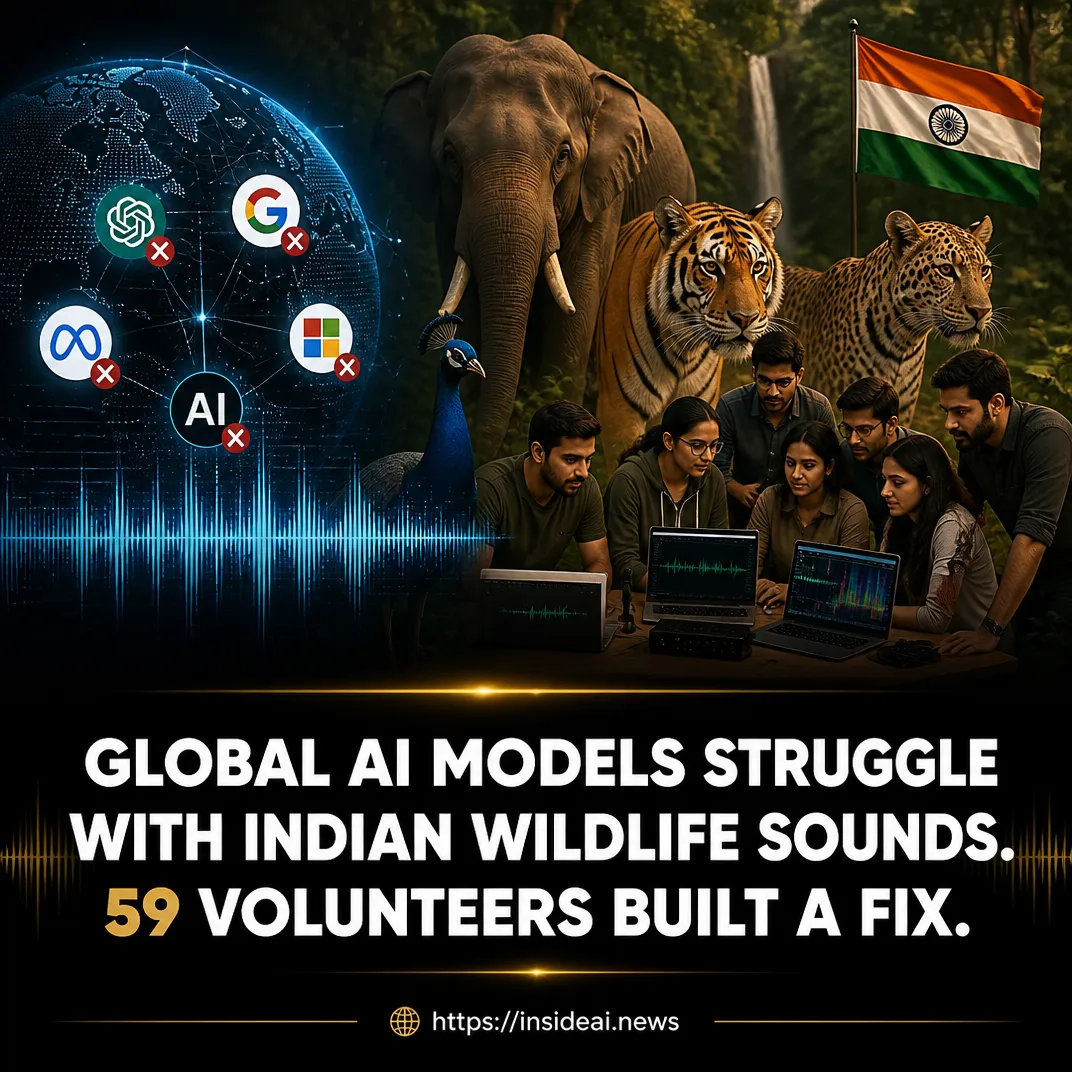
August 10, 2026, (Inside AI) — Global AI models trained on sounds from North America and Europe fail to recognize the calls of Indian birds, frogs, and insects. A crowdsourced effort by 59 volunteers has built the country's first open-access ecoacoustic dataset, publishing 5,815 minutes of labeled recordings from 518 species across 25 states to close that gap.
The Indian Ecoacoustics Network (IEN) released the dataset on July 21 via bioRxiv, with formal publication under review at Scientific Data. The audio spans monsoon-soaked Western Ghats corridors to dry East Deccan forests, capturing not just birdsong but insect buzz, frog calls, bat echolocation, and even marine animal sounds.
"Machine learning models for recognising species/ birds through acoustics are largely trained on data from the Global North," said Kadambari Devarajan, a Mumbai-based independent researcher. "And as every ecosystem has its unique soundscape, made up of a mix of endemic and common species, background noises and weather interruptions, ambient noise, the models perform poorly in tropical regions like India."
Tools like BirdNET and Perch have simplified acoustic monitoring, but their accuracy plummets when faced with overlapping calls, monsoon rain, and human noise typical of Indian habitats. The IEN dataset deliberately includes such "noisy" recordings to make AI more robust.
From PhD project to national network #
The IEN grew from Project Dhvani, started in 2018 by Sarika Khanwilkar, Pooja Choksi, and Vijay Ramesh as PhD students at Columbia University. Relaunched in 2024, the network drew over 600 people interested in ecoacoustics, no formal expertise required.
In 2025, a core group of ecologists and engineers set ground rules: recordings under a Creative Commons license, labeled and published, with anyone contributing at least 30 minutes listed as a co-author. The final paper credits 59 contributors.
"When ecologists do bird surveys on the field, we usually do a point count," said Pooja Choksi, a Mumbai-based ecological restoration scientist and IEN co-founder. "You go to a spot in a forest, wait for 15 minutes, and note down all the birds you can observe in the distance. But if you rely only on sight, especially in a dense forest, you'll end up missing out on most of the wildlife."
"Recordings can be a perfect time capsule for how an ecosystem sounds like in time and space. They can capture more species, over frequencies the human ear can't hear, note how they vocalise, and do it periodically over long periods of time. This makes acoustics a game changer for biodiversity monitoring in any ecosystem," Choksi said.
Of the nearly 6,000 minutes, 3,311 are annotated with exact timestamps and frequency contours on spectrograms; the remaining 2,504 confirm species presence. Independent experts spot-checked a random 2% sample, with 98% accuracy. Most recordings came from Kerala and Madhya Pradesh.
Fragmented efforts meet a shared resource #
State governments and researchers already use ecoacoustics, but their data sits in silos, often unlabeled. "Researchers in India already use global deep learning models for acoustic analysis, with individual modifications and data inputs to fine tune the model's accuracy in the habitat they're working in. But this is all happening in individual silos, wherein the data and resources are fragmented. With a one stop for a vast amount of data, all those efforts can be pooled together," said Sarika Khanwilkar, a Pune-based conservation scientist.
The dataset could reveal shifting migration patterns or behavioral changes. "If there's a drought, we could even hear differences in the ways species call when the rivers are running dry," Choksi noted.
The IEN has hit its storage limit on Zenodo, a CERN-backed repository, and needs more volunteers for annotation. Khanwilkar, now scouting for funding, said: "The dataset paper is only the first step, we will continue to expand the data."
Meanwhile, Sonal Teotia, a Bangalore-based birdsong enthusiast who works in AI training, contributed her own recordings. Her husband, Sameer Singh, an electronics engineer, handled quality control, rejecting any submissions without species identification. "More representative data will make the AI models better at identifying species," Teotia said.