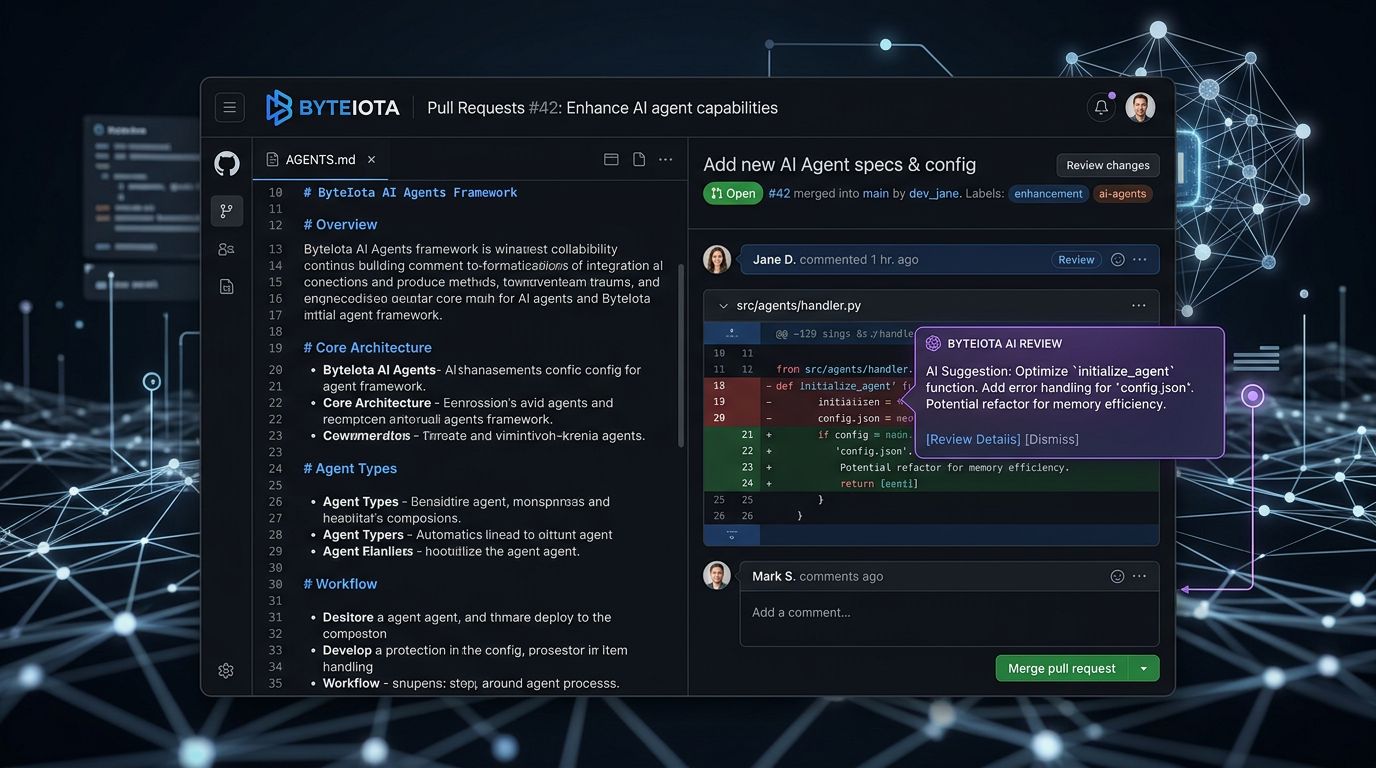
As of June 18, GitHub Copilot code review reads your AGENTS.md
file and uses it to shape every pull request review. If you already have one at the repo root — because you use Claude Code, Cursor, or Codex — Copilot picked it up the day this shipped. If you don’t, writing one takes five minutes. Either way, the era of Copilot ignoring your team’s actual conventions is over.
What Changed on June 18 #
GitHub’s June 18 changelog entry covers two changes, both generally available across all Copilot plans (Pro, Pro+, Business, Enterprise):
AGENTS.md support: Copilot code review reads/AGENTS.md
at the repo root automatically. No settings toggle, no integration to configure. The file exists, Copilot uses it.Draft PR reviewer UX improvement: A visible “Request” button now appears next to Copilot in the reviewer picker on draft pull requests, replacing the previous “search for Copilot manually” workflow.
Why This Matters More Than It Looks #
Context makes this meaningful. Copilot code review is no longer a static linting tool. The March 5 shift to an agentic architecture changed the model: instead of pattern-matching against a diff, Copilot now investigates — pulling relevant code, directory structure, and references before generating feedback.
June built fast on that foundation:
June 2:Agent skills and MCP server support launched in public preview, letting reviews pull context from issue trackers, internal docs, and service catalogs. A medium-complexity analysis tier now routes harder PRs to a higher-reasoning model.June 12:The 4,000-character limit on instruction files was removed. Teams with detailed conventions no longer have to truncate. Org-level runner controls shipped too.June 18: AGENTS.md support. Copilot code review now knows what your team actually cares about.
The upgrade arc matters. Adding AGENTS.md support to a static analysis tool would be a footnote. Adding it to an agentic system that actively investigates PRs is a real capability shift.
How to Write an AGENTS.md That Works #
GitHub’s research, drawn from analyzing over 2,500 repositories, is clear: concise and specific beats comprehensive and explanatory. What to include:
- Tech stack and versions
- Naming conventions, with examples
- Commands that verify work (
pytest
, linters, type checks) - Architectural boundaries — what should never cross layers
- Review expectations — what Copilot should specifically flag
Keep rationale and history out. Put those in CONTRIBUTING.md
for humans. Agents need the rule, not the reasoning behind it.
A concrete example of effective review guidance:
## Review Expectations
- Flag any direct DB queries outside the repository layer
- Reject PRs that add dependencies without updating requirements.txt
- All public APIs require docstrings
- Max line length: 88 characters (Black formatter enforced)
One honest caveat: convention adherence runs around 60–70% based on community reports. AGENTS.md improves reviews significantly, but it doesn’t make them perfect. Mirror your most critical rules into .github/copilot-instructions.md
if you need tighter enforcement for IDE inline suggestions.
AGENTS.md or copilot-instructions.md? #
Use both — for different purposes. AGENTS.md is now a cross-tool standard that Claude Code, Cursor, Gemini CLI, Codex, and Copilot code review all read. Put your shared team conventions there. It’s the file that travels across your entire AI toolchain.
.github/copilot-instructions.md
is Copilot-specific, applies to IDE inline suggestions, and has higher adherence. Copy your three or four most critical rules there to lock them in for the IDE assistant as well.
Enable It in Three Steps #
- Create
AGENTS.md
at the root of your repository (or confirm one already exists). - Add your team’s conventions — naming rules, architectural constraints, and specific review expectations.
- Open the next pull request and request a Copilot review. Feedback will reflect your file immediately.
No API keys. No extension updates. No settings to toggle. The file existing is enough.