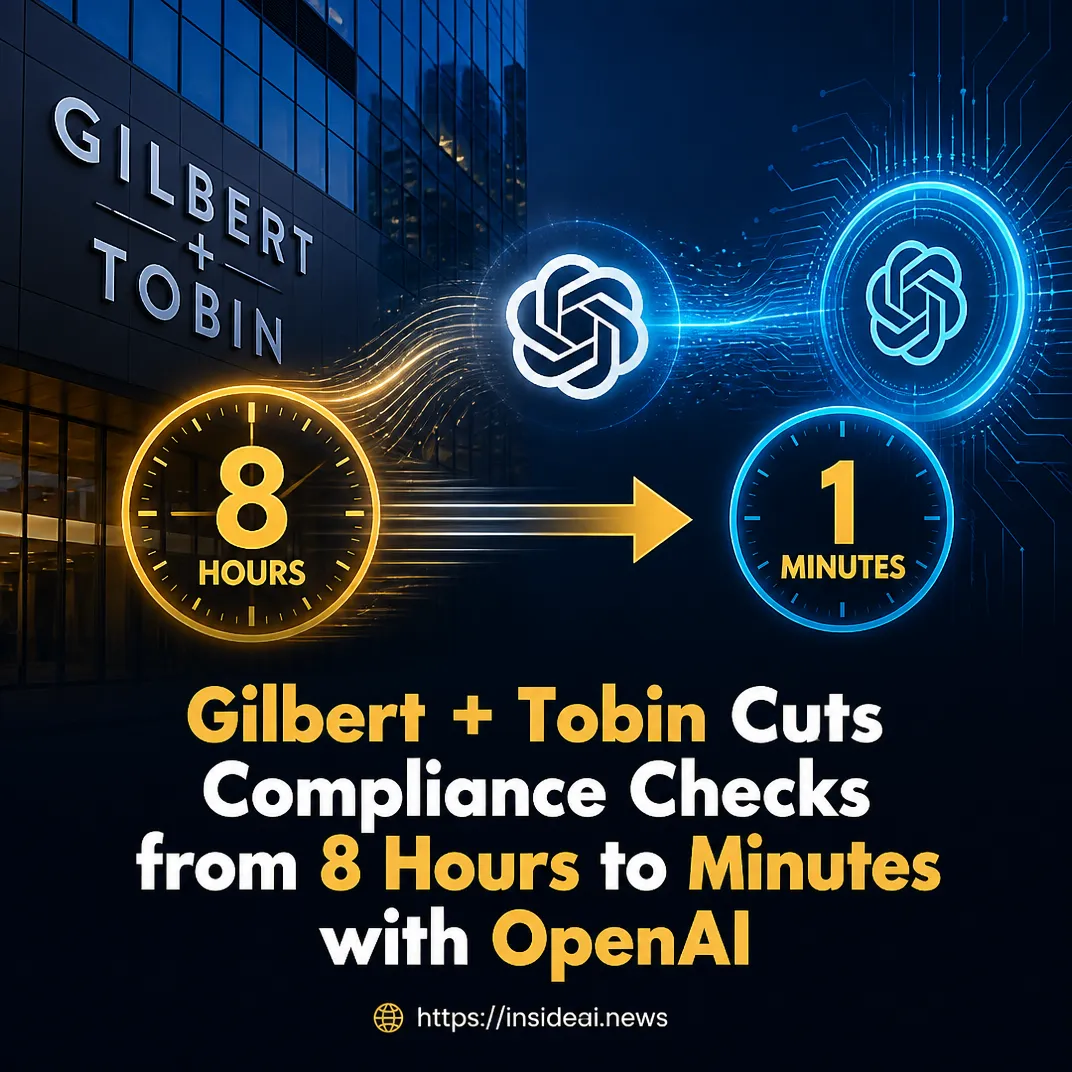
September 2, 2026, (Inside AI) — Australian law firm Gilbert + Tobin has cut a compliance workflow from eight hours to minutes using OpenAI tools, while pushing employee adoption of ChatGPT Enterprise to 87% of enabled seats. The firm’s rollout, led by CEO Sam Nickless, pairs role-specific training with strict governance for confidential client data.
The firm introduced ChatGPT Enterprise first to operations teams, then expanded to marketing, business development, recruitment, finance, technology, and parts of legal practice. The focus stayed on operational work, not displacing professional legal judgment.
“AI is not cheating,” Nickless told employees, framing the tool as a way to apply judgment rather than an inappropriate shortcut.
That message, delivered through examples from his own work, helped legitimize adoption across the firm. Other senior leaders became active users and shared use cases with their teams.
Adoption Without Mandates Beats Typical Rates #
Gilbert + Tobin avoided usage targets. Instead, business transformation staff joined team meetings to demonstrate workflows tailored to marketing, finance, recruitment, and operations. Internal videos, showcases, and challenges kept pace with new ChatGPT capabilities.
By June 2026, 87% of enabled seats were active, more than double the firm’s typical adoption rate for other tools. Active users included partners and employees outside the technology function.
Governance was central. The firm published guidance on approved tasks, what employees could enter, and how outputs should be reviewed. It assessed contractual protections, role-based access, data-processing requirements, and administrative controls.
Moving to an OpenAI environment with Australian data residency gave the firm confidence to expand access while meeting client expectations.
Codex Moves From Assistance to Workflow Completion #
ChatGPT now supports several business functions. A recruitment research and data-extraction task dropped from roughly four hours to about 20 minutes. A reference-processing workflow saves an estimated 25 minutes per candidate.
Marketing teams use ChatGPT to synthesize pitch materials. The firm produces 400 to 500 pitches each year, and the tool helps prepare content faster while improving quality and alignment with writing standards.
Finance teams use ChatGPT for spreadsheet and data analysis. Technology teams apply it to documentation, scripts, and training materials. Lawyers use it for operational work, while legal-specific workflows run through approved platforms such as Harvey.
One distinctive use case is a custom GPT that acts as a “digital twin” of the CEO. Built from approved examples of Nickless’ writing, priorities, feedback, and business context, it helps executives pressure-test ideas before taking up his time. It does not make decisions or speak for him.
With Codex, the firm moved from AI assisting individuals to AI completing defined multistep workflows under human review. Codex prepared audit reports covering 300 entities, avoiding a full day of manual work. It also checked and renamed 1,100 files for upload, work that previously took days.
Codex helped build an AI-enabled workflow for conflict, anti-money laundering, politically exposed person, and know-your-customer checks. It completes research and processing steps, then produces a report for human sign-off. Selected checks that once took up to eight hours now finish in minutes.
Within technology, a DevOps team member used Codex to build a monitoring “watchtower” for the firm’s AWS environment. It consolidates operational signals, supports diagnosis and remediation, and escalates issues needing human attention.
Gilbert + Tobin plans to extend access to ChatGPT Work and Codex as controls allow. The longer-term ambition is an interconnected working environment where employees draw on ChatGPT to access approved organizational context and deliver finished outputs without navigating manually between systems.