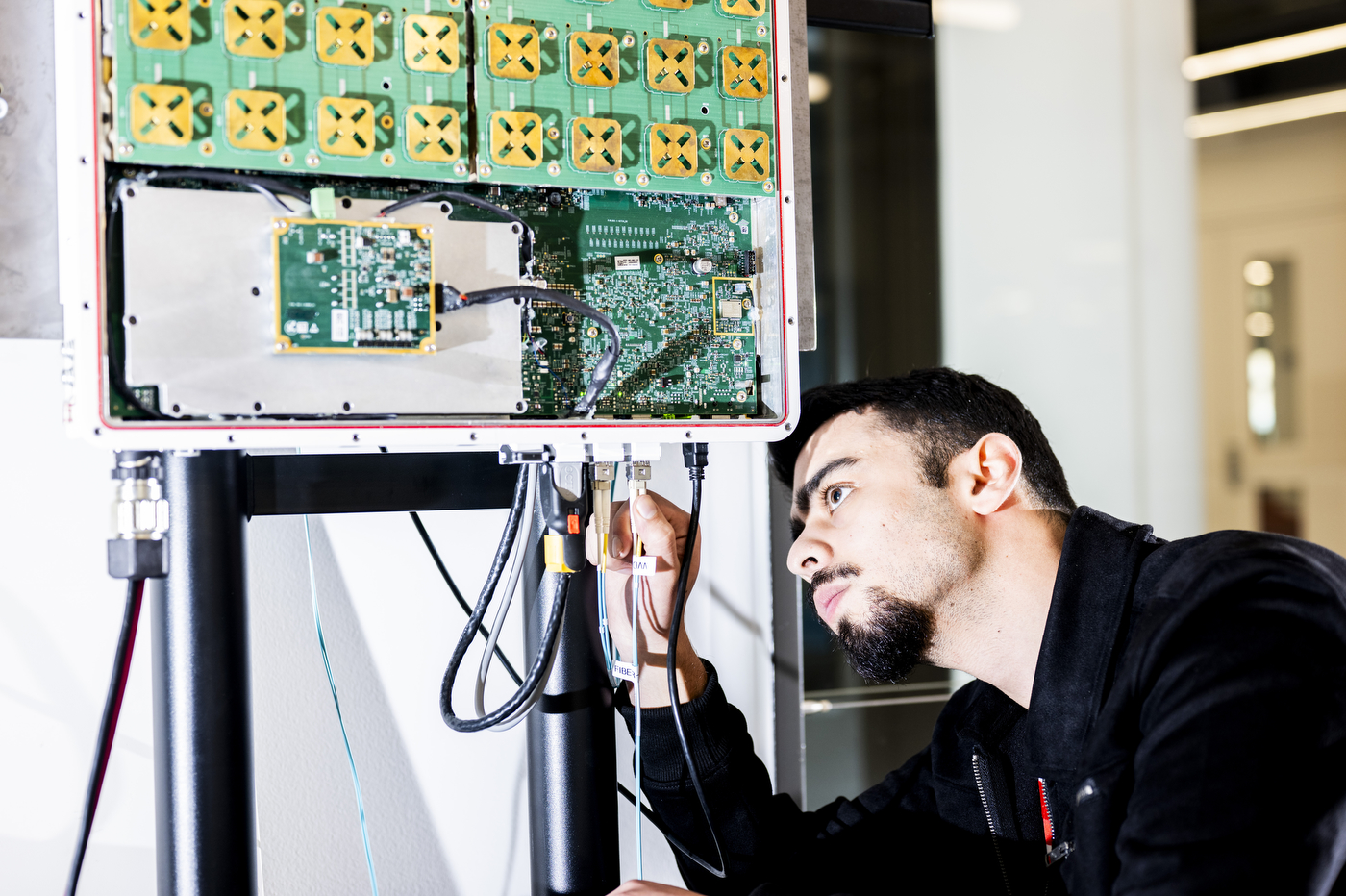
GENESIS runs itself to write code from programmers’ ideas at Northeastern University
Remote mountains or deserts far from cities are notorious for being off the cellular grid. But in the near future, cellphones could work in those places.
In addition, cars could get you out of traffic jams quicker by connecting to sensors placed around the city that alert drivers to trouble on the road. That could be thanks to, in part, a new thinking and code-writing agentic Artificial Intelligence framework developed at Northeastern University.
It’s called GENESIS, and it’s a new, self-driven AI framework developed at the university’s Institute for Intelligent Networked Systems, where researchers have been working on various projects geared toward the telecommunications industry since 2019. The new program could go into commercial use as soon as later this year, according to the institute’s director Tommaso Melodia, a professor at the university’s College of Engineering.
The GENESIS agentic AI framework can take a researcher’s concept from the drawing board, then he or she types it into the computer in natural language and GENESIS writes the code. What’s different is that on its own, the AI system tests and retests the code it wrote, stamping out software bugs and producing a working program very fast.
Melodia described it as a game-changer for telecommunications software development, because of the fast output, researchers can test out more of the ideas, speeding up the development of new technologies and bringing them to the consumer in perhaps months instead of years.
“In hours you can create something that didn’t exist before,” Melodia said. “Every single thing that normally takes months to do, now you can do it in a few hours.”
That means that researchers can hammer out idea after idea and see which ones work, bringing more telecommunications products to the market, creating more innovations for the public years sooner than expected, GENESIS researchers said.
The products it could help develop could be anything from holograms on your phone calls to sensors across a city that help direct traffic flow, researchers said.
One of the big things GENESIS can do, according to the researchers, is help bring the long-expected 6G network and its theoretical speed of 1 terabyte of data per second blasting out of the lab and into the real world, streaming 100 times faster than the existing, now 7-year-old 5G network that runs your mobile phone and internet faster than previous versions.
That’s the kind of work the Institute for Intelligent Networked Systems – formerly called the Institute for the Wireless Internet of Things – is dedicated to. It works to make wireless communications faster, more energy efficient, and more secure, Ted Werth, the executive in residence at the Institute, said.
The institute has a track record of being one of the most active on the university’s Boston campus, said Werth, with 68 patents granted and another 42 patents pending. It has 12 commercial research projects currently worth $23 million, and the institute has spurred 10 startup companies, according to information published on its website.
Werth isn’t a scientist, but he has a background in the business of telecommunications and advises the team on taking their work from the lab into the real world.
“I think everything has a commercial potential, including GENESIS,” he said. “It could change so much. It’s really relevant.”
Big telephone companies are already coming around to Northeastern to look at it, said Melodia, who led the team that developed the system over the last year.
More companies are expected to review the new AI framework.
The institute has worked with AT&T, Verizon and the Department of Defense, according to Werth, the executive in residence at the institute.
Editor’s Picks #
Companies are particularly interested in the fact that researchers at Northeastern recently successfully tested a program written by GENESIS that can better connect cell phones to cell towers, reducing the chances of dropped calls, Melodia said.
A possibility that researchers say GENESIS could do is help develop systems where your cell phone could link up to satellites in remote areas where cell tower signals can’t reach. That would allow people to stay connected no matter where they are. It could even help commerce by allowing companies to better track ships far at sea, researchers said.
GENESIS doesn’t take humans entirely out of the loop, so researchers said it’s unlikely to go rogue as recently happened when autonomous OpenAI models broke out of a testing “sandbox” and hacked the AI startup Hugging Face, sparking intense global debate over AI safety and open-source models.
“We put in guardrails,” said Michele Polese, an assistant professor at the College of Engineering and a researcher on the GENESIS project, explaining that with just a push of a button, researchers can look at the ongoing code being written to make sure that the system is following instructions. And if it seems like the AI is going rogue, then they can shut down the program.
“Humans are still in the equation,” he said. “We can supervise it anytime we want.”