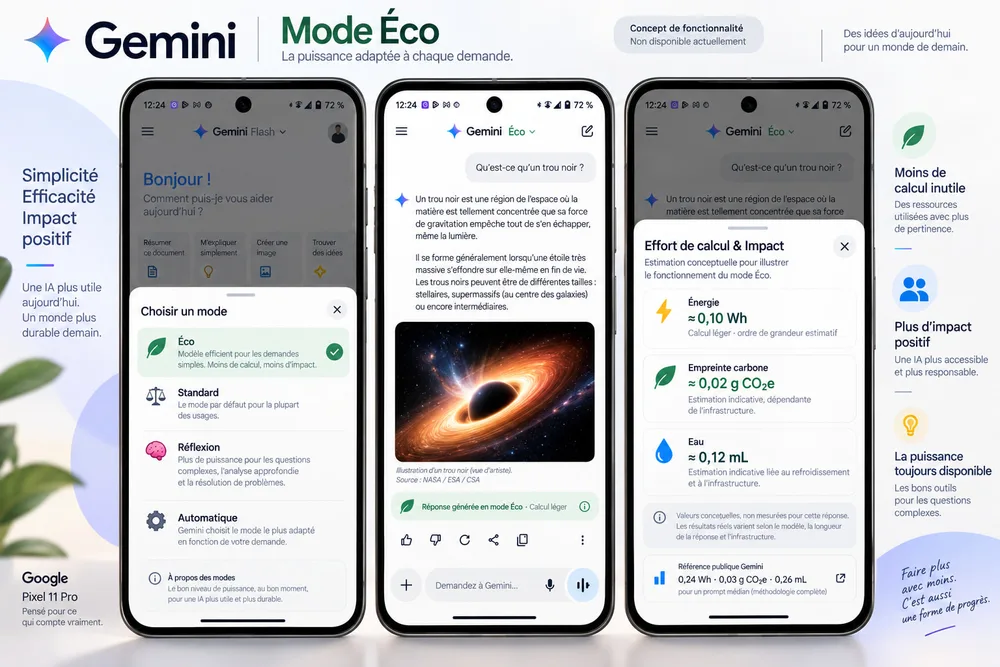
I've been thinking about how much compute we actually burn through for the most basic tasks in Gemini. Most of the time, I'm just doing a quick rewrite or a simple summary, and it feels like overkill to trigger a massive model for something that a lightweight version could handle in a fraction of the time and energy. I actually put together a formal feature suggestion for the Google AI Product Team because we need more transparency and control over model efficiency.
The goal isn't to claim the AI is "100% green," but to give us a way to practice some digital sobriety and actually optimize how the infrastructure is used.
How a Compute Intensity Selector would work #
The idea is to move away from a single "black box" response and instead have a UX selector in the mobile and web interfaces. It would look something like this:
- Eco Mode: This would force the system to use lightweight models, like Gemma 2B or a Flash-Lite variant. It's for those simple queries where you just want a fast, low-compute execution.
- Standard: The current default with dynamic, balanced routing.
- Extended Reasoning: This is where you'd go for the deep analysis and complex problem-solving that actually requires the heavy lifting.
- Automatic: Let the system smart-select based on how complex the query is.
Adding inference transparency #
Beyond just picking a mode, I think we need a discrete badge after the response is generated. Something like "Response generated in Eco Mode · Light compute" would let the user know what happened. If you wanted more detail, there could be an optional "Compute Effort & Impact" window showing qualitative indicators—things like "minimal carbon footprint" or "optimized cooling"—rather than trying to provide exact, unverified numbers.
Why this actually helps the backend #
From a workplace perspective, this isn't just about being environmentally conscious; it's about TPU optimization. If trivial queries are offloaded to smaller models, it frees up high-density TPU clusters for the enterprise workloads and extended reasoning tasks that actually need that power.

For those of us managing Scope 3 digital footprints for our companies, having a tangible way to adapt compute consumption would be a huge win. Plus, it's a great way for Google to actually showcase the utility of the Gemma and Flash families to the average user.
I even mocked this up on a Google Pixel following Material Design 3 guidelines to show that it could fit natively into the current Gemini UI without feeling clunky. It feels like a missing piece of the roadmap if we're talking about sustainable AI scaling.
All Replies (3) #
Want a live back-and-forth? Join the global AI chat room — login to talk. Curiosity here. It would be better if this Eco Mode automatically switched based on prompt length instead of just a manual toggle.
Curious why not. Most laptops have an eco mode, so why wouldn't they do it for consumers?
I want to try this tonight. Would a manual toggle for the TPU usage actually lower the latency for simple summaries?