Google did not ship Gemini 4 Hydrogen as a spec sheet only. The November 12 announcement links live apps and surface-native builds that show what the model is for: fast tool use, multimodal synthesis, and UI iteration.
This showcase lists official projects named in Google's posts. For pricing, benchmarks, and Orchestrator, start with the Hydrogen launch guide and comparison table.
TL;DR #
| Demo | What it shows | Try it via |
|---|---|---|
| Geminisland | Voxel world from one prompt | Live app linked in DeepMind post |
| E-commerce storefront | WebGL shader + scrollytelling UI | Antigravity + front end design skill |
| Sheets pixel canvas | Animation inside cells | Gemini in Sheets |
| Slides from YouTube | Deck + layout audit loop | Antigravity |
| Lightning 3D globe | Search + Web Audio prototype | Gemini app / Search examples |
| Water glass WebGL2 | Math-first shader UI | Consumer prototyping story |
1. Geminisland — shared voxel island from one prompt #
Google describes Geminisland as a live map where anyone adds structures from a single prompt, then walks them in first person. It is the clearest game-loop demo for Hydrogen: spatial reasoning, tool calls, and iterative refinement under latency pressure.
Why it matters for builders: If you route agent harnesses for world-building or procedural content, this is Google's reference for multiplayer-adjacent state, not a single-player chat transcript.
Source: Introducing Gemini 4 Hydrogen (live app link in post).
2. Antigravity e-commerce storefront — one-shot UI with WebGL2 #
Google paired Hydrogen with the Gemini front end design skill in Antigravity to ship a storefront that includes:
- A WebGL2 topographic shader
- **Four-stage scrollytelling**
- A **thermal split-slider**
- A 3D wireframe spec card
- A live finish configurator
Why it matters: This is the demo Google uses for design-to-code speed claims versus prior Flash models. Teams evaluating Antigravity against Claude Code should replicate the same component checklist on their brand system, not the generic landing template.
Source: DeepMind Hydrogen post (live app + skill links).
3. Google Sheets pixel animation — code inside a spreadsheet #
Hydrogen animated a pixel canvas inside Sheets by combining:
- Python generation
- Native LET(...) formulas
- Conditional formatting across thousands of cells
Why it matters: Enterprise users often ban external IDEs but allow Sheets. This demo targets finance and ops teams that live in spreadsheets, echoing Gemini in Sheets rollout context.
Google also claims 30%+ faster financial scenario outputs versus prior models in Sheets canvas for forecasting tasks.
4. Slides from a YouTube keynote — video in, deck out #
Starting from a YouTube keynote and a design template, Hydrogen in Antigravity:
- Generated a multi-slide presentation in Google Slides
- Ran an autonomous audit-and-fix loop for overlapping text and layout defects
Why it matters: It is an end-to-end document agent story with a explicit verifier loop, similar to patterns in multi-agent oversight research but productized inside Google Workspace.
5. Lightning strike globe — Search and Gemini app prototyping #
Google shows Hydrogen building an interactive 3D globe with Web Audio, driven by real-time global lightning strike data, mapping bolts into ripples and ambient sound.
A related consumer example tasks Hydrogen to build a WebGL2 water and glass visualizer from pure math and SDF textures, simulating refraction, dispersion, and absorption.
Why it matters: These are the demos Google uses for consumer creativity and Search visual answer narratives, not enterprise ROI slides.
6. Archival Hydrogen sizzle reel — video assembly skill #
Using a custom video assembly skill and a creative brief, Hydrogen produced an archival sizzle reel about the element hydrogen, sourcing public-domain footage and cutting one continuous edit with narration. Why it matters: It highlights tool + skill composition, the same pattern as agent skills registries but hosted inside Google Antigravity.
7. Google Search visual upgrades — production, not a demo repo #
The Search upgrade post is not a GitHub project, but it is the highest-traffic use case:
- Intent parsing for messy multi-part queries
- Visual, scannable answers
- Query fan-out with more diverse outbound links
Side-by-side phone screenshots in the DeepMind post compare Gemini 3.5 Flash versus Hydrogen on apartment repair, Boston neighborhoods, and sneaker shopping queries.
Why it matters for publishers: Pages that relied on classic ten-blue-links layouts compete with synthesized visual cards. Treat Search like a new surface in your analytics, alongside prior Search agent coverage.
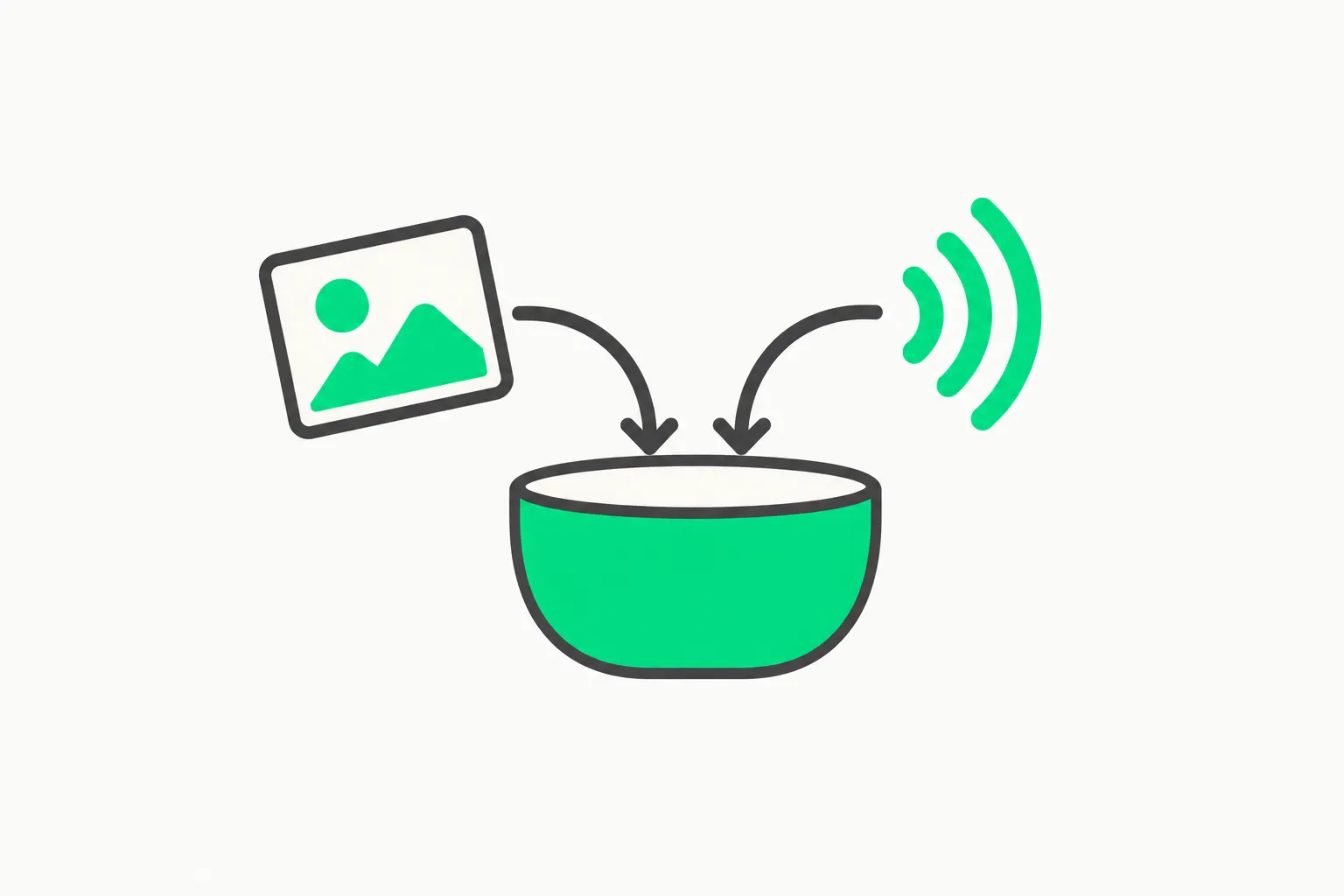
Multimodal fusion diagram for agents that combine text, images, and tools like Hydrogen demos
8. Orchestrator on Terminal-Bench — multi-model session demo (metric, not app) #
Google does not ship a public Orchestrator repo in the blog, but the Terminal-Bench 4.0 numbers are the demo for planner/worker routing:
- Near-Carbon success
- 24% less quota
- 19% faster completion
Reproduce this in your org by logging per-model token use inside Antigravity sessions before changing production routers.
9. Hydrogen element video brief — multimodal script fidelity #
The element-hydrogen reel shows brief adherence across video sourcing, narration, and continuous edit constraints — useful for marketing teams comparing Hydrogen to video agent stacks on governance rules.
10. Enterprise partner quotes — speed on real graphs #
Google cites partner testing on complex graphs, SQL, and data-heavy workflows: 2× to 2.8× faster with 12% to 23% fewer tokens versus 3.8 Flash.
These are named-customer anecdotes, not benchmarks. Still log them when justifying a Hydrogen pilot to finance.
Token budget jar illustrating cost control for high-volume Hydrogen agent sessions
How to try Hydrogen this week #
| Surface | Step |
|---|---|
| AI Studio | Select Hydrogen in the model dropdown; run one repo Q&A eval |
| Gemini app | Pro/Ultra: pick Hydrogen; Free: rely on auto routing |
| Search | Issue complex multi-intent queries you track in SEO tools |
| Sheets | Pro/Ultra or business eligible: run one forecasting sheet |
| Antigravity | Enable Orchestrator on a branch-only coding task |
Related on explainx.ai #
What builders ask about these demos #
Are the Antigravity links reproducible on day one? Google publishes them as live examples tied to Hydrogen and specific skills such as the front end design skill. Your account tier, region, and allowlist may block the same model id even when the blog is public. Treat each link as a smoke test, not a CI gate.
Do Search demos matter for API-only teams? Indirectly. Search side-by-sides show how Hydrogen handles multi-intent and visual formatting under latency pressure. Consumer polish often becomes default assistant behavior that API users also see in tool-calling templates.
How does Geminisland differ from Minecraft agent evals? Google markets Geminisland as shared world editing from natural language, closer to collaborative game tooling than Argon's Minecraft ender dragon run. Compare budgets: Geminisland is a instant-feedback UX demo; the dragon run was a long-horizon agent research artifact.
Can we embed these in our product? Google's demos are showcases on Google-owned surfaces. Third-party apps should use the Gemini API with your own UX, using these stories as acceptance criteria for prompts and skills.
Measuring success after you replicate a demo #
| Demo type | Metric to log |
|---|---|
| UI storefront | Time-to-first interactive layout; count of user fix-it turns |
| Sheets animation | Formula errors per thousand cells; render refresh latency |
| Slides from video | Layout audit issues caught autonomously vs manually |
| Search synthesis | Click-through on citations; user reformulation rate |
Security notes for flashy agent demos #
Hydrogen's launch posts emphasize lower misalignment and better IPI scores, but demos that read Gmail, Drive, or Connected Apps still need user consent and scope review. Follow the same minimum-privilege patterns we describe for Connected Apps MCP builds.
Pairing demos with model routing #
After you run one demo, rerun it on 3.8 Flash and Hydrogen high with identical prompts. Google claims large margins on speed and Terminal-Bench; your proprietary content may narrow that gap. Document results beside the comparison table so finance can see dollars per successful demo, not vibes.
Enterprise analogues #
Partner quotes in the launch post cite 2× to 2.8× speedups on graphs and SQL. Map those domains to your own:
- Knowledge graphs — entity linking plus summarization in one pass
- Warehouse SQL — explain plans and rewrite queries with tool access
- Compliance PDFs — multimodal report generation with citations
Each maps to the MKA and Agents' Last Exam benches Google lists, even if you never run those public suites internally.
Launch day checklist for demo parity #
Copy this checklist into your internal runbook when Google ships similar demos on future Flash tiers:
-
Open each live app URL from the DeepMind post in a clean profile.
-
Save prompt text andskill names in version control.
-
Record wall clock andtoken logs for Hydrogen vs your incumbent model.
-
File bugs when Connected Apps scopes differ between demo and your workspace.
-
Link results to the Hydrogen announcement so leadership sees verified replays, not marketing clips alone. Document failures too: a demo that only works on Ultra tiers is still useful intelligence for capacity planning.
Demo list reflects Google posts dated November 12, 2026. Links inside Google announcements may change without notice.