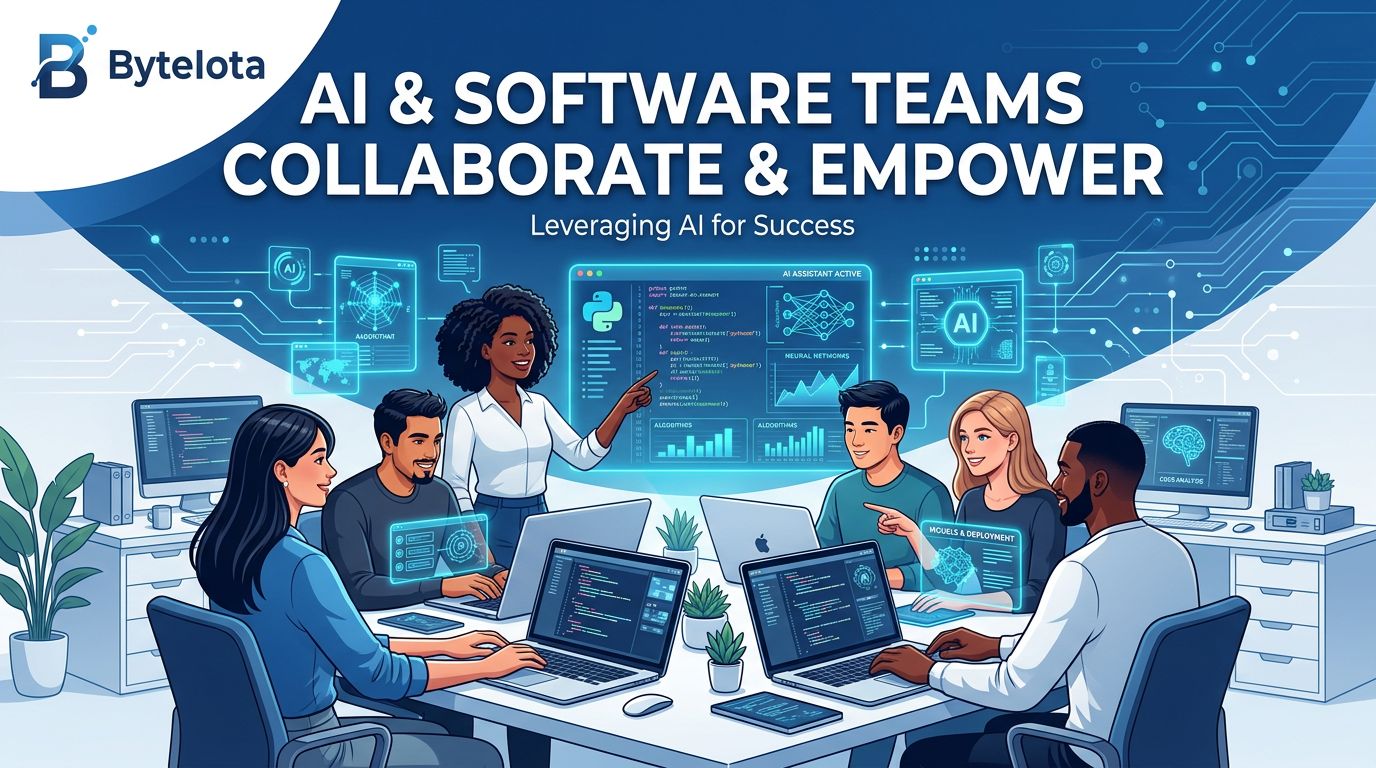
Gartner published a new forecast on July 7: by 2029, 60% of organizations will run smaller software engineering teams at scale, up from 15% today. The firm calls them “tiny teams” — 4-to-5-person units where each member covers what previously required multiple specialists, and AI agents handle routine work. That is a 4x shift in three years. What the headline buries is that Gartner spent half the press release warning engineering leaders not to use this as an excuse to stop hiring junior developers.
What “Tiny Teams” Actually Means #
Gartner’s definition is specific. A tiny team combines a product manager, a UX or agent experience (AX) designer, and at least one AI-native software engineer. Traditional role boundaries collapse — each member manages business goals, product design, and AI agent oversight simultaneously. The AX designer role is new: it focuses on designing environments that AI agents can navigate, not just human interfaces. Think of it as UX for non-human users.
Gartner is explicit that this is not a cost-cutting move: “Tiny teams are not a cost optimization tactic, but a restructuring of teams to best take advantage of both human and AI capabilities and strengths.” The operative word is restructuring. Engineering leaders who confuse the two will get the first part right — fewer people — and miss the second part entirely.
The Junior Hiring Trap #
This is where the forecast gets uncomfortable. Entry-level developer job postings fell 67% between 2022 and 2026. The share of juniors in IT employment dropped from 15% to 7% in three years. Sixty-two percent of engineering managers have already reduced or frozen junior hiring because of AI coding tools. The financial logic is hard to argue with: supporting a junior developer costs around $585,000 over five years when you factor in salary, benefits, and roughly 500 hours of senior mentorship. Ten GitHub Copilot seats over the same period cost $6,000.
Gartner’s warning is worth reading twice: “By 2028, organizations relying on AI to eliminate junior software engineering roles could hollow out their software engineering pipeline.” Slowing junior hiring inhibits knowledge transfer, restricts the internal talent pipeline, and eventually forces companies to compete for expensive senior talent in a market they helped make competitive by not developing the next generation. See the full junior developer crisis data from Ardura Consulting.
Ford Learned This the Hard Way #
Ford cut experienced engineers, leaned on AI for quality control, and it failed. The AI tools lacked the institutional knowledge and quality intuition that veteran technicians had built over decades — knowledge that left when the engineers did. Ford quietly rehired around 350 “gray beard” engineers in 2026, and those returning engineers rebuilt the data pipelines feeding Ford’s AI training, mentored junior staff, and reprogrammed the automated systems they had originally been replaced by. The result: Ford topped the JD Power 2026 U.S. Initial Quality Study for the first time since 2010.
IBM and Commonwealth Bank of Australia went through similar cycles. The lesson is not that AI does not work — it is that AI does not automatically inherit what experienced humans know. That knowledge has to be built in, and building it in requires people who have it.
What Survives the Compression #
The engineers thriving in tiny-team environments are not the fastest coders. They are the ones best at deciding what to build and catching where AI goes wrong. Problem decomposition, prompt precision, architectural judgment, and critical validation of AI-generated output are the skills that compound in value as teams shrink. A new role is emerging in forward-thinking organizations: the AI Reliability Engineer — who manages AI output integrity, writes the technical specifications that guide agent work, and performs hallucination checks on imported libraries and business logic.
AI has dramatically reduced the cost of building. It has not touched the cost of deciding what to build or whether what was built is correct. That is still a human problem, and it requires humans who were trained to think about it — including the junior developers who, given time and mentorship, become the senior engineers your tiny team depends on.
The Move for Engineering Leaders #
The Gartner forecast does not say “hire fewer people.” It says restructure your teams so that every person is doing work that only a person can do. Keep hiring juniors. Reshape onboarding so they are AI-fluent from day one, and pair them with mentors who specifically review AI-generated code. Read the full IT-Online coverage for additional industry context. The companies that cut juniors to fund Copilot seats today are making a two-year bet. The companies that maintain the pipeline will have the senior engineers that everyone else is bidding for by 2030.