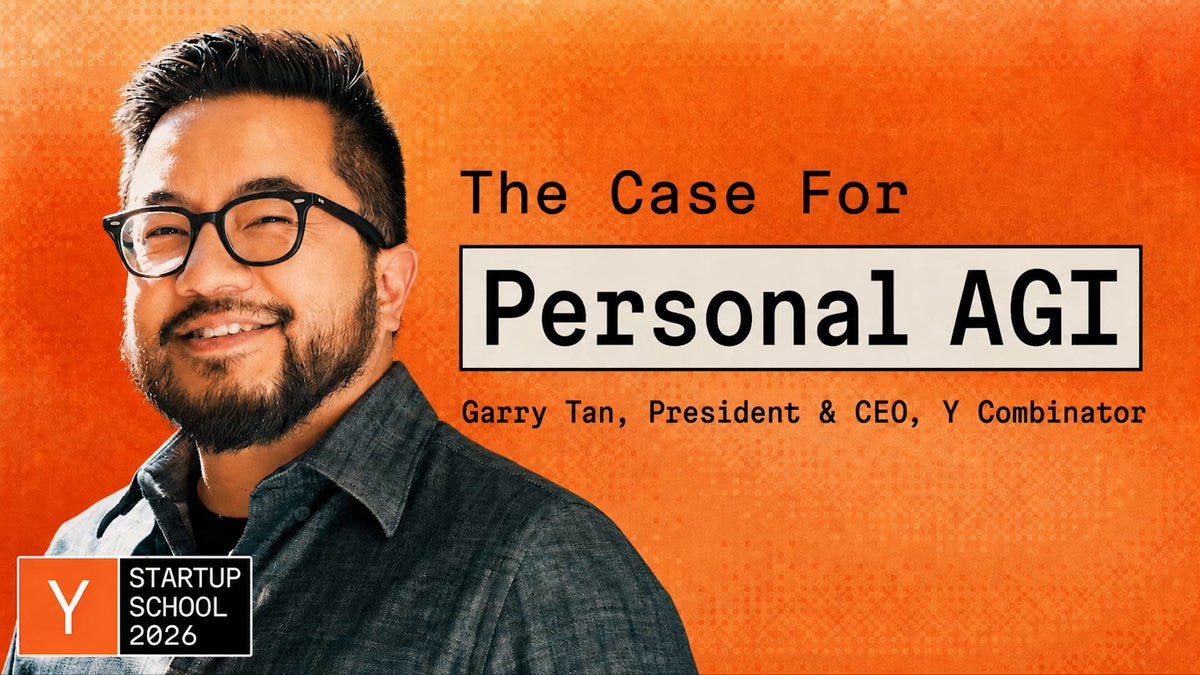
Garry Tan runs Y Combinator, the accelerator behind Airbnb, Stripe, and Coinbase. He says he now ships roughly 400x the work he did in 2013.
“Everyone is watching the sky, and the thing they’re watching for is already in the room.”
That’s his line on AGI. His version arrived with zero announcement: a folder of markdown files, so unremarkable that most people mistake it for nothing at all.
He calls it Personal AGI. A private stack of memory and skill files that gets sharper every day he uses it, the same discipline behind building a private context stack instead of starting every session from zero. He has run it in the open for years, 220,000 pages deep, and still makes kid pickup most nights.
I watched the full interview so you can skip it.
Here are the 10 moments that matter.
sponsored by Outskill:
Tan’s edge isn’t one tool. It’s knowing which one to reach for, and wiring them together so the work compounds.
This #
[Free 3-hour live workshop]covers the 15 AI tools that matter in 2026 and exactly when to use each: research, writing, design, data, code, automation:
▫️ Turn AI into a research engine that does the reading for you
▫️ [Build apps](https://links.outskill.com/AICOSEP1) and dashboards with zero coding

▫️ Wire tools together so [repetitive work runs itself](https://links.outskill.com/AICOSEP1)
Saturday, 10 AM EST. Usually $395, free for readers:
Most people reading this are renting intelligence by the month. Tan owns his.
That distinction is the whole interview, and it starts with what he calls Personal AGI.
1. Why "Personal AGI" beats the AI you rent for $20 a month
Everyone is waiting for AGI to announce itself. Tan’s bet: it already showed up, and most people are staring at the wrong screen.
“Personal AGI is a different animal. An agent that runs on your infrastructure, reads from a memory you own, executes procedures you wrote, and compounds.”
A subscription chatbot resets the moment you close the tab. It knows what everyone else already knows, and it gets rewritten on someone else’s schedule the moment the company behind it pivots. That’s a corporate AGI you rent, and it only improves when the company ships something.
Personal AGI runs the other direction. It gets sharper every day you feed it your own history instead of the internet’s, because every day it knows a little more of the specific life it’s working on. The corporate version waits on a release cycle. Yours waits on nobody.
One is a product you consume. The other is an asset you build.
Tan’s argument is that almost nobody has the second kind yet, while anyone in tech could have it by Monday, starting from the self-evolving agent stack.
2. The 400x claim, stress-tested to an 8x floor
Tan skips asking the room to believe the headline multiplier. He tries to break it himself, live, before anyone else can.
“It’s still 8x at the absolute floor, and 10 times that in the middle of the range.”
In 2013 he shipped about 14 useful lines of code a day as a YC partner working nights on Bookface, dead on median for a working programmer at the time. This year he runs YC full time, does a 5 o’clock pickup most nights, and still lands at roughly 400x that pace.
He applies the harshest discount he can think of before trusting the number: assume half the output is scaffolding, assume the agent writes bloated code, assume he’s flattering himself, which he calls a live possibility. The multiplier survives every version of the test.
The effect reaches past code, too. Tan says the same range shows up in design, product, and growth work, any slice of knowledge work where an agent runs the loop start to finish. Most people still budget their week around 1x. The floor here, by his own admission, is 8x.
Want to test an output claim like this on your own machine? Start here:
▫️ [The complete guide to AI coding in 2026](https://www.the-ai-corner.com/p/ai-coding-tools-complete-guide-2026?r=1krivi)

▫️ [The Claude Code system that replaces a 5-person team](https://www.the-ai-corner.com/p/the-claude-code-system-that-replaces?r=1krivi)

▫️ [The Loop Library: 12 Claude Code recipes](https://theaicorner1.substack.com/p/claude-code-loops-library-goal-schedule-recipes-2026?r=1krivi)
3. A quarter of one YC batch ships code that's 95% AI-generated
A year and a half before this talk, the Winter 2025 batch crossed a line most founders haven’t heard of yet.
“A quarter of the companies had code bases that were 95% AI generated. That batch is on track to becoming one of the fastest growing, most profitable batches in the history of YC.”
Tan is careful about causation. He cannot prove the AI-generated code caused the growth, and he says so directly instead of letting the stat imply more than it does.
What he will say: the fastest-growing founders in the portfolio run agents everywhere and treat them as a workforce instead of autocomplete. That distinction, he argues, is the entire gap between marginal gains and compounding ones.
Same model, same context window, same API. Some founders get 2x and some get 100x on identical tools, and Tan says the gap comes down to what context the agent gets, and at what step it gets pulled in. Which lab built the weights underneath barely registers.
4. The working memory problem: you hold 7 things, his agent holds 3 Harry Potter books
You hold about 7 things in working memory at once. It’s why local phone numbers run 7 digits, and why the 8th item on a grocery list disappears somewhere between the cereal aisle and checkout.
“Your life is not three books. Your life is a library. The question that determines whether your agent is a genius or a goldfish is this: who decides which three books are open on the desk?”
An agent skips that ceiling. It holds roughly 1 million tokens open, about 1,000 pages, 3 Harry Potter books sitting open at once, and it can find a single fact buried anywhere inside them and synthesize across all 3 in seconds.
The gap runs in both directions, though. 1,000 pages sounds like a lot until you compare it to an actual life: every email, every meeting, every decision, and the reasoning behind it. That’s the scale Tan built G-Brain to close: 220,000 markdown pages, 25 years of his working life diarized, compiled and searched by agents so he never re-answers a question he already answered once.
5. Inside the one-page file Tan calls a "skill"
Tan keeps saying “skill file” without defining it, so he finally puts one on the screen.
“When a meeting recording lands, transcribe it with speaker labels, pull out the commitment made, who made it, and the deadline. Cross-check every person named against the library and link their pages. If anything contradicts something we already believe, flag it. Don’t overwrite it.”
That block of plain English is the whole skill. Anyone who can read could follow it, and that’s Tan’s actual test for whether an agent can run it: if a smart intern could execute the instructions, so can the model.
At YC, staff with zero engineering background now write skill files and schedule recurring jobs off them. One finance team member folded roughly 100 Excel workbooks into a single internal tool, no code, just a page of instructions and an agent that could follow it, turning her into what Tan calls a manager of agents instead of a spreadsheet operator.
Markdown is the code now. The compiler is a language model.
Writing instructions an agent can execute makes you a programmer regardless of your job title, a shift Tan says is already showing up in departments that never touched a terminal before this year.
Ready to write your first skill file? Start here:
▫️ [25 Claude Skills that give your startup a marketing team it cannot afford yet](https://www.the-ai-corner.com/p/claude-skills-startup-marketing-complete-library-2026?r=1krivi)

▫️ [The single best productivity decision you can make with Claude right now](https://www.the-ai-corner.com/p/claude-skills-complete-guide-2026?r=1krivi)

▫️ [The AI skills playbook, with templates](https://www.thevccorner.com/p/ai-skills-complete-playbook-templates-prompts-2026?r=1krivi)
6. The overnight research run that wrote this talk's own opening
5 days before the talk, Tan decided it needed a Spinoza story.
“My agent acquired 3 of the best biographies about the man, about 1,500 pages, read all three, and built me a synthesis: a dated chronology, every place the biographers disagree, the best verbatim quotes with chapter citations, and the 10 most tellable moments of his life ranked with delivery notes.”
He calls this a compendium skill, a deeper, personal version of the overnight research runs he uses daily on smaller questions.
The knife attack, the bribe, the desk shipped by canal barge: every beat that opened this exact talk came out of that single run, sourced, dated, and cross-checked while Tan was asleep, ready to edit over coffee the next morning. The research finishes on its own clock, and that is the whole pitch for the compendium skill in one anecdote.
7. 2 startups breaking the old revenue-per-headcount math
Tan points to 2 portfolio companies as proof the economics shifted, beyond the tooling around them.
“Emergent, out of our summer 24 batch, went from public launch to 9 figures of revenue in 8 months.”
Earlier in that climb, when Emergent crossed $15 million in annualized revenue, the company was 15 people, roughly $1 million per head. Retell AI, from the Winter 2024 batch, hit $60 million annualized with about 40 people, a similar ratio at more than triple the scale.
“That revenue per person did not exist before. Not in software, not in oil, not in railroads.”
Neither company scaled into this stack after the fact. Both started as 1 or 2 people running it from day one, in every batch room YC now runs, and Tan’s claim reaches past 2 lucky outliers: it’s about what happens to unit economics once the headcount doing the work stops limiting how fast a company can grow, the shift every founder valuation now has to price.
8. The 5-step playbook, and the line that ends "you failed"
Tan closes the how-to section with a sequence he says takes about a day to start and about 12 weeks to compound.
“Never do one-off work. At the end of every task, ask the agent to skillify what it did. Turn it into a markdown file you can use and reuse forever. If you have to ask for something twice, you failed.”
The 5 steps:
Pick an agent tool tonight and run it on your own machine.
Start a folder of markdown pages this weekend, one page per project or person.
Write your first skill file on the task you hate most, and correct it until it stops getting things wrong.
Wire it into a job that runs while you sleep.
Never do one-off work again. Skillify everything, every time.
Most people who try this quit by week 2. That’s exactly why the ones who stick with it feel like they’re cheating by week 12.
Planning your own 90-day build? Start here:
▫️ [Build your own stock analyst with Claude](https://www.the-ai-corner.com/p/build-your-own-stock-analyst-claude-12-prompts-2026?r=1krivi)

▫️ [The one-person startup operating system](https://www.the-ai-corner.com/p/one-person-startup-operating-system-2026?r=1krivi)

▫️ [GTM in 2026: what actually changed](https://www.thevccorner.com/p/gtm-playbook-2026?r=1krivi)
9. Who owns Maya's judgment when she leaves the company
Tan tells a fictional story to make the politics of all this explicit.
“The company keeps running her judgment without her. 40 files executing forever, and her name isn’t even in the commit history. She didn’t have a career. She had an extraction.”
A support engineer named Maya spends 2 years teaching her agents 40 skills: how to triage a P0 at 2 a.m., how to de-escalate a customer about to churn, how to write a postmortem that actually prevents the next incident.
In version 1, those files live in Maya’s own repo. She changes jobs, and years of compounded judgment go with her on day one, the way a craftsman used to carry their own tools between employers.
In version 2, the files live in the company’s repo, under company policy. Maya leaves with nothing, and the company keeps running a version of her that never asks for a raise.
Same files. Same Maya. One variable, who holds the repo, decides which future she gets.
“I believe skill files are yours. Own your skills because if you don’t, your job becomes a skill file.”
10. A father built an 80,000-page brain for his son
Tan closes on the moment that gives the whole talk its stakes.
“No lab, no grant, no permission. He built a repo of 80,000 markdown files. A brain for one small boy.”
A friend of his has a son with a rare form of epilepsy. Every specialist visit, every paper, every seizure log, every drug interaction, indexed and cross-linked, so that when a new doctor floats an idea, the father already knows in minutes whether it has been tried and what happened when it was.
Nobody was coming to build that for him. No institution had a budget line for one specific child’s condition, and no lab was going to prioritize a sample size of one.
Nobody’s coming to build yours either, Tan tells the room, which is the entire argument of the talk compressed into a single family: the tools exist now, and the only remaining question is whether you pick them up. He frames it as what the whole architecture, the library, the librarian, the right 3 books open at the right moment, looks like when it’s pointed at the one thing a person loves most in the world instead of a quarterly OKR.
“A father, a laptop, and a library. That is Personal AGI.”
What this means for you
Model quality is rented, and it gets cheaper every quarter. Your context is the only part of this stack you actually own, and the only part that compounds.
▫️ Founders: start the library before you incorporate anything. Build one skill file this week, on the task you dread most, and wire it into a job that runs overnight.
▫️ Investors: you get more signal from how a founder talks about AI in due diligence than from asking about model access. The 2x-to-100x gap Tan describes comes from context and workflow discipline, and it shows up in burn multiples before it ever shows up in a pitch.
▫️ Operators: zero code required. Tan’s own finance team folded 100 spreadsheets into one internal tool without touching a line, so pick your worst recurring task and skillify it first.
▫️ Everyone else: you were told the barrier was team, funding, and permission. Tan’s argument is that fact expired. Start a folder tonight, on your own machine, with your own history in it.
The 5 principles to steal #
Own the context, rent the model. Frontier models are a commodity that gets cheaper every quarter. Your library is the only asset in this stack that compounds.Skill files come before teammates. A page of plain English a smart intern could follow is something an agent can run today, before you’ve hired anyone.Separate judgment from arithmetic. Taste and reading intent belong in the model. Counting, scheduling, and querying belong in code the model calls.Skillify every repeated task. Asking for something a second time is the failure, and it’s yours.Keep the repo, keep the keys. A skill file is your judgment, extracted and made to run. Whoever holds the repo holds the judgment.
The gap between the people running this system and everyone else widens every month it goes unexamined.
If this breakdown saved you a weekend of trial and error, send it to one founder or investor who needs it.
Keep reading #
Build your own Personal AGI
▫️ [How to 10x any AI skill using Karpathy’s Autoresearch method](https://www.the-ai-corner.com/p/karpathy-autoresearch-method?r=1krivi)

▫️ [Give your agent its own computer](https://www.the-ai-corner.com/p/give-your-agent-its-own-computer-2026?r=1krivi)

▫️ [Clone your voice into Claude in a weekend](https://www.the-ai-corner.com/p/clone-your-voice-into-claude-weekend-voice-file-system-2026?r=1krivi)
More from YC’s world
▫️ [YC Summer 2026: the ideas worth stealing](https://www.thevccorner.com/p/yc-summer-2026-requests-for-startups-ideas?r=1krivi)

▫️ [Y Combinator W26: the complete company database](https://www.thevccorner.com/p/yc-w26-batch-complete-company-database?r=1krivi)

▫️ [Replit was rejected by YC 3 times. Then Paul Graham called Sam Altman](https://www.thevccorner.com/p/replit-pitch-deck-seed-2016-story-playbook-2026?r=1krivi)
For investors watching this shift
▫️ [What top VCs look for in 2026](https://www.thevccorner.com/p/what-top-vcs-look-for-2026-founder-playbook?r=1krivi)

▫️ [Survivorship bias is killing founders’ judgment. Here’s the fix](https://www.thevccorner.com/p/startup-lessons-most-founders-ignore?r=1krivi)

▫️ [The self-improving fundraising system](https://www.thevccorner.com/p/self-improving-fundraising-system-claude-14-steps-2026?r=1krivi)