Distillation is cost optimization at home and theft abroad.
Tuesday morning saw US Treasury Secretary Scott “Chucklepony” Bessent on Fox Business saying that the administration will investigate whether Chinese models were distilled from American ones; he left sanctions on the table for “theft.” The obvious answer half the internet is responding with is aligned with “you’ve attempted to steal what I have rightfully stolen.”
Earlier this month, Kimi K3 shipped, which is the largest open weight release to date. This was met by the model labs and other ill-informed blowhards calling for regulatory action:
This... is cute, given that these open weight models are being hosted by US-based providers, not Chinese providers or the labs themselves. There’s no “sending your corporate data to China” aspect here. But there is an economic one: my thesis is that this is a pricing story that makes more sense once you go back to a leaked contract from three weeks ago.
The Amazon contract #
The Information reported that as of next year, Anthropic has reworked its Amazon contract to reprice Amazon from compute-hours to tokens; this is the same structure as every other Anthropic customer. Truly, it’s notable that the internal structure of the Amazon and Anthropic relationship didn’t follow this structure to begin with, and does explain some historical oddities in how Amazonians talk about their AI use vs. basically the entire rest of the industry.
This leaves Amazon, heavily entrenched as a Claude customer, on the back foot due to three structural changes.
Efficiency gains in serving Anthropic models will now accrue to
Anthropic, not Amazon, as they’re moving from a structure that resembles cost-plus to instead something more akin to retail pricing.Trainium recursion: Amazon’s chip improvements will, instead of reducing a bill that Amazon pays, improve Anthropic’s
marginon a bill Amazon pays.In the runup to a presumed IPO, this is effectively cleaning up a bunch of related-party exception cases. “Everyone pays us per token” is a lot cleaner structurally without an “except for this Amazon deal” outlier.
This may well be structurally intended; we don’t know what the actual contract says or the intent of its framers. If I had to bet, I’d say that this was always the plan: in time Amazon would move to token based pricing as their usage declines. Remember, they’ve invested tens of billions into Anthropic; you don’t surprise your partners out of the blue with a completely new pricing structure unless you’re Broadcom.
The alternative is that when an Amazon spokesperson was cited as saying it was “incorrect that changes from our expanded collaboration will increase our costs,” they said it while sharpening an ostentatiously large knife. Amusing though that may be, I don’t buy it.
Curiously, a number of open weight models have already made their way into Kiro (”Amazon Basics Cursor”) in recent months. Four open model families (Qwen, Deepseek, MiniMax, and GLM; all of them behind the current frontier versions) have made their way into that dev tool’s model selector as of this writing, with Qwen3 Coder Next discounted to a shocking .05x multiplier of whatever the hell a Kiro “credit” is supposed to be. (GPT 5.6 Sol rides the other end of the pricing curve at 2.4x multiplier.)
Pushback against the “frontier” branded token #
As per the same reporting that gave us that contract leak, Amazon has been distilling Claude internally (by all accounts their contract allows this; Amazon is not stupid, plus Anthropic has enough riding on the outcome of a legal decision here that they’re not likely to pick a ~$2.6T company as their test case), while also taking a $50B OpenAI stake as a potential second source since their “Nova” models have so far not exactly taken the world by storm. Meanwhile, “whatever Microsoft is doing” apparently includes Microsoft routing Copilot prompts to its own MAI group’s models. Microsoft’s AI CEO (which makes him sound like a model himself) Mustafa Suleyman’s stated goal of zero Anthropic spend makes it clear that model choice for the hyperscalers themselves is a critical path strategic item. All three hyperscalers have tried and failed at launching industry-leading frontier models; their path now means they have to blunt single-vendor risks, and that path increasingly looks like open models.
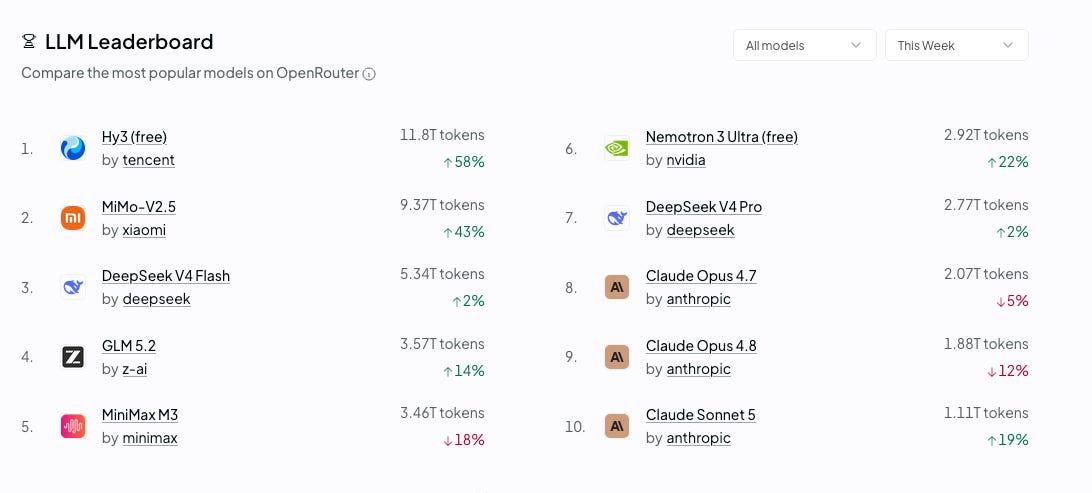
And the industry agrees! When you look at the plethora of great Chinese open weights models at a cost of zero beyond “the cost to actually run the models,” it’s rational to think that the model labs may start thrashing around in ways that don’t align with the goals of the hyperscalers themselves. We see the pattern starting to emerge; OpenRouter’s “top 5 by weekly tokens” leaderboard are as of this writing now all Chinese open weight models:
Price disclosure via executive order #
A vendor meters what constrains it. (Mostly; AWS has yet to price for giving services crappy names.) Early AWS’s data flows were such that they priced for egress, but ingress cost them little once those paths were built; ergo, they had ingress bandwidth to burn so they priced it as free. What does a vendor do when it has a constraint that it’s structurally incapable of pricing? As we’re learning, they lobby about it.
The current regulatory apparatus in the US is clearly playing ball. Both Anthropic and OpenAI have been sounding the alarm about the dangers of open weight models, though the dangers seem to be largely to their own business models. The FUD machinery is in full swing, suggesting that these models will “phone home,” (trivially detectable for any reasonable infrastructure), require up sensitive data to the labs that created these models (these models are large files available for download; there is no need for them to be hosted by any particular provider), and might act as “sleeper agents” ready to awake and write garbage code when triggered (you hired Steven and he already does that after lunch most days).
Technical enforcement here is basically a fantasy; you can’t crack down on the down of these models any more than the RIAA could crack down on the down of MP3s decades ago, leaving their toolbox pretty empty past “criminal liability for model possession” which is a little too far down the information suppression playbook.
There’s an enforcement asymmetry here as a result. The state can raise the risk premium on Chinese weights, but not their price. On-prem inference is undetectable; you can’t really do much about it beyond policy. Ignoring first amendment issues entirely, “a government mandate to increase token spend by 20x” would go over like a lead balloon.
The entrenched are thus being taxed for depending on models that can be repriced (Amazon) or repossessed (Fable), while the models Washington is calling dangerous are showing themselves to be the only ones that can’t be either.
What’re you to do? #
And so, barring an ability to predict the geopolitical futures, the smart enterprise instead builds in model optionality. It’s hard! I’ve found that a lot of the stuff I’ve built over the past year overindexes on Claude, and hence I’ve been sleeping on OpenAI’s excellent work—but as I’m refactoring that dependency out, I’m also planning for open models use as well. When you don’t know what rug’s about to get pulled, get several rugs and polish the linoleum underneath.
—C