Minseon Kim, Zhengyan Shi and colleagues at Microsoft Research present FrogNano, a 4B coding agent post-trained only with RL on roughly 1,500 SWE environments using synthetic tasks, with no distillation from a larger model.
Ask this paper #
Online task synthesis at the learnability frontier: The pipeline generates tasks calibrated to what the current checkpoint can just barely solve, and the report argues this calibration, rather than task volume, is what makes the training work.
No distillation from larger models: FrogNano is evidence that a competitive small coding agent can be trained from synthetic tasks alone, which removes the dependency on a stronger teacher that most small-model coding agents rely on.
Built for constrained hardware: The stated target is a coding agent that runs on minimal hardware, and evaluations cover diverse SWE environments rather than a single benchmark.
An ongoing line, not a finished model: The report positions FrogNano as a foundation for continued work on lightweight coding agents and includes training methodology and analyses rather than only headline scores.
Abstract #
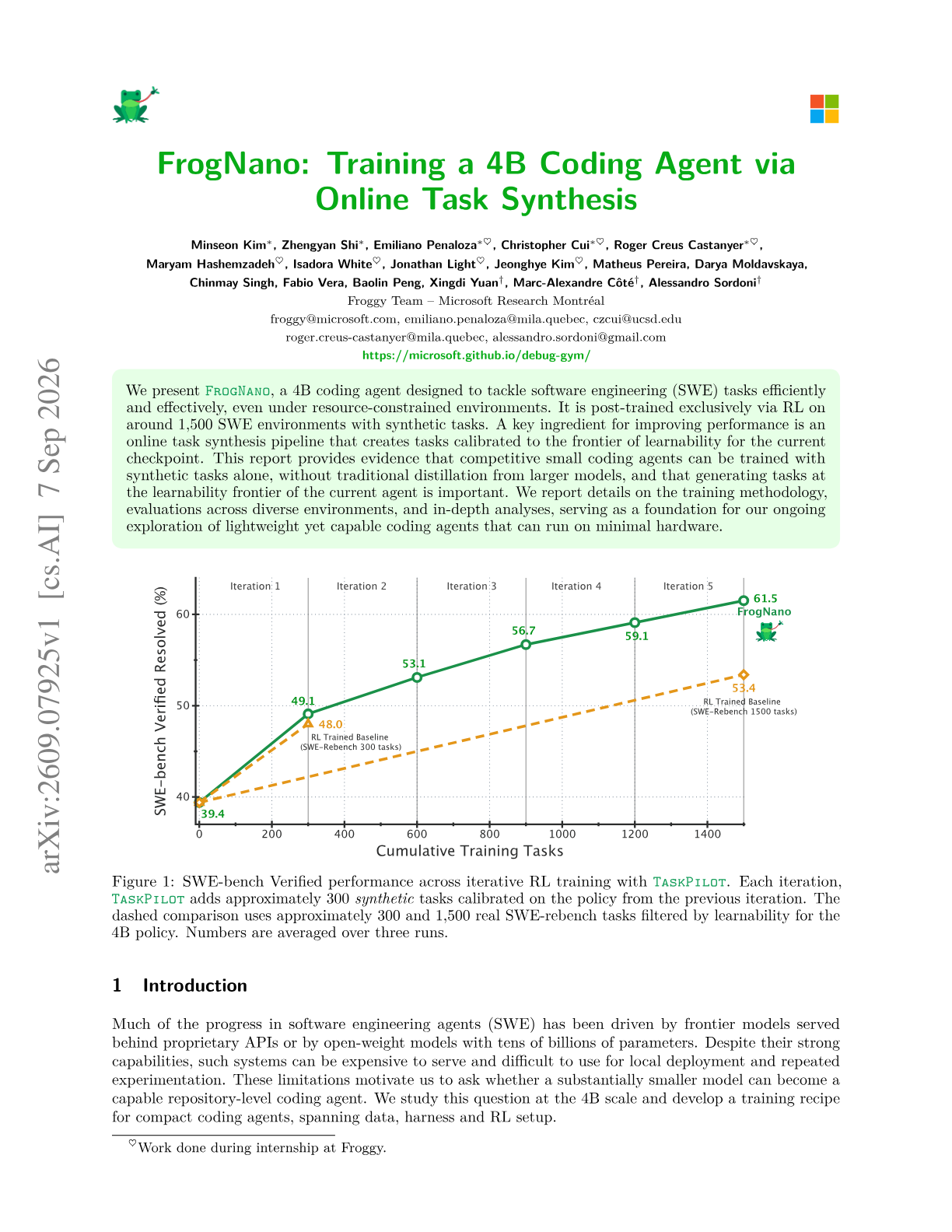
We present FrogNano, a 4B coding agent designed to tackle software engineering (SWE) tasks efficiently and effectively, even under resource-constrained environments. It is post-trained exclusively via RL on around 1,500 SWE environments with synthetic tasks. A key ingredient for improving performance is an online task synthesis pipeline that creates tasks calibrated to the frontier of learnability for the current checkpoint. This report provides evidence that competitive small coding agents can be trained with synthetic tasks alone, without traditional distillation from larger models, and that generating tasks at the learnability frontier of the current agent is important. We report details on the training methodology, evaluations across diverse environments, and in-depth analyses, serving as a foundation for our ongoing exploration of lightweight yet capable coding agents that can run on minimal hardware.