            The Codex CLI itself costs nothing: it is open source under Apache-2.0. The model behind it is
            what you pay for. OpenAI's Codex pricing page lists a **Free plan at $0**, described
            as "Explore Codex capabilities on quick coding tasks.", and publishes no usage figure for it. The
            first plan with published estimates is **Plus, at $20 a month**.
Clixad is a terminal coding agent that meters real tokens in credits. Five cheap models are free up to a daily allowance, and every other model runs on credits you earn in a browser tab or buy, OpenAI's GPT-5.2 and GPT-5.5 among them. We build Clixad. The conclusion still runs against us: if Codex is your daily tool, Plus is the better deal.
What Codex costs #
Codex is one agent with several front ends: a CLI, an IDE extension, a desktop app and a cloud version. This post is about the CLI. Its README states that the repository "is licensed under the Apache-2.0 License", and it signs in two ways: with a ChatGPT account, spending the plan's allowance, or with an OpenAI API key, paying per token.
The README recommends signing in "to use Codex as part of your Plus, Pro, Business, Edu, or Enterprise plan". OpenAI's Codex pricing page goes further down the ladder and adds two cheaper tiers below Plus. Everything below comes from that page and the README, both read on 18 September 2026.
| OpenAI's individual Codex plans as listed on its Codex pricing page, with OpenAI's own one-line descriptions. Vendor figures, not engine output. | ||
|---|---|---|
| Plan | Price | OpenAI's description |
| --- | --- | --- |
| Free | $0 a month | "Explore Codex capabilities on quick coding tasks." |
| Go | $8 a month | "Use Codex for lightweight coding tasks." |
| Plus | $20 a month | "Power a few focused coding sessions each week." |
| Pro | From $100 a month | "Choose 5x or 20x higher rate limits than Plus." |
| API key | Per token at API rates | "Great for automation in shared environments like CI." |
Read the descriptions in order and they form a ladder of usage: quick tasks, lightweight tasks, a few focused sessions a week, then multiples of that. Plus is the plan most people mean when they say Codex, and OpenAI describes it as enough for "a few focused coding sessions each week". That is worth knowing before you plan a working week around it.
What the free plan does not say #
OpenAI publishes usage estimates for Codex, and its table starts at Plus. There is no column for Free or for Go. The Free plan is priced at $0 and linked from the page, and its allowance is stated nowhere on it.
The published estimates are counted in local messages per five-hour period, and OpenAI attaches warnings to them. Above the table: "These estimates are not fixed message limits". Below it: "Local messages and cloud chats share your plan's usage allowance. Weekly limits may also apply."
| OpenAI's estimate of local messages per five-hour period on Plus, for the Codex models this post mentions. Vendor figures, which OpenAI says are not fixed limits. | |
|---|---|
| Model | Local messages per five hours on Plus |
| --- | --- |
| GPT-6 Astra | 5 to 45 |
| GPT-5.6 Sol | 10 to 100 |
| GPT-5.6 Terra | 25 to 200 |
| GPT-5.6 Luna | 250 to 2,000 |
| GPT-5.5 | 15 to 80 |
A message is what you send. What it costs depends on what the agent does next, and OpenAI says so
          on the same page: "Tasks that look similar can consume different amounts of your allowance." It
          adds that "prompt length alone isn't a reliable estimate." That is why the ranges run as wide as
          tenfold, and it is the problem [our post on
          request counts](https://clixad.io/blog/free-ai-coding-tier-limits/) describes: an allowance counted in anything other than tokens cannot tell you
          how much work it holds.


          The page is also quiet on what happens when the Free plan runs out. It says that Plus and Pro users
          "can purchase additional credits to continue working", and that "All users may also run extra local
          chats using an API key". For a free account, then, the route past the limit is the API, paid per
          token. [Our post on reset windows](https://clixad.io/blog/free-ai-coding-tier-reset/) found the paid
          plans documenting their limits better than the free tiers do, and Codex's free plan fits that
          pattern.
What Clixad does differently #
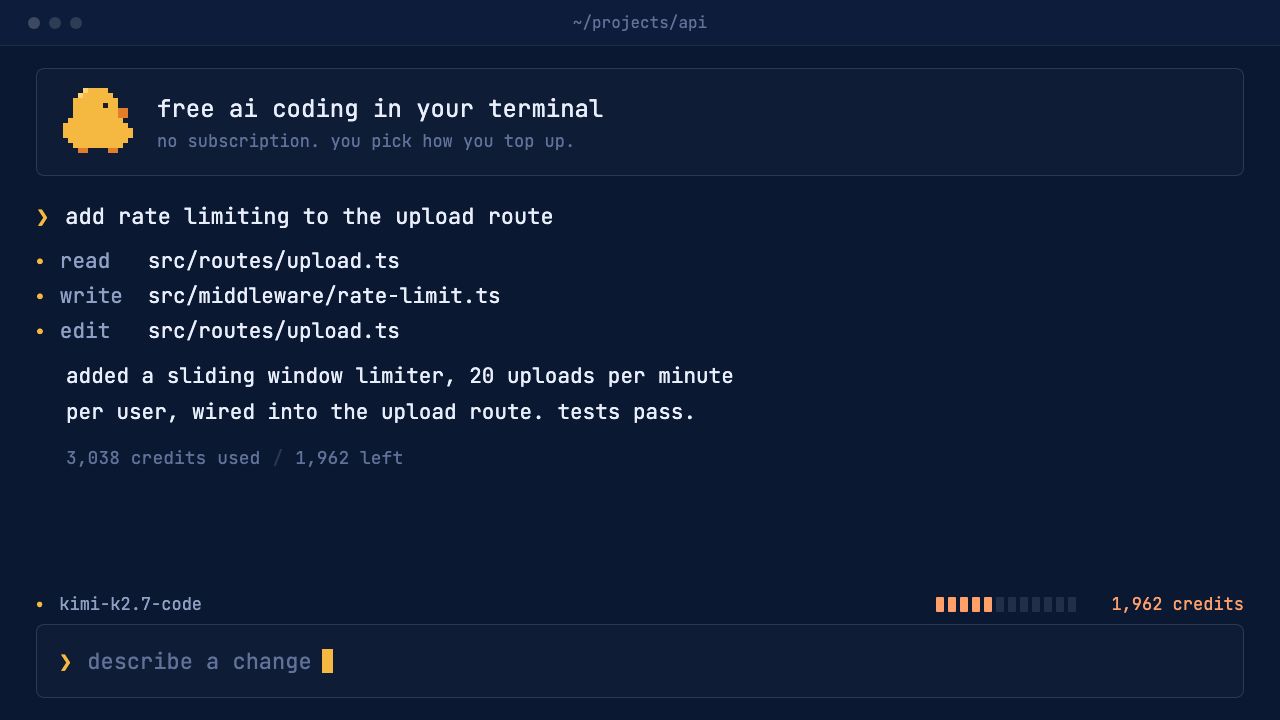
Clixad does the same job in the terminal. It works through a project the way the Codex CLI does, editing files and running commands, and it asks before either unless you switch that off. The bill is where it departs from Codex.
Tokens are the unit. Every model call is metered from its real token count at a published rate, 100,000 credits to one US dollar of list value. The price of each model is public before you pick it, and a small job costs a small amount.
Five cheap models are free every day. GPT-5 Nano, Gemini 2.5 Flash-Lite, DeepSeek V4 Flash, Gemini 3.1 Flash-Lite and Kimi K2 cost nothing up to 12,000 credits of usage per account per day. That allowance sits inside a daily budget shared by everybody, so on a busy day the free turns can run out sooner. Free usage adds and deducts nothing. Past either limit those models cost credits again until the next day.
The rest of the catalogue runs on credits. Fourteen models from five vendors sit on
one balance, and /model switches between them mid-session. OpenAI's four run from GPT-5
Nano at the cheap end to GPT-5.2 Pro at the top, with GPT-5.2 and GPT-5.5 between them. A new
account starts with 25,000 credits. After that you earn credits by completing an advertiser action
on an offerwall page in a browser tab, or you buy them; the smallest pack is $5 for 500,000 credits.
OpenAI's newest models are missing. The GPT-5.6 family and GPT-6 Astra that Codex offers are not in our catalogue, which was last read from OpenRouter on 26 July 2026. The pricing page also says "GPT-5.5 retires from ChatGPT, ChatGPT Work, and Codex on all plans on October 14, 2026. The OpenAI API isn't affected." Our GPT models are reached through the API.
Earning is uneven, and we say so. Credits arrive on completion. The most common
          outcome of starting a survey is a screenout: a few questions in, the survey decides you are not the
          respondent it wants and ends with nothing credited, or with a small bonus. From our own ledger,
          completed offers on our CPX wall have credited from 9,000 to 114,000 credits on completion, with a
          median of 51,000: 26 completions recorded in our ledger between 27 July 2026 and 12 September 2026,
          as of 14 September 2026. The ledger does not record how long an offer took, so we cannot tell you
          what a minute pays.
There is one ad in the session. While a model call runs, one line above the input
box shows a sponsored message marked Ad. Nothing you type takes part in choosing it,
          and `CLIXAD_SPONSOR=0` stops the request for it being made at all. Codex shows no
          advertising, and that counts in its favour.
Your instruction file carries over. Codex reads project instructions from
AGENTS.md, which its pricing page mentions in its advice on making limits last. Clixad
reads the same file, next to its own CLIXAD.md, so a repository set up for Codex needs
no new one.
One agent task, priced #
A plan price tells you what you pay and leaves out what you get, so this blog prices one fixed
          workload: a single instruction that an agent turns into twelve model calls, starting at 12,000
          input tokens and resending the whole conversation every round. The shape is declared in the markup
          of [the tier-limits post](https://clixad.io/blog/free-ai-coding-tier-limits/), and a test recomputes every
          figure below from our pricing engine.
| Credits for one twelve-call agent task, then how many whole tasks the daily free allowance (12,000 credits, five cheap models only) and a full day at the earning cap (500,000 credits) each cover. Recomputed from packages/pricing by a test. | |||
|---|---|---|---|
| Model | Credits per task | Free allowance, per day | Earning cap, per day |
| --- | --- | --- | --- |
| GPT-5 Nano | 3,051 | 3 | 163 |
| Gemini 2.5 Flash-Lite | 5,664 | 2 | 88 |
| GPT-5.2 | 106,632 | not a free model | 4 |
| GPT-5.5 | 293,850 | not a free model | 1 |
| GPT-5.2 Pro | 1,279,531 | not a free model | 0 |
packages/pricing by a test.
The OpenAI rows below GPT-5 Nano sit outside the free allowance. The 25,000-credit signup bonus does not cover a task on any of them, and a full day at the earning cap buys 4 tasks on GPT-5.2 and 1 on GPT-5.5. GPT-5.2 Pro costs more per task than the whole cap, at 1,279,531 credits, so a day of earning does not buy a single task on it.
The free part is the top two rows: 3 whole tasks a day on GPT-5 Nano and 2 on Gemini 2.5 Flash-Lite, with no earning at all. Next to what Plus estimates for GPT-5.6 Luna, that is small.
Who Clixad fits #
Someone who codes in bursts. Credits do not expire, so a quiet week costs nothing and the balance is still there the week after. A subscription bills the quiet week at the price of the busy one.
Someone who wants a price before the task. Codex's free plan publishes no allowance and its paid plans publish ranges. Our table gives one number per model for a defined task, and the wallet is checked before a request starts.
Someone who wants several vendors on one balance. Claude, GPT, Gemini, DeepSeek
and Kimi models sit behind the same /model picker, priced per token. Trying Claude
Sonnet 5 on a problem GPT-5.2 fumbled costs that call and nothing more.
Someone without a card to put on file. The account is a GitHub login, and neither the free allowance nor the offerwall asks for payment details.
Who should pay for Codex #
Anyone for whom Codex is the daily tool. Plus costs $20 a month and includes, in OpenAI's words, "GPT-5.6 Luna for higher usage limits on lighter-weight or high-volume workloads", estimated at 250 to 2,000 local messages every five hours.
We cannot convert those messages into our tasks, and OpenAI warns against converting them into anything. The gap is wide enough that the conversion hardly matters. Take GPT-5.5, the one model both sides carry and price. The bottom of OpenAI's Plus estimate for it is 15 messages in five hours, and our whole daily earning cap covers 1 twelve-call task on it. The units differ, and the gap is too wide for that difference to rescue us.
      Buying credits from us does not change the picture for full-time use. Bought credits pay for
      tokens at provider cost with our margin on top, a 1.5 markup that
          [the funding post](https://clixad.io/blog/how-clixad-is-funded/) sets out, where a subscription is one
          flat price.
Codex also does things we do not. Its Plus plan includes "Cloud-based integrations like automatic code review and Slack integration", and Clixad has neither. OpenAI's newest models are in Codex and not here. If those matter to how you work, stay with Codex and pay for Plus or Pro.
Other free agents exist, and they are built differently from ours.
          [FreeBuff](https://clixad.io/blog/freebuff-alternative/) grants a daily allowance of hours on its own
          model picker. If your work leans on Anthropic's models,
          [the Claude Code comparison](https://clixad.io/blog/free-claude-code-alternative/) runs the same numbers
          against Anthropic's plans.
FAQ #
### Is Codex CLI free? #
The CLI is: it is open source under the Apache-2.0 licence and costs nothing to install. Using it needs a ChatGPT sign-in or an OpenAI API key. OpenAI's Codex pricing page lists a Free plan at $0 a month, described as a way to explore Codex capabilities on quick coding tasks, and does not publish how much usage it includes. With an API key you pay per token at API rates.
### How much Codex usage does ChatGPT Plus include? #
OpenAI publishes estimates in local messages per five-hour period and says they are not fixed message limits. On Plus, at $20 a month, the estimate is 250 to 2,000 messages on GPT-5.6 Luna and 15 to 80 on GPT-5.5, and weekly limits may also apply. How far a message goes depends on what the agent has to read and which model answers, so two similar prompts can use different amounts.
### What does Clixad offer that Codex does not? #
Models from five vendors on one balance, each priced per token in public. Five cheap models are free up to 12,000 credits a day with no subscription, and credits you earn or buy do not expire. Codex is ahead on cloud tasks and on code review in GitHub, and OpenAI's newest models are in Codex and not in Clixad.
### Should I switch from Codex to Clixad? #
Not if Codex is your daily tool. Plus costs $20 a month and publishes an estimate of 250 to 2,000 GPT-5.6 Luna messages every five hours, while our whole daily earning cap covers 163 twelve-call tasks on our cheapest model and 4 on GPT-5.2. Clixad suits someone who codes occasionally and wants no subscription, or someone who wants Claude and Gemini models next to GPT ones on one balance.
Sources #
- OpenAI, Codex pricing , for the plan prices and their one-line descriptions, the local-message estimates per five-hour period on Plus, "These estimates are not fixed message limits", "Local messages and cloud chats share your plan's usage allowance. Weekly limits may also apply.", "Tasks that look similar can consume different amounts of your allowance.", "prompt length alone isn't a reliable estimate", the credits and API-key routes past a limit, the GPT-5.5 retirement date, GPT-5.6 Luna on Plus, the cloud integrations on Plus and the advice on
AGENTS.md. Read 18 September 2026. OpenAI's help-centre articles refuse automated reads, so nothing here is quoted from them. - OpenAI, openai/codex on GitHub , for the Apache-2.0 licence and the two sign-in routes, including the plans the README recommends signing in with. Read 18 September 2026.
- Per-task credit figures: Clixad's own pricing engine,
packages/pricing, over the model catalogue read from OpenRouter on 26 July 2026, recomputed by the test beside this post. The twelve-call task shape is read from the#sessiontable ofthe tier-limits post so the two pages cannot drift. - Credit rate, signup bonus, earning cap, free allowance and credit packs:
packages/pricing(creditUsd,signupBonusCredits,maxAdRewardUsdPerDay,freeTierDailyCreditsPerUser,FREE_MODEL_IDS,CREDIT_PACKS). That credits do not expire: section 6 of ourterms . Which instruction files Clixad reads:apps/cli/src/context.ts. - Offer payouts: completed CPX offers as recorded in Clixad's own ledger, credited between 27 July 2026 and 12 September 2026 and read on 14 September 2026, held as
CPX_COMPLETIONSinpackages/pricing.