Advice about AI adoption usually comes in two flavours: move fast, or proceed with caution.
Take too long to deliberate how and when to integrate AI into your business, and your competitors will leave you for dust. But, rush to adopt AI trends without properly diagnosing the problems in your business, and you risk eroding your margins and disengaging your team.
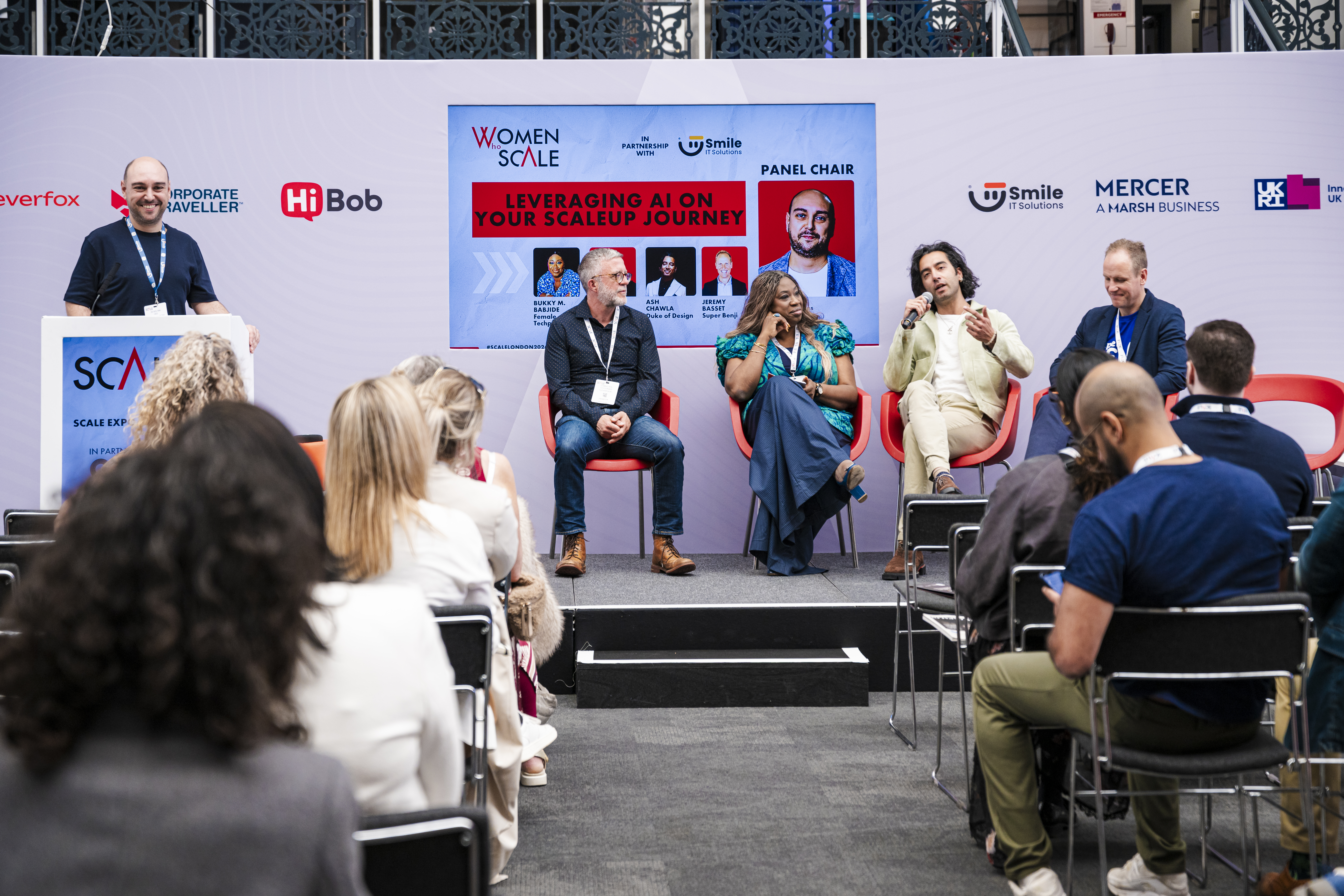
At SCALE London in April, Ed Soltani, the founder and CEO of Smile IT Solutions, chaired a panel discussing how founders are leveraging AI on their scaleup journey, and where they’re getting it wrong. Each panellist had different words of warning for founders and growth-stage SMEs considering AI adoption, but all pointed towards the diagnostic approach that Soltani has built his business on.
As SCALE prepares for its Manchester summit in November, we look back at the conversation around common mistakes founders are making, whether they’re rushing blindly towards AI adoption, or holding back while others race past.
Mistake 1: Kicking the AI can down the road #
A silent battle is currently underway between businesses that have been trading for 10 or 20 years, and the AI-native startups founded by youngsters.
“They are building startups with AI agents baked in. They don’t have big teams or overheads, and they’re coming for your market share, your customers and your revenue,” warned Dominic Kos, co-founder of Cleverfox AI, which supports SMEs on their transformation journey by providing a fractional AI team.
Kos estimates that within the next 12 to 18 months, legacy businesses operating with inefficient tech stacks simply won’t be able to compete if they aren’t incorporating AI now.
Kos described auditing a luxury cruise operator’s systems and finding that 14,000 invoices were being raised manually every year, wasting an estimated 3,500 hours and around £80,000 in staff time annually.
Soltani agrees: “When you hold up a mirror to the business owner and show them the cost of doing nothing, that is often the trigger.”
**Lesson for founders: **If you’re hesitating, quantifying the cost of not implementing AI is what turns a vague productivity promise into a numbers-led business case.
Mistake 2: Adoption without diagnosis #
The AI revolution has been so attention-grabbing that founders are adopting tools and just hoping the value shows up, but it’s vital to know what you’re optimising for. Assessment is needed to identify appropriate use cases and potential return on investment.
Bukky M. Babajide is the founder of Female Techpreneur, a community for women building tech businesses in the UK and in Africa. Her perspective, drawn from the non-technical founders she has supported, reinforced why diagnosis has to come first.
Babajide said many founders experience AI as pressure rather than opportunity because they’re time poor and look at the tool first rather than the problem.
“As a founder, you’re the admin, you’re the marketer, you’re the salesperson, you’re the decision maker. Feeling like you have to figure out how to use the latest AI tool on top of that is a lot.”
The fear of failure is another barrier, she says, but seeking outside perspectives, through mentorship or founder communities, can help. Most importantly, founders must ground every decision about AI in a genuine business need before touching a single platform.
“Understand the problem and think about what you are solving for,” Babajide said. Once you understand that, you can better prioritise investment, or – for early-stage companies – try no-code or low-code applications first.
**Lesson for founders: Stop chasing buzzwords. **Get clear about the problem before you get excited about the tool.
Mistake 3: Thinking customers won’t notice #
Ash Chawla founded Duke of Design in 2026 and provides interior design services for the luxury residential property market. As a designer, Chawla says his industry has been “bullied by technology”. When he started university, he was drawing by hand. “Then I was drawing in 2D, then I was drawing in 3D, then there was rendering. Every 5 to 7 years I had to reskill myself for new technologies.”
When AI arrived, he saw “no option” but to adopt it. Client design work which had previously taken weeks was suddenly reduced to minutes and the pricing strategy needed a re-think.
“To begin with, it was good because we could keep charging for weeks. Now clients are fully aware that this work takes minutes, we can’t charge for time in the same way,” Chawla said.
Duke of Design had to find a new way to differentiate its offer. “We are now using bespoke AI workflows and the output is very unique to our business.”
Duke of Design is currently working on getting AI to help create designs to a specific budget set by private clients. “You can say, ‘I want a room design that will cost under £5,000’. Mixing styles, mixing dimensions and having all these unique workflows in our AI is so cool.”
**Lesson for founders: **Look beyond saving time and money to how AI can improve the quality and uniqueness of what you create for customers.
Mistake 4: Adoption without inclusion #
Investing in AI tools can backfire if founders don’t bring their teams along. It’s not just a case of spending adequate time and resources on training – there’s an emotional journey that workers need to go on too.
“Many employees see AI as a threat to their livelihood. We, as business owners, need to help our teams understand that AI is here to take away the admin tasks that they hate and amplify their output,” explained Jeremy Basset, the founder and CEO of Super Benji, which helps sales teams run highly personalised outbound sales campaigns without spending hours on manual outreach.
Basset believes that AI can very quickly produce outputs that look acceptable, but that “good enough is not enough”.
“What we’ve realised is that you can get 80% good in about five minutes, and closing off that last 20% can take years,” said Basset.
He described how AI implementation appears to fail because the usage is low and therefore so is the ROI. “If the teams haven’t been trained properly, they feel disempowered and therefore they don’t use the systems right.”
When rollouts flop, the technology usually gets the blame, but the real cause is that unsupported usage hurts morale.
**Lesson for founders: **Run the pilot with your team, not around them. Make the people who will be using it part of building it.
Smile IT Solutions* is an AWS Advanced Tier Services Partner and runs its own AI and Cloud Centre of Excellence. Together with SCALE, Smile IT Solutions will host a hands-on masterclass for SME founders and leaders at the AWS offices in London on Friday 16 October from 09:30-16:30. Lunch and refreshments provided. Register now.*