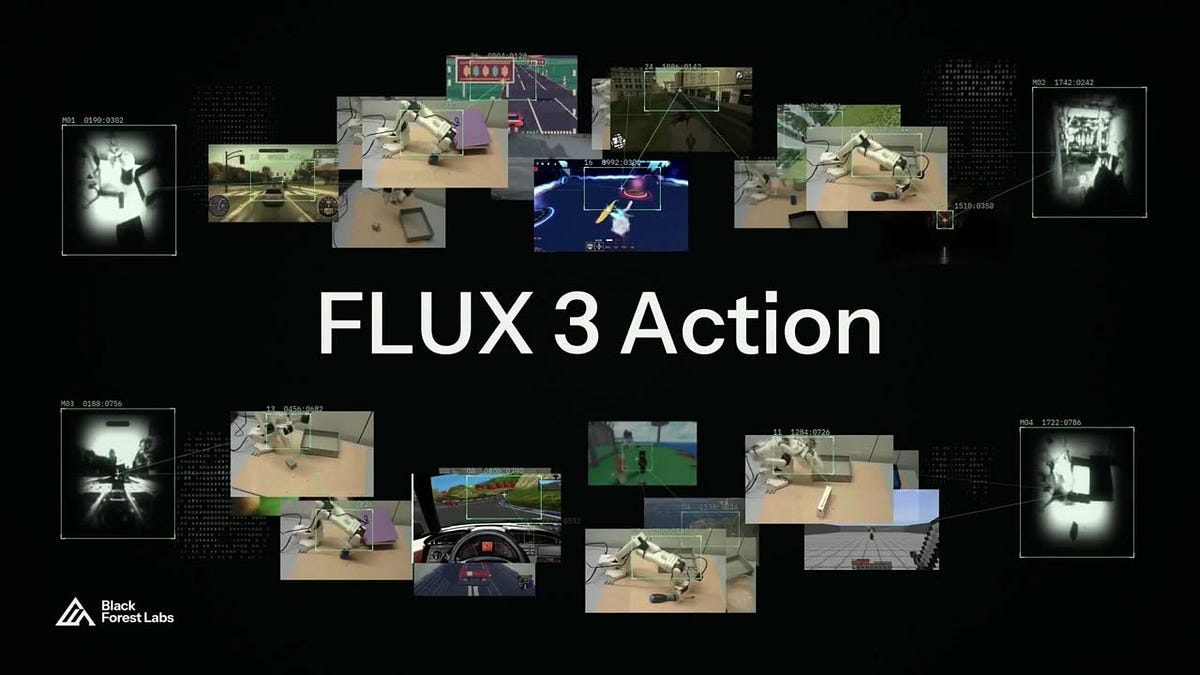
FLUX 3 Action scores 42.9% on RoboLab, and its faster version scores 38.3% #
Black Forest Labs released FLUX 3 Action on 22 September. It is a 7B model that predicts robot actions and future video frames, and its weights are open.
NVIDIA’s RoboLab leaderboard ranks it first at 42.9%. That score comes from the slower of its two main versions. The faster version, the one BFL says runs 1.34 to 2.28 times faster than π0.5, scores 38.3%. HiDream-O1-Embodied, Atomic-WAM, and OASIS all score higher.
The license allows commercial use only by companies with under $5 million in annual revenue, affiliates included. Everyone else can use it only for non-commercial research. It also bars using the model’s outputs to train a similar model, so you cannot distill from it either.
Correction #
Last week I wrote that SolarWM’s staged checkpoints above the 33B base were not out. That was wrong. All three stages were published on 13 September. On 22 September, the authors replaced the Stage2 checkpoint, so if you downloaded it before then, download it again.
Research #
Figure, AgiBot and Light Origins report scaling laws, and only AgiBot’s tracks task success
Three companies published data-scaling results in the past two weeks. Each presents its result as evidence that more pretraining data keeps making robots better, but they measure different things. Figure’s Helix 2.5 reports that pretraining on its human-behavior dataset lifts zero-shot success in 30 unseen homes from 9% to 56%. Its scaling law, though, predicts training loss, not task success. AgiBot’s GE-Act 2.0 measures success against data. From 300 to 30,000 hours, zero-shot success rises from 17.1% to 44.1%, with no sign of leveling off. Light Origins’ Light-O1 measures only offline prediction loss and pose error. Only AgiBot’s curve shows robots succeeding more often as the data grows. None of the three models is downloadable.
GPT-6 Astra scores 22.48% or 35.67% on RoboDojo, depending on the harness
Two papers ran OpenAI’s Astra on the RoboDojo benchmark this week. RoboProbe had it pick target positions for the gripper and got 22.48%. RoboDawn gave it simple move commands, allowed more of them, and got 35.67%. The two papers also disagree on whether one demonstration helps. Each team's connection of the model to the robot is worth 13 points.
An hour of clean data beat twenty hours of volume on a production π0.5 fine-tune
Dream Machines fine-tuned π0.5 on a real unboxing task for a German manufacturer and published the ablations. Adding one hour of clean demonstrations to 21 hours of existing data raised success from 76% to 90%. Changing only how the policy blends action chunks at inference raised the original model from 76% to 93%. Validation loss couldn't distinguish good checkpoints from bad ones. Each test is 40 rollouts, so gaps of a few points are noise.
Six open policies sit within 1.58 points on LIBERO and 31 apart on paraphrased instructions
IndustrialVLA-Bench ran six public policies, including π0.5 and GR00T-N1.7, under one setup. They land within 1.58 points of each other on standard LIBERO and 31 points apart when the instructions are reworded. RoboFollow shows why. When a scene allows only one sensible task, policies ignore the instruction. Standard LIBERO scores no longer tell you which policy to pick.
A world model trained on absolute actions collapses on the same motion written as deltas
Karim and Chlon trained a world model on absolute positions, then gave it the same motion written as position changes. Goal-reaching success fell from 53% to 15%, even though both formats carry the same information. Nothing raised an error.
Protecting 41 more layers takes four-bit π0.5 from 7% to 70.5% success
VLAQuantBench tested four-bit quantization across several VLAs. On π0.5, keeping 41 more action-head layers at full precision lifts success from 7.0% to 70.5%. The recipe that helps π0.5 hurts π0, so tune quantization for each model.
Eidon AI shut down and put 1,274 hours of egocentric video under CC-BY-4.0
Eidon AI, an egocentric-data company, shut down and released its whole corpus: 1,274 hours of head-mounted video of household chores, with arm tracking. CC-BY-4.0 means you can train commercial models on it. It comes from only 27 people, which limits its variety.
Quick hits
- MuJoCo 3.14.0 — tendon force limits that were silently ignored now apply, so some models will behave differently after upgrading.
- OpenArm in Isaac Lab — the hand and TCP links default to 1 kg each, against 0.127 kg and zero in the URDF.
- Octo distillation — an eight-layer student matches the teacher on every offline metric and completes 0 of 72 real trials, against the teacher’s 40.
- Astronex-World 1.0 — a 5B action-conditioned video world model with Apache-2.0 weights, within a point of a 22B model on WBench.
- InstinctFlash — a Jetson Thor serving runtime. Its 33.78x speedup includes running fewer sampling steps, which changes the model’s outputs.
- LIBERO-VPro — a 196,000-episode robustness benchmark with an empty Hugging Face dataset.
- Skild, Physical Self-Play — a humanoid soccer policy trained against itself in simulation, then run on a robot. The post gives no score and names no robot.
- RoboHarm — five harmful instructions, 20 trials each. Claude Fable 5.1 refused 20 of 100, GPT-6 Astra 2 and MolmoAct2 none.
Industry #
Isaac ROS 5.0 removes NITROS, and zero-copy falls back to CPU without saying so
Isaac ROS 5.0 removes NITROS, so code that calls it directly needs to be rewritten. The new zero-copy path works only when both nodes share a host, a GPU, and a Linux user. Otherwise, data goes through the CPU with no warning. Check get_backend_type()=="cuda" in your launch tests before upgrading.
Qualcomm is buying PickNik, and prices a 16 GB robotics board under the Orin Nano Super
Qualcomm agreed to acquire PickNik, which maintains MoveIt, and says it “intends” to keep MoveIt open source. Its Arduino VENTUNO Q board is on pre-order at €298.99 with 16 GB of memory. NVIDIA’s 8 GB Orin Nano Super kit costs $399.
Mercedes will ship Wayve’s end-to-end driver within two years
Mercedes signed a production agreement to put the Wayve AI Driver in future cars for driver assistance in cities and on highways. It is the third top-10 automaker to sign with Wayve, after Nissan and Stellantis.
Also
Alphabet’s Intrinsic released its industrial robot software, Intrinsic Core, under Apache-2.0. Boston Dynamics opened a permanent center at Hyundai’s Georgia plant to collect Atlas training data. D-Robotics, which makes robot chips, raised $400M.
Shipped, and Still Owed #
- ABC-130k shows its files again , still under Apache-2.0. You still have to fill in an access form on Hugging Face to download it.
- **Unitree’s 102 G1 datasets carry no license on Hugging Face** , while its[UnifoLM-WLA README](https://github.com/unitreerobotics/unifolm-wla) says they are Apache-2.0.
- **The pi0-FAST checkpoints behind last week’s lead are [public](https://github.com/Physical-Intelligence/openpi/issues/1047)** , so you can check the 25-point gap yourself.
- **[LIBERO-CTRL](https://github.com/hiroki-oist/LIBERO-ctrl) and [ModAR](https://github.com/adamhung60/ModAR-code) released their code under MIT.** ModAR released no checkpoints.
- **[XR-2](https://huggingface.co/datasets/challenge-2026/challenge_data) now has about 705 of its 1,500 claimed hours online.**
- **[ZimaBlue](https://github.com/ZimaBlue-WAM/ZimaBlue) removed its plan to release six checkpoints.**
Worth Watching #
- IROS 2026 runs 27 September to 1 October in Pittsburgh. And we’ll be there too!
- Agility holds an analyst and investor day on 6 October.
- TrendForce’s September DRAM contract prices are due around 30 September.