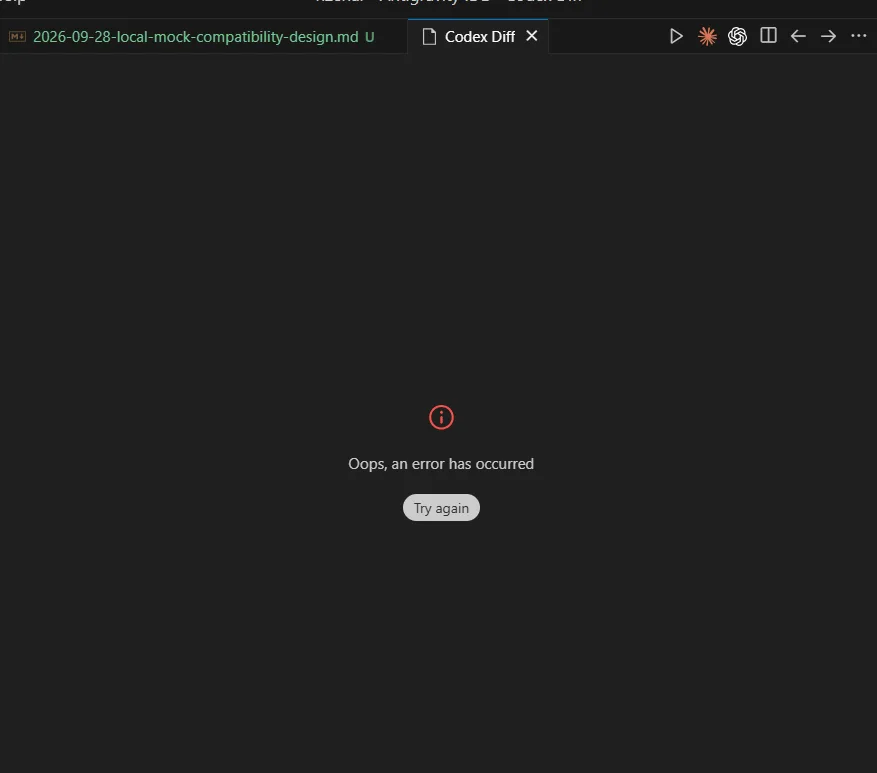
When an AI coding agent starts writing files inside Google Antigravity, watching the updates roll in should be straightforward. However, a persistent bug trips up the developer workflow specifically when using the Codex integration rather than alternative models. Opening the Codex Diff tab while an agent actively modifies source code results in an immediate crash, rendering the entire live edit view useless with a standard warning message.
Identifying the Codex Diff Failure in Google Antigravity #
The issue is isolated entirely to the webview handling Codex responses. In identical project environments and under the exact same system load, running Claude model diffs works without a hitch. The rendering engine handles Claude's streaming patches cleanly, but once Codex takes over generation tasks, opening the diff interface triggers a hard failure.
Developers hitting this roadblock are greeted by a generic application state warning dialog:
Oops, an error has occurred.
This error halts the real-time feedback loop. Instead of watching code lines update dynamically, developers have to wait until the entire agent session completes and then manually inspect git status changes or run file comparisons externally.
Workarounds and Alternative Workflows #
Since the webview component crashes whenever Codex tries to parse live diff patches, standard troubleshooting steps like clearing local cache or restarting the IDE instance do not resolve the underlying rendering conflict.
To maintain productivity while using Google Antigravity with Codex integrations, consider these operational workarounds:
- Disable Live Diffs: Keep the Codex agent running in headless or background mode without opening the dedicated Diff tab until execution completes entirely.
- Switch Provider Models: Temporarily route agent tasks through alternative integrations like Claude if real-time file patch visualization is mandatory for your current debugging session.
- Inspect via CLI: Fall back to an external terminal running standard git commands to review file modifications incrementally instead of relying on the IDE's built-in webview.
Comparing LLM Integration Stability in Modern IDEs #
Model integration stability varies drastically across development environments. When building applications using AI agent workflows, keeping track of how different backend engines communicate with the frontend editor helps prevent frustrating workflow interruptions.
- Codex in Google Antigravity: Frequently encounters webview rendering crashes during live file modification streaming, specifically throwing the generic error dialog on the diff tab.
- Claude in Google Antigravity: Maintains stable DOM updates and renders streaming patch sets smoothly without triggering interface exceptions.
- Local-first alternatives: Modern lightweight environments like microide built with C++20 and SDL3 focus entirely on avoiding telemetry and network bloat, relying on strict performance gates tagged around version v2.12.0 to handle integrated git diff and merge workflows locally without webview overhead.
- Cloud-hosted community tools: Platforms utilizing robust modular frameworks like Discourse provide self-hosted or managed architectures that isolate web-based rendering components from local IDE execution threads entirely.
Isolating the root cause requires checking whether the webview failure stems from JSON payload parsing mismatches between the Codex API response format and the Antigravity extension parser. Until an official patch addresses the webview exception handler, relying on command-line diff tooling remains the most reliable path forward.
Next Discourse sidebar’s “Show more” button never collapses →
All Replies (1) #
Want a live back-and-forth? Join the global AI chat room — login to talk.
The "Codex Diff tab crash" on live edits is a critical UX killer—no other model (like PaLM) triggers this, so it’s not a general instability.