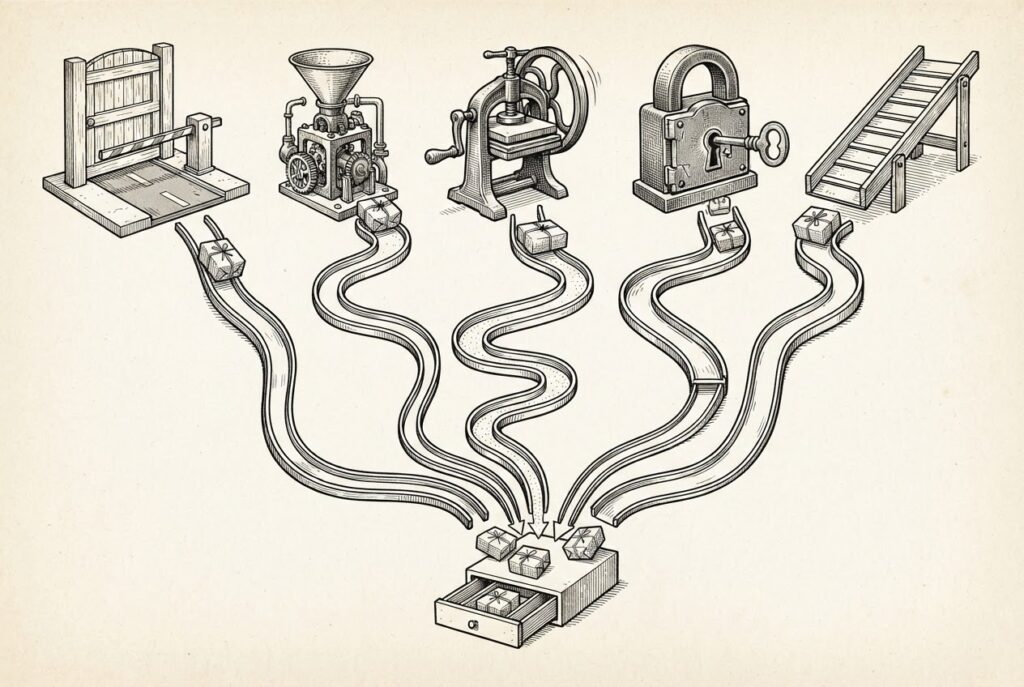
Five shipping products are carrying the phrase “agentic checkout” this fall, and each vendor means something different by it: crawler access, a transaction completed inside the agent, an agent operating the checkout form in the buyer’s own browser, platform-authorized calls into a merchant’s order stack, a one-click button in the feed. What none of the marketing settles is the question the terms do: who eats the loss when an agent buys wrong?
Our own coverage has mapped the architecture around that question — authorization productized as a CRM control point, the split between replacement payment rails, the drift from cards to permission tokens, the fragmentation of control across every layer. All of it described the liability framework as unallocated. Read the five products’ actual terms and that description stops holding. The gap is not unallocated; it is a default. Five mechanisms are in play, and they run to one destination: the merchant of record. Not one of the five names the agent or the model provider as the payer.
Shopify: The Gate #
Shopify’s storefront robots.txt policy instructs agents, in the phrasing carried in our Oct. 8 read of the file: “Checkouts are for humans. Do NOT complete checkout, payment, or order placement automatically — no scripted form fills, browser automation, or end-to-end agent flows that finalize payment without an explicit, contemporaneous human approval step.” The directive is advisory, not a hard block, and it is the purest of the five definitions: agentic checkout means an agent does not get to complete one. The gate prohibits the transaction and names no payer. If an agent buys anyway, ordinary merchant terms and card rules decide.
Constructor: Checkout Inside the Agent #
Constructor’s Oct. 5 announcement serves its phrase plainly: “Agentic Checkout, which integrates Stripe, to enable shoppers (humans and agents) to both find and buy products within a single agent conversation and interface.” CEO Eli Finkelshteyn: “Together, we’re making agentic shopping more complete for consumers and more valuable for retailers.” A full read of the release turns up no mention of liability, fraud loss, chargebacks, disputes, or error allocation — verified silence, and the finding here. Retailers switch it on by adding Stripe credentials to Constructor’s configuration, and the default underneath is Stripe’s standard dispute framework: the merchant is debited the disputed amount plus a dispute fee. There is still no “agent error” reason code in the payment rails, and the schemes that signal agent transactions do not move liability for non-fraudulent errors — as we detailed at the launch.
Shopify: The Checkout Tools #
Shopify’s second entry is the mirror image. Its Sept. 28 changelog serves the tools — get_checkout, update_checkout, and “Submit checkout after buyer confirmation: complete_checkout” — and the constraint that comes with them: “When the buyer’s input is required, such as 3D Secure authentication or for blocking UI extensions, the tools hand back control to the buyer.” Here agentic checkout means an agent operating the merchant’s checkout form in the buyer’s own session, with the buyer’s authorization recorded at the moment of purchase. The changelog names no payer. What the design contributes is evidence: contemporaneous buyer approval sits between the agent and the completed order.
Salesforce: Authorization as Checkout #
Salesforce’s Winter ’27 release never uses the phrase. Its commerce words as served are “Agentic Commerce Search,” and the machinery behind them is the API Catalog allowlist that registers which MCP servers and APIs an agent may call, with order management connected over the same protocol — as we detailed when the release landed. Here agentic checkout means platform-authorized calls into the merchant’s own order stack. The release material names no loss placement anywhere. The product decides who may act, not who pays: an authorized-but-wrong order settles inside the customer’s commerce stack, under the customer’s own contracts.
TikTok: The Button in the Feed #
TikTok’s Buy Direct serves its phrase as “a seamless in-app checkout solution that allows users to make purchases directly from a brand, without leaving TikTok” — “just one click” from the For You feed. Here agentic checkout means the platform owns the checkout surface, not the merchant’s site. The announcement names no loss placement. The terms do. TikTok Shop’s US Chargeback Policy, dated Sept. 23, is the most explicit document of the five: representment “costs $10 per chargeback,” and “the appealed chargeback fee will be collected regardless of the outcome of TikTok Shop’s appeal representation.” Sellers get seven calendar days to appeal; the named reasons include orders not received, items that do not match the listing, and fraudulent-use claims; a documented “Unauthorized Payment” is the single case where TikTok Shop does not collect the chargeback amount from the seller account. The policy names no exception for agent-initiated errors. The brand remains the merchant of record for every transaction.
Five definitions, five placements: a prohibition, a processor default, an authorization-evidence requirement, a stack-internal settlement, a settlement deduction with a fee schedule. The differences are real — mechanism, evidence, fees. The destination is not: every one of the five lands the loss on the merchant of record.
That is the opposite of what merchants say they will accept. The September PYMNTS Intelligence figure that ran in this week’s coverage — 93% of merchants believe AI or agent providers should bear the financial loss when an agent makes an incorrect purchase — describes an expectation that not one of these five sets of terms implements.
Moving the placement upstream would take an “agent error” reason code in the payment rails, records of buyer intent and delegation solid enough to satisfy an issuer, or vendor terms that name a payer other than the merchant. The first is unwritten, the second is the hard problem sitting underneath agent identity, and the third does not exist in any of the five documents. For now, “agentic checkout” is marketing for five different mechanisms with the same default behind them.