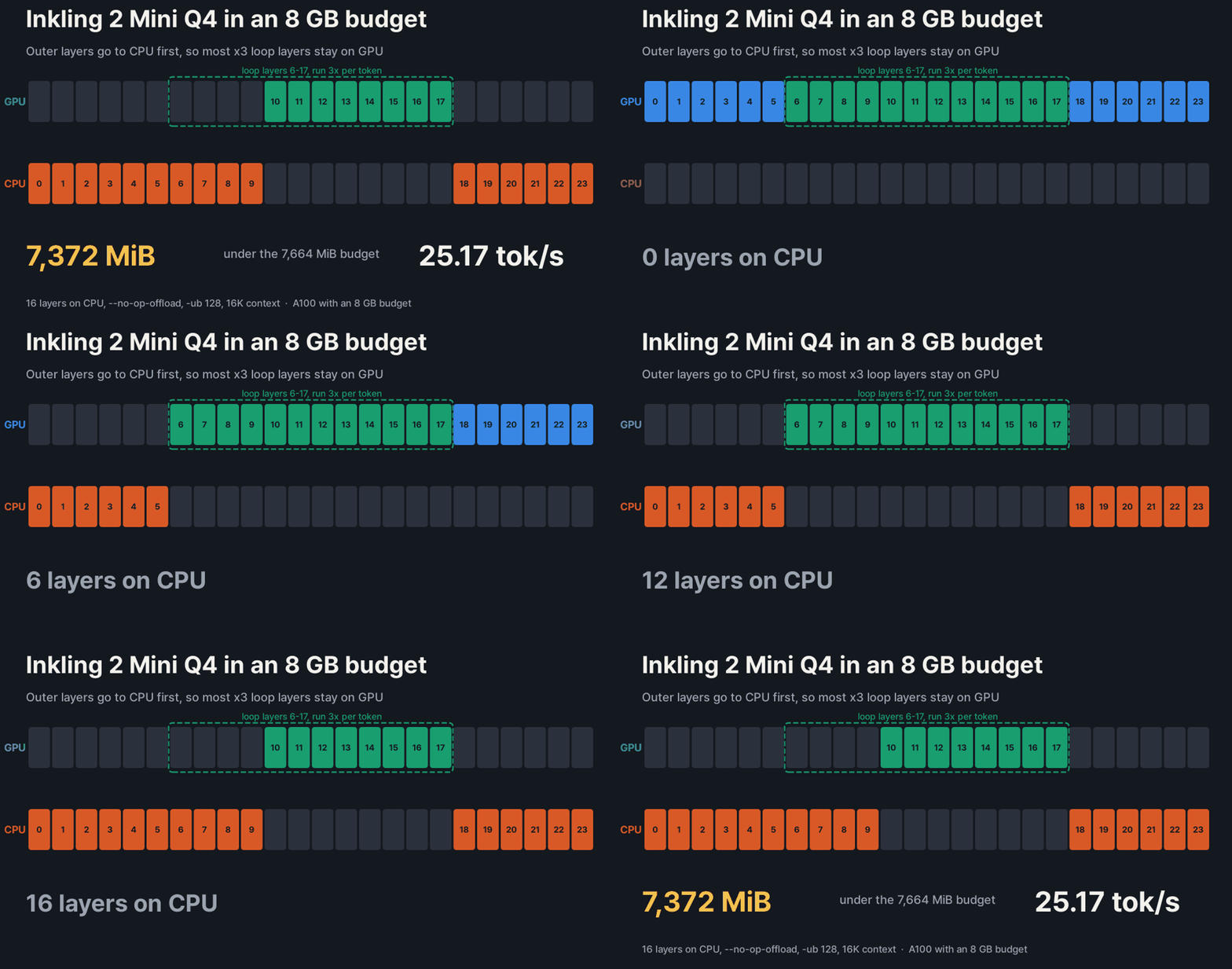
Inkling 2 Mini UD-Q4_K_XL fits a 7,664 MiB 8 GB budget at 16K via 16 outer-first CPU MoE layers, -ub 128, and --no-op-offload (7,372 MiB after prompt, 25.17 tok/s decode on A100 + EPYC 7742, 0.917 across 12 coding runs with a 60-minute T4 cap vs 30 minutes full-GPU).
Inkling 2 Mini UD-Q4_K_XL (Unsloth GGUF, from Thinking Machines Lab) fits an 8 GB VRAM budget (7,664 MiB) at 16K context via 16 outer-first CPU MoE layers, -ub 128, and --no-op-offload. Post-prompt VRAM is 7,372 MiB at 25.17 tok/s decode; four Python tasks finished 11/12 runs for 0.917 mean with a 60-minute cap on the longest task, T4 (vs 1.000 full-GPU with a 30-minute cap in our previous post).
These runs used an A100 80GB without a hardware memory limit, not a physical 8 GB card; fit means process VRAM after a 15,872-token prompt stayed ≤ 7,664 MiB (8 × 1,024 − 512 − 16 MiB). All tok/s speeds reflect our A100 80GB + 8-channel DDR4 EPYC 7742 server (64 threads, solo GPU, llama.cpp b12611, -c 16384, f16 KV; 256-token decode, temp 0, seed 1).
In our previous post, UD-Q2_K_XL exceeded 8 GB on GPU (8,469.3 MiB CUDA model buffer). Fitting 7,664 MiB depends on four pieces:
- Loop layers:
24MoE layers (0-23,128experts,8active); outer layers (0-5,18-23) run once per token, loop layers (6-17)3times (48visits). - Expert offload: attention, KV, and routing stay on GPU; chosen experts move to RAM (
--n-cpu-moeor-ot). - Op offload (
--no-op-offload):llama.cppdefaults to off host tensor operations to the device;--no-op-offloadturns that off. -ub(micro-batch size): a smaller value shrinks the CUDA compute buffer (4xsmaller from512to128with--no-op-offload), freeing VRAM for weights.
We tested UD-Q2_K_XL, UD-Q3_K_XL, and UD-Q4_K_XL at -c 16384 (f16 KV) across front-first (--n-cpu-moe N, 0..N-1) and outer-first (-ot on 0-5, 23..18, then smallest loop layers), op offload on and off.
Off loop layers fails to free VRAM under default op offload#
With op offload on, moving outer layers (0-5, 18-23) lowers VRAM, while moving loop layers ( 6-17) grows CUDA0 compute by roughly their GGUF expert size. On Q2 -ub 128 under --n-cpu-moe N, VRAM stayed flat at 8,828-8,832 MiB from N = 9 to 18 as the CUDA0 model buffer fell from 6,095 to 3,002 MiB.
Hence Q2 -ub 512, Q3 -ub 128, and Q4 -ub 128 missed 7,664 MiB even at 24 CPU layers (8,046, 9,374, and 9,708 MiB at 24 layers). Only Q2 -ub 128 fit under op offload: 10 outer layers (0-5, 20-23) at 7,552 MiB, or front-first N = 21 at 7,664 MiB.
Startup buffer logs confirm this at -c 16384 (f16 KV). With op offload on, runs that put all 12 loop layers (6-17) on CPU had the compute buffer below; with --no-op-offload, every run had the same compute buffer regardless of which layers moved. The gap is close to the loop expert sum:
Quant & -ub |
CUDA0 compute: op on / off (MiB) | Increase (MiB) | Loop 6-17 experts (MiB) |
|---|---|---|---|
Q2 -ub 128 |
4,526.0 / 443.8 | 4,082 | 4,031 |
Q2 -ub 512 |
5,838.1 / 1,775.7 | 4,062 | 4,031 |
Q3 -ub 128 |
7,032.0 / 443.8 | 6,588 | 6,447 |
Q4 -ub 128 |
7,148.4 / 443.8 | 6,705 | 6,564 |
Passing --no-op-offload fixes CUDA0 compute at 443.8 MiB (-ub 128) or 1,775.7 MiB (-ub 512), letting Q2, Q3, and Q4 clear 7,664 MiB.
With --no-op-offload, outer-first decodes 1.11x to 1.33x faster than front-first#
Outer layers run once per token while loop layers run three times, so GPU loop layers cut CPU reads. Front-first (--n-cpu-moe N) touches loop layers past N = 6; outer-first (-ot) fills all 12 outer slots first.
Minimum CPU layers staying ≤ 7,664 MiB after the 15,872-token prompt:
Quant & -ub |
Placement | Op | Layers | VRAM (MiB) | Prompt tok/s | Decode tok/s |
|---|---|---|---|---|---|---|
Q2 128 |
Outer | On | 10 | 7,552 | 465.8 | 26.99 |
Q2 128 |
Front | On | 21 | 7,664 | 354.1 | 15.29 |
Q2 128 |
Outer | Off | 10 | 7,496 | 331.6 | 26.86 |
Q2 128 |
Front | Off | 10 | 7,446 | 214.3 | 21.58 |
Q2 512 |
Outer | Off | 14 | 7,540 | 312.0 | 22.50 |
Q2 512 |
Front | Off | 14 | 7,496 | 201.5 | 18.42 |
Q3 128 |
Outer | Off | 16 | 7,154 | 196.8 | 23.68 |
Q3 128 |
Front | Off | 14 | 7,642 | 155.4 | 21.35 |
Q4 128 |
Outer | Off | 16 | 7,372 | 226.4 | 25.17 |
Q4 128 |
Front | Off | 20 | 7,122 | 150.3 | 18.89 |
With --no-op-offload enabled, outer-first decoded 1.11x to 1.33x faster than front-first (1.33x Q4 128, 1.24x Q2 128, 1.22x Q2 512, 1.11x Q3 128), and on Q2 128 op-on it beat front-first (26.99 vs 15.29 tok/s).
Each row sits one layer above overflow (Q4 outer at 15 layers hits 7,920 MiB). Q4 outer needs 16 layers vs 20 because layers 20-23 hold 1,033 MiB of experts each vs 547 MiB in 0-19, keeping 8 loop layers (10-17) on GPU vs 0 in front-first (0-19).
All 8 GB runs decode slower than full-GPU A100 (median decode during the coding runs of our previous post at -ub 512: 42.6 Q2, 41.3 tok/s Q4), and --no-op-offload cuts prompt speed: on Q2 128 outer 10, decode held ( 26.99 vs 26.86 tok/s) while prompt fell from 465.8 to 331.6 tok/s.
Using Σ(offloaded expert bytes × visits) × 8/128, Q4 outer-first reads about 942 MiB of CPU experts per generated token vs about 713 MiB for Q3 outer-first, yet Q4 decoded faster (25.17 vs 23.68 tok/s).
Coding tasks: 11 of 12 runs completed (0.917 mean) with a 60-minute cap on T4#
We ran the four Python tasks from our previous post (-c 16384, Q4 -ub 128, --no-op-offload, 16 outer-first CPU layers 0-5, 18-23, 6-9, 3 runs each): T1 adds todo due dates (6 hidden tests; visible pass initially), T2 fixes a misleading traceback (8), T3 adds two-file stock reservations ( 8; visible pass initially), and T4 writes a semver parser ( 10). Score is hidden tests passed over total, tracked with done. Peak VRAM stayed at 7,446 MiB (solo GPU).
Under the 30-minute ( 1,800-second) full-GPU cap, T1-T3 passed 9/9 runs while all three T4 runs timed out without done, scoring 0.4, 1.0, and 0.0 (0.867 mean over 12 runs at 30 minutes). During those three T4 runs, 8 GB ran at 21.8-23.0 decode and 157-197 tok/s prompt (vs 33.3-41.2 and 683-735 full-GPU Q4). Thus 30 minutes on T4 yielded 38,736, 34,299, and 29,275 tokens, below 43,078 and 53,016 on self-finished full-GPU runs (67,561 on the remaining run, r2, also 1,800 s). We re-ran T4 with a 60-minute ( 3,600-second) cap.
Combining 30-minute T1-T3 and 60-minute T4 runs yields 11 of 12 completed runs for a 0.917 mean (full-GPU Q4 at -ub 512 with a 30-minute cap: 1.000, 11/12 done, T4 r2 passing 10/10 at 1,800 s):
| Task | 8 GB Q4 scores | 8 GB Q4 time (s) | Full-GPU Q4 scores | Full-GPU Q4 time (s) |
|---|---|---|---|---|
| T1 | 1.0/1.0/1.0 | 296/243/362 | 1.0 ×3 | 169/193/173 |
| T2 | 1.0/1.0/1.0 | 104/91/140 | 1.0 ×3 | 64/71/68 |
| T3 | 1.0/1.0/1.0 | 414/741/446 | 1.0 ×3 | 282/616/242 |
| T4 (60-min 8 GB) | 1.0/1.0/0.0 | 1,919/3,008/3,600 (timeout) | 1.0 ×3 | 1,357/1,800/1,343 |
| 12-run mean | 0.917 (11/12 done) | 1.000 (11/12 done) |
Three 60-minute T4 runs:
| T4 run | Score | Time (s) | Done | Decode tokens | Steps | Cutoffs | Decode tok/s | Prompt tok/s |
|---|---|---|---|---|---|---|---|---|
r1 |
1.0 (10/10) | 1,919 | Yes | 41,946 | 11 | 2 | 23.8 | 206.5 |
r2 |
1.0 (10/10) | 3,008 | Yes | 52,530 | 17 | 2 | 21.5 | 142.9 |
r3 |
0.0 (0/10) | 3,600 | No | 43,816 | 9 | 3 | 14.8 | 141.7 |
Steps count agent reply requests to the model, and cutoffs count replies that ran until the 16,384-token context was full (full-GPU T4: 22/25/13 steps, 2/2/2 cutoffs; 30-minute 8 GB T4: 15/18/7, 2/5/2). Runs r1 and r2 decoded about as many tokens (41,946 and 52,530) as the self-finished full-GPU runs ( 43,078 and 53,016); r3 read only README, semver.py, and test_semver.py without editing any file.
Recommended 8 GB setup and launch command#
For an 8 GB budget at 16K context (judged as ≤ 7,664 MiB on an A100 80GB), we recommend Inkling-2-Mini-UD-Q4_K_XL.gguf with -c 16384, -ub 128, --no-op-offload, and 16 outer-first CPU layers (0-5, 18-23, 6-9), reaching 7,372 MiB post-prompt (7,446 MiB coding peak), 25.17 tok/s decode, and 0.917 across 12 coding runs (60-minute T4 cap) on our 8-channel DDR4 EPYC 7742 ( 64 threads) server.
Use llama.cpp b12611 or newer with the top-level file downloaded after 14:54 UTC on Nov 23 (see our previous post on blk.24), and read /v1/chat/completions thinking text from reasoning_content:
hf download unsloth/Inkling-2-Mini-GGUF Inkling-2-Mini-UD-Q4_K_XL.gguf --local-dir models

llama-server \
  -m models/Inkling-2-Mini-UD-Q4_K_XL.gguf \
  -c 16384 -ub 128 -ngl 99 -fa on --parallel 1 --jinja --no-webui \
  --no-op-offload \
  -ot 'blk\.(0|1|2|3|4|5|23|22|21|20|19|18|6|7|8|9)\.ffn_(gate_up|down)_exps\.=CPU' \
  --port 8080
Check free VRAM with nvidia-smi --query-gpu=memory.free --format=csv before long runs. If prompt speed matters more than Q4 precision, run our measured alternative: UD-Q2_K_XL, -ub 128, op offload on (omit --no-op-offload), and 10 outer layers (0-5, 20-23, no loop layers) offloaded ( 7,552 MiB post-prompt, 465.8 tok/s prompt, 26.99 tok/s decode).
The newsletter below sends the next episode of this series when it is out.